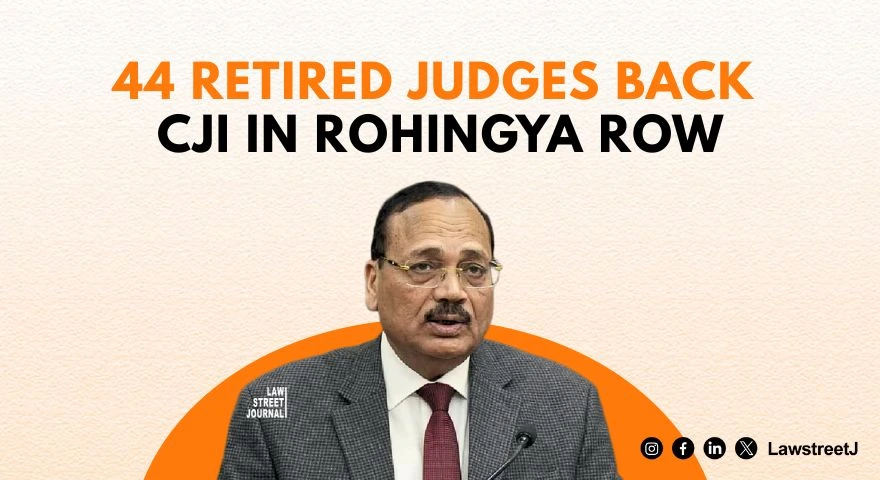
New Delhi: A group of 44 retired judges of the Supreme Court and various High Courts across the country have issued a strong open statement rejecting what they described as a “motivated campaign” against the Chief Justice of India, following his recent observations during court proceedings related to Rohingya migrants. The statement, dated December 9, 2025, objects to an open letter circulated earlier this month that accused the Chief Justice of bias, and asserts that judicial proceedings are being deliberately mischaracterised to damage the credibility of the judiciary.
The retired judges stated that the Chief Justice had merely raised a basic legal question during the hearing—who, in law, had granted the status being claimed before the Court? They stressed that no adjudication on rights or entitlements is possible unless this threshold issue is addressed first. The judges further stated that critics have selectively ignored the Bench’s clear affirmation that no person on Indian soil—whether citizen or foreigner—can be subjected to torture, disappearance or inhuman treatment, and that every individual’s dignity must be respected. Suppressing this aspect of the proceedings, they said, and portraying the Court’s conduct as “dehumanising,” amounts to a serious distortion of the record.
The statement also reiterated that Rohingyas have not entered India as refugees under any statutory refugee protection framework, and that India is neither a signatory to the 1951 UN Refugee Convention nor its 1967 Protocol. The judges said that India’s obligations towards those who enter its territory arise from its Constitution, domestic laws governing foreigners and immigration, and general human rights principles—not from an international treaty regime the country has consciously chosen not to join.
Raising serious concerns about national security and administrative integrity, the retired judges highlighted how persons who entered India illegally may have obtained Aadhaar cards, ration cards and other official Indian documentation. They warned that these identification and welfare instruments are meant for citizens and lawfully resident individuals, and their misuse undermines the credibility of public systems while raising alarming questions about collusion, document fraud and organised networks.
In this backdrop, the judges supported the consideration of a Court-monitored Special Investigation Team to probe the illegal procurement of Indian identity and welfare documents by foreign nationals. Such an SIT, they said, should identify the officials and intermediaries involved and uncover any trafficking or security-linked networks exploiting humanitarian concerns.
The statement also pointed to the complex situation of the Rohingya community in Myanmar, where they have long been treated as illegal migrants with contested or denied citizenship status, often traced to Bangladesh. This background, the judges observed, reinforces the need for Indian courts to proceed strictly on the basis of clear legal categories rather than political labels or emotional narratives.
Defending the judiciary’s role, the retired judges said the Supreme Court’s intervention has remained firmly within constitutional bounds, seeking to strike a balance between protecting national integrity and upholding basic human dignity. They warned that if every judicial examination of nationality, migration, documentation or border security is met with accusations of hate or prejudice, judicial independence itself would be placed at serious risk.
In conclusion, the judges affirmed their full confidence in the Supreme Court of India and the Chief Justice in the discharge of constitutional duties without fear or favour, condemned attempts to personalise disagreement into attacks on individual judges, and reiterated their support for a lawful and court-supervised investigation into the illegal procurement of Indian identity documents by foreign nationals who entered the country in violation of law.
The statement was signed by several eminent former judges—including former Supreme Court judges and former Chief Justices and judges of multiple High Courts—and was formally issued under the name of Justice Permod Kohli, former Chief Justice of the Sikkim High Court and former Chairman of the Central Administrative Tribunal.