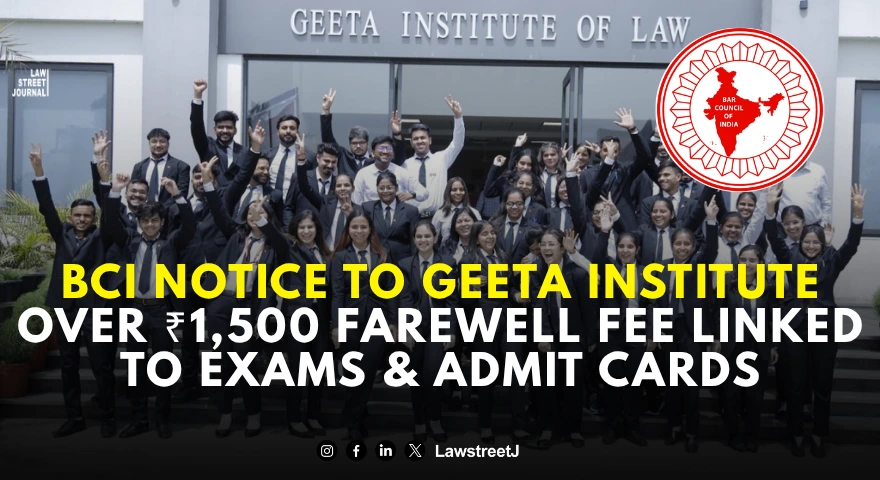
The Bar Council of India issued two successive show cause notices in a single day on 29th April 2026 to the Principal of Geeta Institute of Law, Panipat, Haryana, directing the institution to immediately ensure that no eligible law student is denied or delayed admit card, NOC clearance, or practical examination permission on account of non-payment of farewell charges, and calling for a detailed compliance report with supporting documents within 48 hours. Both communications were issued under the directions of the Co-Chairman of the Standing Committee on Legal Education and were signed by Srimanto Sen, Principal Secretary, Bar Council of India.
The matter arose from complaints alleging that the institution had uploaded a sum of Rs. 1,500 under the head "Other Fees, Farewell Charges" in the student ERP portal for final semester students of the law degree course, and that non-payment of this amount was being linked with the issuance of admit cards, NOC clearance, and permission to appear in practical examinations. The urgency was acute: the practical examinations were scheduled for 30.04.2026 and the final semester examinations were to commence from 07.05.2026.
An earlier notice bearing reference BCI:D:288/2026 had been issued earlier the same day asking the institution to furnish an immediate explanation. In response, the institution stated by email that no farewell fee had been prescribed or collected, that no farewell party was organised by the college, that no fine had been collected, that no admit card had yet been issued to any student, and that the complaint had been sent by an unknown person with mala fide intention.
The Bar Council of India was not satisfied with this reply. After receiving the institution's response, the Council received further complaints and documentary material from students, including screenshots of the student ERP portal reflecting an entry of Rs. 1,500 under the head "Other Fees — Farewell Charges" for the 10th Semester, WhatsApp communications relating to payment of farewell amounts, and a notice concerning completion of NOC requirements for issuance of admit cards. Students further alleged that this ERP entry had been uploaded against the accounts of students who had not attended or paid for any farewell function. Crucially, the Bar Council also received a screenshot of a WhatsApp group communication stated to relate to an earlier batch of the same institution, recording that students not paying the farewell amount would not be allowed to give practicals and that admit cards would not be issued. Though relating to an earlier batch, the Council noted this communication as relevant for examining whether such a practice or pattern had existed in the institution and whether similar coercive conditions were being applied in the current academic year.
The second notice, bearing reference BCI:D 294:2026 (LE), took serious note of the contradiction between the institution's categorical denial and the material now placed before the Council. It called upon the institution to specifically state whether the screenshots, WhatsApp messages, and ERP records brought to its notice were genuine or false, and if disputed, to produce comprehensive supporting records including ERP ledgers, fee head creation records, circulars, WhatsApp group communications, internal instructions, and details of persons authorised to upload or circulate such information.
The Bar Council also addressed the institution's attempt to deflect the complaint by questioning the identity of the named sender. The Council clarified that the grievance before it was not confined to the identity of one complainant. The substance of the complaint related to whether students of the law degree course had been subjected to a compulsory farewell charge, or whether such charge had been linked, directly or indirectly, with no dues, practical examinations, admit card issuance, or examination clearance. The institution was required to answer the substance of the allegations. The Council further clarified that it was not required to disclose the identity of students who had approached it, particularly where those students had expressed apprehension of academic repercussions, and the institution was directed not to insist upon complainant identity as a condition for responding.
The communication laid down the applicable legal position clearly: no student who is otherwise eligible under academic, attendance, examination and university norms can be deprived of practical examination, admit card, provisional admit card, NOC clearance, or permission to appear in final semester examination merely on account of non-payment of any farewell charge, contribution, optional event fee, or other non-academic demand. A farewell function, whether organised by the institution, by students, or informally, cannot be made a condition precedent for any academic clearance or examination appearance.
Within 48 hours, the institution was directed to place on record nine categories of information: the complete ERP fee statement for all 9th and 10th semester students showing all fee heads; the date, authority and purpose of creation of the Rs. 1,500 entry; a statement on whether any student had paid this amount; copies of all circulars, WhatsApp messages, notices and internal instructions relating to farewell charges and admit card issuance; a clarification on whether any staff member ever communicated that non-payment of farewell charges would affect examination eligibility; the present status of admit card and NOC clearance for final semester students; a clarification on whether any student's ERP account reflected this liability; copies of any rules or approvals under which the farewell amount was uploaded; and a written undertaking that no student shall be victimised for approaching the Bar Council or raising a grievance, with no adverse action in internal marks, viva voce, project evaluation, no dues, or admit card issuance on account of any such complaint.
The institution was warned that any act of victimisation, intimidation, indirect pressure, arbitrary deduction of marks, withholding of clearance, or denial of practical examination for any student who had approached the Bar Council would be viewed seriously, and that if farewell charges were found to have been imposed as a compulsory condition for academic clearance, the Bar Council would be constrained to initiate appropriate action under the Rules of Legal Education.



![Supreme Court upholds order to bar Advocate from practice for running taxi service [Read Order]](/secure/uploads/2023/09/lj_8175_practicing_law_as_an_advocate_texi.jpg)