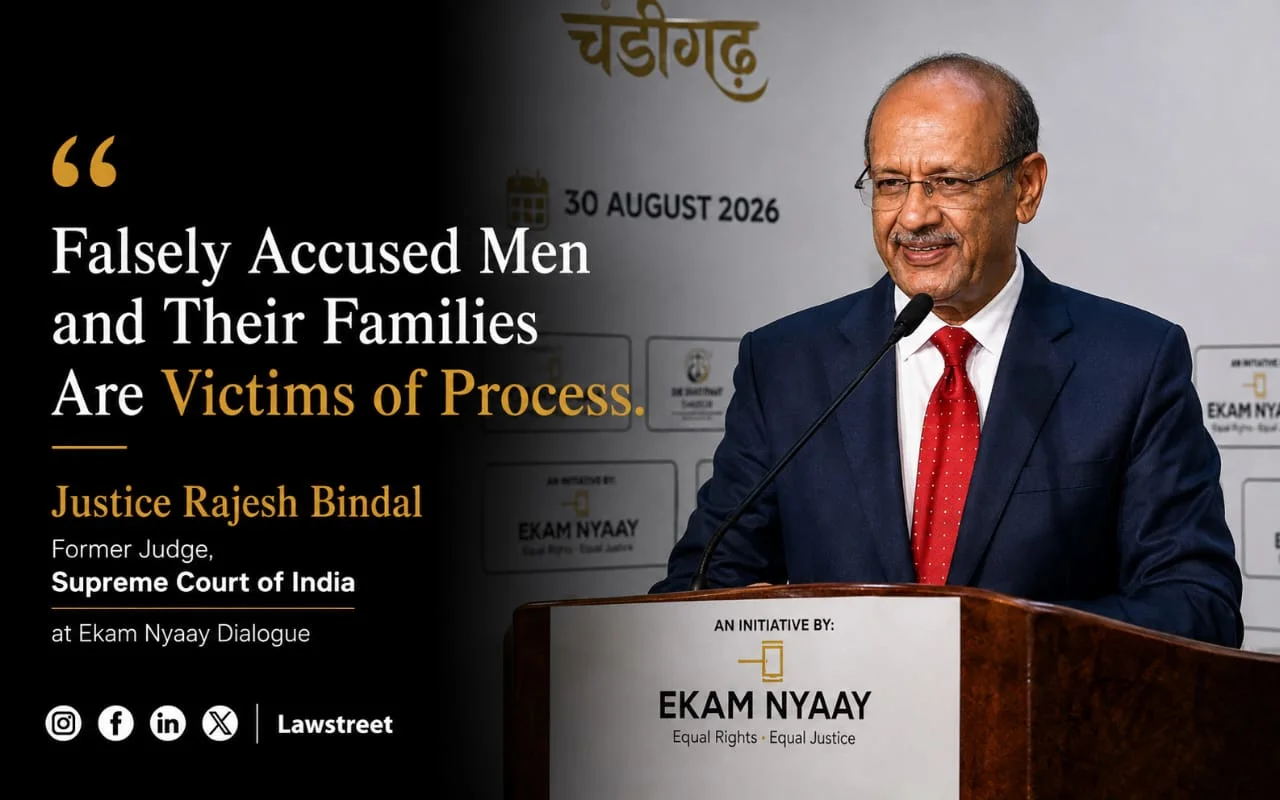

Chandigarh - Former Supreme Court Judge Justice Rajesh Bindal said that people who are falsely accused can themselves become “victims of the process”, stressing that the justice system must protect genuine victims while also ensuring that innocent people and their families do not suffer through prolonged legal proceedings.
Justice Bindal was speaking at the Ekam Nyaay Dialogue organised by the Ekam Nyaay Foundation at Law Bhawan, Chandigarh, on August 30, 2026. The Foundation, founded by Deepika Narayan Bhardwaj, works on gender equality and issues faced by men in society.
In his address, Justice Bindal spoke about equality before law, alleged misuse of legal provisions, matrimonial disputes, false accusations, mediation, custody disputes and the impact of prolonged criminal proceedings on accused persons and their families.
‘All Are Equal Before the Law’
Justice Bindal began by speaking about the constitutional principle of equality. Referring to Article 14, he said that there must be equality before the law and equal protection of the laws. He also referred to Article 21 and the requirement that due process of law be followed.
He said that when a case reaches the court, the decision has to be based on the evidence and material placed before the court. Justice Bindal also spoke about the perception that courts are biased depending on whether a decision goes in favour of a man or a woman.
He said courts cannot decide cases by blindly believing anyone. What is said on social media, in newspapers or outside the courtroom, he said, is not the basis on which a court decides a case.
“The fact is that we cannot believe any person blindly,” he said, stressing that courts have to examine what is on record before them. Justice Bindal said laws are enacted by Parliament or the legislature with the objective of addressing particular problems and providing solutions.
At the same time, he said that provisions intended to protect people can sometimes be misused. He referred to safeguards available in cases involving false accusations and illegal arrest, while observing that such provisions are not frequently used. He also referred to compensation provisions in cases involving false accusations under the POCSO law and questioned how often compensation is actually awarded in such cases.
Speaking about acquittals, Justice Bindal distinguished between cases where an accused is acquitted because of the benefit of doubt and what he described as an “honourable acquittal”, where there was nothing against the accused.
He said there was a need for greater data on what happens to people who spend years facing proceedings before being acquitted.
Concern Over Family Members Being Implicated
Justice Bindal recalled his experience with cases involving provisions such as the earlier Section 498A of the Indian Penal Code. He said the Supreme Court had emphasised the need for balance and that allegations should be specific.
According to Justice Bindal, courts began seeing cases in which entire families were named in matrimonial disputes. He said that even people who had not attended the marriage could sometimes be named on allegations that they had instigated the husband. He questioned how such allegations were being drafted and said courts were trying to balance the interests of the parties.
Justice Bindal also referred to the Supreme Court's 2026 decision in the Ishwar Chand Sharma case. He said courts should be careful before taking cognizance of complaints invoking rape provisions when parties are heavily embroiled in matrimonial litigation. During the address, Justice Bindal recalled several cases from his judicial career to explain why courts need to examine the facts of individual matters carefully.
He recalled a case from 2008, when he was in Chandigarh, involving an NRI family. According to his recollection, an NRI wife registered an FIR alleging rape under Section 376 against her father-in-law after coming to India and staying for a few days. The matter came before the court for quashing.
Justice Bindal said the allegations in the case were extensive and recalled the matter as an example of the kinds of cases that can come before courts. He also recalled another case involving an NRI family from Punjab. According to him, the couple had already divorced, probably in a foreign country, and allegations were made concerning gold, foreign exchange and cash.
The matter came before the court in an anticipatory-bail proceeding. Justice Bindal recalled questioning the complainant's counsel about how such a large amount of gold and cash could have been brought into India without disclosure at customs. He said the complainant's side subsequently backed out. Justice Bindal also recalled a case in which the sister of a woman had lodged an FIR alleging rape against her brother-in-law.
According to his recollection, when he asked why the rape complaint had been lodged, the woman said that the man had been harassing her sister and that she had therefore filed the rape complaint. Another case he recalled was from Allahabad, involving a person who had secured employment.
Justice Bindal said that, according to his recollection, a jealous person had got an FIR registered through his daughter against the individual so that he would not get the job.
He said that when the matter came before the court, the girl stated that her father had asked her to make the complaint. Justice Bindal said that, fortunately, the proceedings did not take long enough for the person to lose his employment. He cited these experiences while explaining why courts have to examine the facts carefully and balance the interests of the parties.
Justice Bindal also spoke about cases involving allegations of rape based on an alleged false promise of marriage. He referred to cases where couples had lived together for several years before an allegation was made that the promise of marriage had been false. He said courts have been examining such complaints and that a number of complaints and FIRs had been quashed.
At the same time, Justice Bindal pointed out that an acquittal does not necessarily mean that every case was false. He said there can also be cases where the evidence was not properly led and the prosecution therefore failed. He also referred to cases where rape allegations had arisen in connection with other disputes, including landlord-tenant and monetary disputes.
Need for Data on Compensation
Justice Bindal also raised concerns about victim compensation. He said that in some cases an FIR is registered and compensation may be provided, but the criminal proceedings may ultimately not result in a conviction. He said there was no adequate data showing what happens in such cases.
According to Justice Bindal, there can also be situations where a complainant receives compensation and later does not support the case or settles the matter with the accused. He said that where compensation has been paid in such circumstances, the question of recovery should also be considered. Justice Bindal stressed the need for proper data so that the issue can be examined further.
Justice Bindal said that genuine cases can involve both women and men.
He pointed out that a husband can also be a victim of domestic violence, while observing that there is no corresponding law under which a husband can identify himself as a victim of domestic violence.
He said genuine cases should be recognised regardless of whether the victim is a man or a woman. One of the central points of Justice Bindal's address was the suffering caused by prolonged legal proceedings. He referred to people who spend years in jail or undergo lengthy trials before ultimately being acquitted.
Such people, he said, can themselves become sufferers, “victims of the process.” Justice Bindal extended this observation to matrimonial disputes, saying that female members of a husband's family who are falsely accused can also suffer. He said such women may face imprisonment or harassment for years or even decades, but their suffering is not necessarily recognised in the same way. His point was that while the legal system must recognise victims of crime, it must also remain conscious of people who suffer because of a prolonged legal process.
‘Mediation Is One of the Solutions’
Justice Bindal strongly emphasised the importance of mediation in matrimonial disputes. He recalled his experience in Allahabad, where a pre-litigation mediation programme had been started. According to his recollection, about one-third of the people who approached the panel and appeared before it settled their cases.
He said people need solutions and should be made aware that mediation is one of the options available to them. “Litigation is not the only solution,” he said. Justice Bindal said mediation can be useful in matrimonial disputes. He also spoke about the hesitation sometimes shown by litigants when a court sends a matter for mediation.
According to him, some people believe that the matter is simply being sent to another court, whereas mediation is an attempt to resolve the dispute. Justice Bindal said that when matrimonial disputes arise, people often approach lawyers for advice. He observed that the mindset of parties at that stage can sometimes become focused on settling scores.
He recalled a Chandigarh case involving a husband from a rural village who refused to take his wife back after, according to his recollection, members of his family had been put behind bars.
The husband, he said, took the position that he would not reconcile because his family had been sent to jail. Justice Bindal also spoke about the role of the police. He said that, apart from heinous crimes, arrests can sometimes begin immediately after an FIR is registered in such matters. He stressed that the focus should be on resolving the underlying dispute rather than aggravating it.
Justice Bindal also highlighted child custody as an important issue. He said custody disputes had become an international issue and expressed concern that children can sometimes become the centre of prolonged disputes between parents. He said parents can end up fighting over the child without adequately considering the child's welfare and future. According to Justice Bindal, the welfare of the child should remain an important consideration in such disputes.
Need for a Change in Mindset

Towards the end of his address, Justice Bindal called for a change in the way matrimonial and related disputes are approached. He said parties should not think that putting someone in jail at the first instance is the only solution. Instead, he stressed the need to focus on resolving the problem.
Justice Bindal said lawyers have an important role to play in this process, while the police also have an equally important responsibility. When a matter reaches the court, he said, judges have to balance various factors and examine the material available on record. He acknowledged that courts may be accused of bias depending on the outcome of a case, but said the court's responsibility is to consider the material before it and the welfare of the parties.
Justice Bindal concluded by praising the Ekam Nyaay Foundation for organising the dialogue and said discussions on these subjects should continue. He expressed hope that such discussions would eventually lead to a legal framework in which the rights of all parties are balanced.
The address centred on the need to protect those who genuinely need protection while ensuring that innocent people and their families do not end up suffering because of the legal process itself.

![Supreme Court Upholds Stringent Standards for Police Employment, Rejects Man's Plea After POCSO Act Acquittal in Madhya Pradesh [Read Judgment]](/secure/uploads/2023/09/lj_4880_7f215c01-85ff-4067-aba6-2efff4635636.jpg)
![‘Endless Compassion Not Permissible’: SC Bars Claims for Higher Post After Compassionate Appointment [Read Judgment]](/secure/uploads/2025/12/lj_7921_Endless_Compassion_Not.webp)