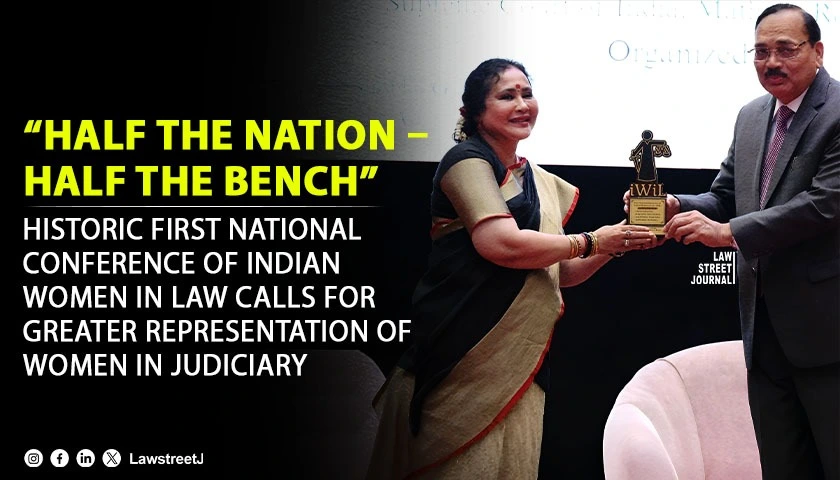
New Delhi: In what marked a historic, unprecedented and path-breaking moment in the constitutional journey of India’s legal fraternity, the First National Conference of Indian Women in Law (iWiL) titled “Half the Nation – Half the Bench” was held at the Supreme Court of India on the occasion of International Women’s Day.
The landmark conference — widely regarded as the first national deliberative platform dedicated to women’s representation in the higher judiciary in the 76 years of independent India — was spearheaded and led by Senior Advocate Mahalakshmi Pavani along with Senior Advocate Shobha Gupta. The conference was held under the erudite mentorship and guidance of former Chief Justice of India Justice N.V. Ramana, whose vision and idea for initiating such a national dialogue laid the foundation for the initiative, with Senior Advocate Pavani nurturing and translating that vision into a historic institutional gathering.
The conference commenced with a powerful opening address by Senior Advocate Mahalakshmi Pavani, who emphasised the urgent need for sustained institutional conversations around the representation of women in the higher judiciary. This was followed by the inaugural address delivered by Senior Advocate Shobha Gupta.
Delivering the keynote address, Chief Justice of India Justice Surya Kant observed that while the judiciary has increasingly acknowledged the importance of gender diversity, the time has now arrived to move beyond symbolic representation and aspirational declarations.
“Institutional intent is no longer enough,” the Chief Justice remarked, emphasising that the architecture of judicial appointments must evolve to create genuine opportunities for deserving women advocates.
Justice Surya Kant urged members of the Bar — particularly senior practitioners — to recognise that the demand for greater representation is not a plea for concessions but a legitimate call for equality rooted in constitutional principles.
Significantly, the Chief Justice called upon High Court collegiums across the country to consider meritorious women advocates for elevation to the Bench as a norm rather than an exception. He also urged collegiums to expand the zone of consideration to include women advocates practising in the Supreme Court who belong to the respective states.
“They are seeking fair and appropriate representation which has long been due. Only when the profession itself internalises this truth will the pathway to the Bench become clearer,” the Chief Justice remarked, emphasising that institutional intent must be accompanied by concrete structural action.
The conference witnessed the presence of some of the most eminent constitutional figures of the Indian judiciary, including former Chief Justice of India Justice N.V. Ramana, Attorney General for India R. Venkataramani, and several sitting judges of the Supreme Court and High Courts, making it one of the most remarkable and intellectually significant gatherings in recent legal history.
The deliberations were structured into four substantive sessions, each examining the persistent gender gap in judicial appointments and exploring pathways to strengthen women’s representation in the higher judiciary.
The first session featured former Chief Justice of India Justice N.V. Ramana, Justice B.V. Nagarathna, Attorney General R. Venkataramani, and Senior Advocate Vikas Singh, who reflected on the historically low representation of women in constitutional positions. The panel highlighted that despite seventy-five years of independence, women’s representation in the higher judiciary has remained limited and sporadic, underscoring the need to move from aspiration to affirmative institutional action.
The second session, led by Justice P.S. Narasimha and Justice Vijay Bishnoi, examined the structural opacity of judicial appointment processes and how the absence of clearly articulated diversity benchmarks often reproduces existing institutional demographics.
The third session, presided over by Justice Ujjal Bhuyan, Justice N. Kotiswar Singh and former Supreme Court judge Justice Hima Kohli, emphasised the need for stronger mentorship structures and institutional support for women advocates navigating the demanding nature of litigation practice.
The session highlighted that discussions on gender representation must move beyond academic discourse and translate into concrete policy-driven reforms capable of transforming the institutional culture of the legal profession.
The fourth and final session, led by Justice Dipankar Datta and Justice Prasanna Bhalachandra Varale, examined the constitutional principle of substantive equality, stressing that merit must be evaluated within its broader social context rather than through rigid and abstract standards.
Delivering the valedictory address, Justice Vikram Nath reflected on the challenges faced by women lawyers — particularly first-generation litigators — and underscored that a judiciary reflecting the diversity of society strengthens the administration of justice.
“A diverse Bench brings varied perspectives and lived experiences, enriching judicial deliberations and enabling courts to better understand the complexities of the issues that come before them,” Justice Nath observed.
The conference concluded with a powerful consensus that enhancing women’s representation in the higher judiciary is not merely a matter of diversity but a constitutional imperative essential for strengthening the legitimacy, inclusivity and democratic character of India’s judicial institutions.
The historic conference — envisioned by former CJI Justice N.V. Ramana and spearheaded by Senior Advocate Mahalakshmi Pavani along with Senior Advocate Shobha Gupta — has firmly placed the call for “Half the Nation, Half the Bench” at the centre of India’s constitutional discourse.