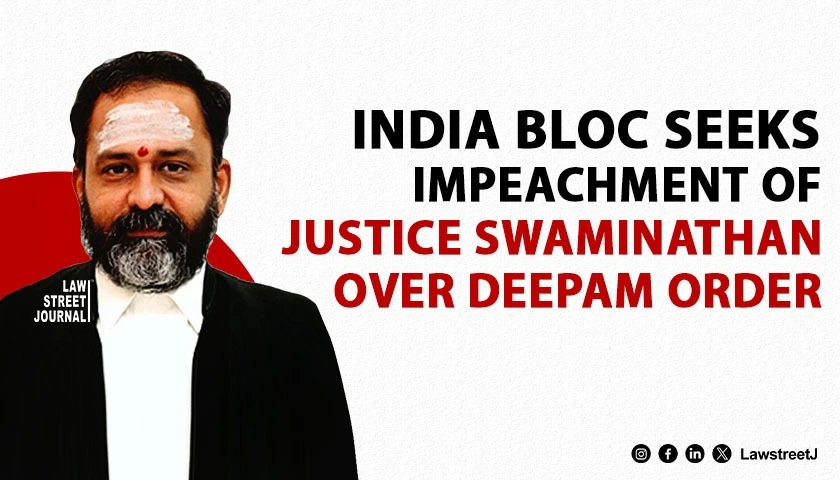
New Delhi: A major political storm erupted on December 9, 2025, after the opposition INDIA bloc submitted a formal notice seeking the removal of sitting Madras High Court Judge Justice G. R. Swaminathan. The notice was handed over to Lok Sabha Speaker Om Birla following growing controversy over a recent order passed by the judge concerning the lighting of a ceremonial lamp at the Thiruparankundram hill in Madurai. The move marks one of the rarest confrontations between the opposition and the higher judiciary in recent years. The impeachment notice reportedly carries the signatures of 107 MPs.
The matter was initiated by a delegation comprising senior leaders including DMK MP Kanimozhi, TR Baalu, Congress MP Priyanka Gandhi Vadra, and Samajwadi Party chief Akhilesh Yadav. The opposition plans to move the impeachment motion in both Houses of Parliament.
The controversy originates from Justice Swaminathan’s December 1 order, delivered at the Madurai Bench of the Madras High Court, permitting the lighting of the traditional Karthigai Deepam lamp atop the Thiruparankundram hill. The judge directed the revival of the practice at the Deepathoon, a stone lamp pillar located near a historic dargah at the site.
Senior leaders of the ruling DMK government contend that the judge’s order violated judicial discipline, pointing out that a Division Bench of the Madras High Court in 2017 had clearly restrained courts from interfering in temple rituals or prescribing the specific location for lamp lighting. They argue that a single-judge Bench could not have passed an order that effectively overrides a prior Division Bench ruling.
The impeachment notice accuses Justice Swaminathan of serious misconduct. The allegations include compromising judicial impartiality and transparency, showing undue favouritism towards certain advocates, and deciding matters based on particular ideological leanings allegedly contrary to secular constitutional principles. The notice cites “proven misbehaviour and incapacity” as the grounds for removal.
Justice Swaminathan has previously drawn public attention for his strong views on religious practices and cultural identity. Several of his earlier rulings relating to Hindu rituals and religious traditions have been modified or overturned by Division Benches. Notably, his 2024 order permitting the revival of the Angapradakshinam ritual—previously banned in 2015—was set aside by a Division Bench in March 2025. Following the Deepam order, tensions escalated at the site, with Hindu groups mobilising in defiance of restrictions and incidents of stone-pelting being reported.
Politically, the issue has triggered sharp reactions across party lines. The BJP has openly backed the court’s order, with former Tamil Nadu BJP President K. Annamalai accusing the INDIA bloc of attempting to intimidate the judiciary under the guise of secularism and appeasement.
Meanwhile, the Madurai District Collector and the Executive Officer of the Subramaniya Swamy Temple have challenged Justice Swaminathan’s order before a Division Bench, which is scheduled to hear the matter on December 12. If the Speaker admits the impeachment motion, a three-member inquiry committee will be formed under the Judges (Inquiry) Act, 1968. The motion would then require a special majority in both Houses of Parliament before it can be sent to the President for final action.
Historically, despite several attempts, no judge in India has ever been successfully impeached since Independence.



![TN Medical Council declares change of gender identity of LGBTQIA+ as misconduct [Read Notification]](/secure/uploads/2022/12/lj_5268_5cebb05a-97fb-40fb-8045-25cdf8f4207a.jpg)
![Madras High Court Directs Tamil Nadu Government to Ensure Quota for Transgenders in Local Body Elections [Read Order]](/secure/uploads/2023/08/lj_2507_7a03d113-08b1-4670-b6fb-9058aee481d0.jpg)
![Anti Corruption sleuths acted like "puppets in The Muppet Show", HC notice to ex TN CM in disproportionate assets case [Read Order]](/secure/uploads/2023/09/lj_8675_7b37fc02-1b2d-4f4a-9816-3df20545b37e.jpg)