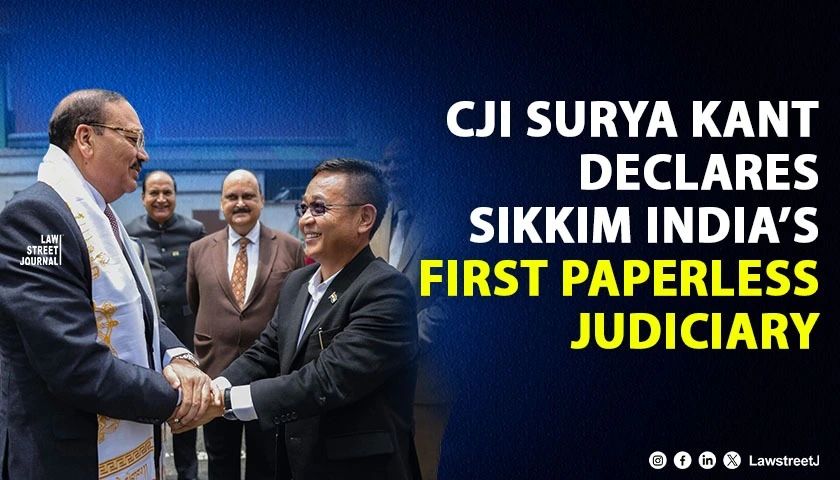
Gangtok: Sikkim was officially declared India’s first paperless state judiciary on May 1, 2026. The declaration was made by Chief Justice of India Surya Kant at a conclave held in Gangtok, the state’s capital.
The conclave, themed Technology and Judicial Education, is being organised by the High Court of Sikkim and the Sikkim Judicial Academy and is scheduled to continue on May 2, 2026. The event brought together judges, legal experts, and policymakers to discuss the digital transformation of the Indian judiciary.
CJI Surya Kant
Making the declaration, CJI Surya Kant spoke of the role of technology in transforming access to justice:
“In the past, distance for a litigant was not measured in kilometres but in days of travel, difficult terrain, and uncertainty. Today, that reality is changing not only because of infrastructure but because technology is reshaping access. The digital highway now connects citizens directly to various judicial fora. We have moved away from the era of paper trails,” the CJI said.
Justice J.K. Maheshwari
Supreme Court Justice J.K. Maheshwari commended Sikkim on the declaration, drawing a distinction between the role of technology and the act of judging:
“Sikkim being declared a paperless judiciary is a remarkable moment. It does not replace human judgment; rather, it removes barriers—physical papers, distance, or missing files. That is the correct ambition of technology in justice: not to replace the human act of judging, but to remove every obstacle that stands between the individual and that act,” he said.
Chief Justice of Sikkim High Court
Sikkim High Court Chief Justice A. Muhamed Mustaque described the conclave as a historic moment for Sikkim and the Indian judiciary, emphasising that the initiative is rooted in practical impact rather than technological showcase:
“Today’s conclave is about starting something at the ground level—a practical approach. The aim is not to create high-tech courts for the sake of it, but to impact the lives of citizens,” he said.
Justice Bhaskar Raj Pradha
Sikkim High Court Justice Bhaskar Raj Pradha stressed the importance of ensuring that digital advancement serves the rule of law and does not exclude marginalised groups:
“We must ensure that digital advancement does not distance marginalised groups. If we use technology to make courts faster, fairer, cheaper, more accessible, and more humane, we are bound to succeed. If technology helps fulfil this mission, we must welcome it. If it seeks to dilute it, we must restrain it,” he said.
Sikkim Advocate General
Sikkim Advocate General Basava Prabhu S. Patil observed that the paperless judiciary initiative is aimed at making justice delivery faster and more efficient, while clarifying that the transition is not a departure from the sanctity of legal records:
“The move towards a paperless judiciary is not to disrespect paper, which has carried our pleadings, precedents, evidence, and constitutional history. The point is to ensure that a citizen does not have to wait because a file is in transit, a page is missing, a record is untraceable, or a certified copy is moving at the speed of dust. Technology is not about replacing justice, but removing friction from it,” he said.
Chief Minister P.S. Tamang
Chief Minister Prem Singh Tamang, speaking in the context of Sikkim’s 50th year of statehood, expressed pride in hosting the conclave:
“As Sikkim celebrates 50 years of statehood, we feel proud of our journey and achievements. It is a great honour to host this conclave in the presence of the Chief Justice of India and other distinguished dignitaries,” he said.
Other dignitaries who addressed the conclave included Attorney General for India R. Venkataramani, Chief Justice of the Supreme Court of Seychelles Rony James Govinden, and Sikkim High Court Justice Meenakshi Madan Rai.