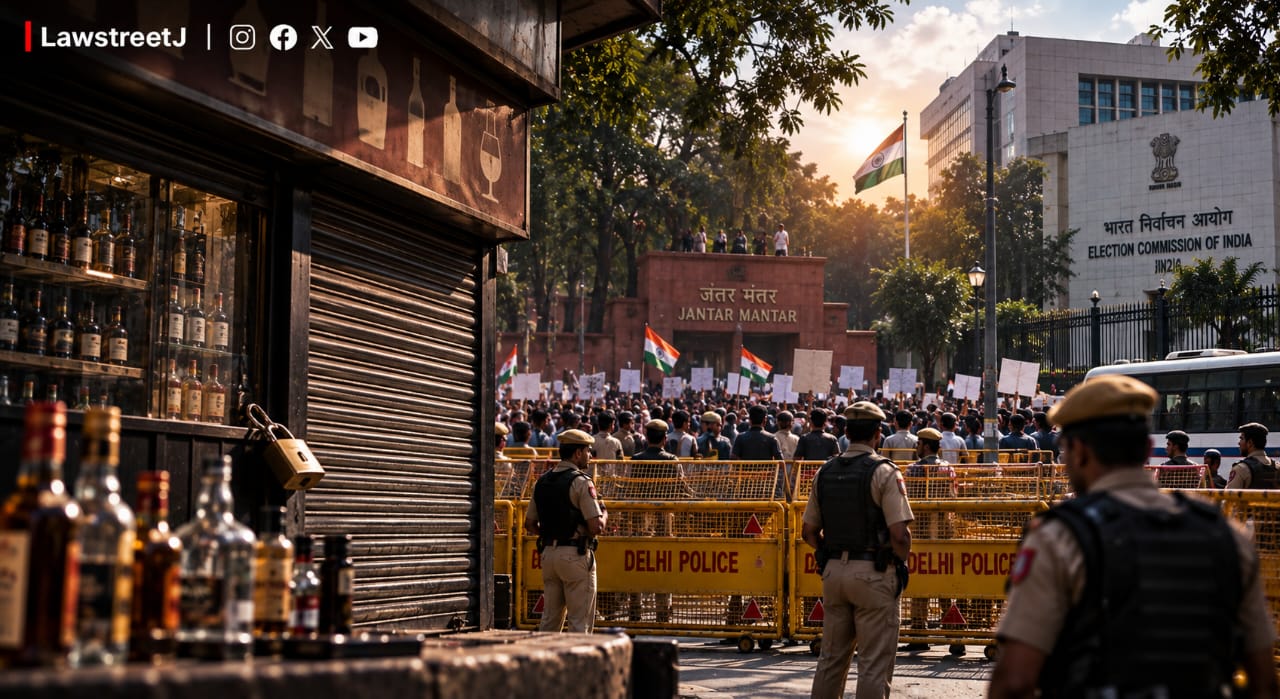
New Delhi — The Delhi government's Excise Department has ordered the closure of all retail liquor outlets across the capital on October 9 and 10, 2026, as a preventive measure ahead of a planned protest by the Cockroach Janta Party demanding the resignation of Chief Election Commissioner Gyanesh Kumar. The closure comes as Delhi Police has denied permission for the group's proposed demonstration at Jantar Mantar, even as the party has indicated it intends to proceed.
According to a circular issued by the Delhi Excise Department, all retail liquor vends operating under licences in Form L6, L6 and L6FG, L8, L10, and L8 and L14 will remain completely closed on October 9 and 10, 2026. The order states that the closure was issued "in view of the prevailing situation and inputs received from Delhi Police, as a preventive measure aimed at maintaining public order."
The Excise Department directed relevant government agencies, including the Delhi State Industrial and Infrastructure Development Corporation, Delhi Tourism and Transportation Development Corporation, and Delhi State Civil Supplies Corporation, to ensure compliance. Hotels, clubs, bars and restaurants holding valid excise licences to serve liquor will remain open and are not covered by the closure order.
The Planned Protest
The closure precedes a protest called by the Cockroach Janta Party, commonly known by its acronym CJP, scheduled for October 10 at Jantar Mantar in central Delhi. The party, founded by Abhijeet Dipke, is demanding the resignation of Chief Election Commissioner Gyanesh Kumar over allegations relating to the Special Intensive Revision of electoral rolls, including claims of "vote theft" and the exclusion of young voters from electoral rolls. CJP has stated that the Delhi demonstration forms part of a wider series of protests planned across India.
Delhi Police has declined to grant permission for the October 10 gathering. CJP co-convenor Saurav Das questioned the requirement for police permission, stating that Jantar Mantar is a designated protest site with a history of hosting peaceful demonstrations. Dipke separately alleged that police in Chandrapur, Maharashtra, had pressured activists to avoid travelling to Delhi for the protest.
Police have said they are coordinating with paying-guest accommodation owners, market associations and resident welfare associations to prevent large crowds from gathering, and have indicated that facial recognition technology is being used to identify individuals who have participated in earlier protests at the site, some of whom could face detention. Local businesses near the protest site have also been asked to close earlier than usual, at 11:30 pm instead of midnight, as part of the heightened security arrangements.
Background: The July 2026 Protest and Its Aftermath
CJP's planned October 10 protest follows an earlier, prolonged demonstration at Jantar Mantar that began in June 2026, initially centred on demands for the resignation of the Union Education Minister over repeated national examination paper leaks, and which included a hunger strike by climate activist Sonam Wangchuk. That protest culminated in a march toward Parliament on July 20, 2026, for which Delhi Police had publicly stated no permission had been granted.
Clashes were reported as thousands of protesters gathered despite the lack of permission, with Delhi Police stating that 118 security and police personnel were injured, and separately stating that around 60 protesters were injured. Allegations subsequently emerged regarding the use of lathi charges and tear gas against the protesters, which Delhi Police has disputed, stating that the protest was "handled professionally."
Multiple legal proceedings followed the July violence. The Supreme Court agreed to hear a plea alleging police excesses against the protesting students, while the Delhi High Court separately issued notice to the Centre and Delhi Police on a plea seeking a Special Investigation Team probe into the alleged police conduct, with the court directing police to preserve CCTV footage and other video evidence from the protest and observing that the incident was not an "isolated" occurrence.
The Supreme Court also agreed to hear a separate public interest litigation questioning whether Jantar Mantar should continue to serve as Delhi's designated protest site, citing disruption to residents and the movement of essential supplies. Reports indicate a fresh Crime Branch inquiry has also revisited the violence that occurred during the July march, and a related court hearing was scheduled for October 9, 2026, though the specific subject matter of that hearing has not been independently detailed in available reporting.
Legal Framework
The Excise Department's order closing liquor shops is issued under the regulatory authority conferred by the Delhi Excise Act, 2009, and the Delhi Excise Rules, 2010, which empower excise authorities to regulate the sale and supply of liquor within the National Capital Territory, including through temporary closures directed in the interest of public order. Such closures, commonly referred to as "dry days," are a recurring administrative measure used by the Delhi government ahead of elections, major public events, or periods of anticipated law-and-order sensitivity.
The right to peaceful assembly and protest in India is protected under Article 19(1)(b) of the Constitution, which guarantees citizens the right to assemble peaceably and without arms, subject to reasonable restrictions that the State may impose under Article 19(3) in the interests of public order and the sovereignty and integrity of India.
The Supreme Court, in its 2020 judgment in Amit Sahni v. Commissioner of Police, held that while the right to peaceful protest is constitutionally protected, public ways and public spaces cannot be occupied indefinitely, and the right to protest must be balanced against the rights of other citizens to free movement and the functioning of public order. Police authority to grant or deny permission for public assemblies in Delhi derives from provisions of the Delhi Police Act, 1978, and relevant prohibitory-order provisions under the Bharatiya Nagarik Suraksha Sanhita, 2023, which govern the maintenance of public order and allow authorities to impose restrictions on public gatherings in specified circumstances.
As of October 9, 2026, liquor shops across Delhi remain closed under the Excise Department's order, with the closure set to continue through October 10. Delhi Police has not reversed its denial of permission for CJP's planned Jantar Mantar protest, and security has been visibly tightened across the city, including through coordination with local institutions and the deployment of facial recognition technology.
CJP has indicated it intends to proceed with the demonstration despite the lack of police authorisation. The outcome of the planned protest, and of the pending judicial proceedings relating to the July 2026 unrest and the broader question of Jantar Mantar's continued use as a protest site, remained undetermined at the time of this report.
![NewsClick received funds from Chinese firms to create false narratives: Delhi police FIR [Read Order]](/secure/uploads/2023/10/lj_9371_b4600c46-2a07-4866-b478-1c7683cd8363.jpg)
![Delhi High Court asks RBI, MHA to respond on various aspects of fraudulent digital bank transactions [Read Order]](/secure/uploads/2023/11/lj_3880_WhatsApp_Image_2023-11-29_at_4.49.08_PM.jpeg)

![Parliament security breach: Former DCP LN Rao calls for SOP for crime reporting [Watch Video]](/secure/uploads/2023/12/lj_6987_fb4a149e-b55e-447b-90cd-ab83b39cdc46.jpg)