


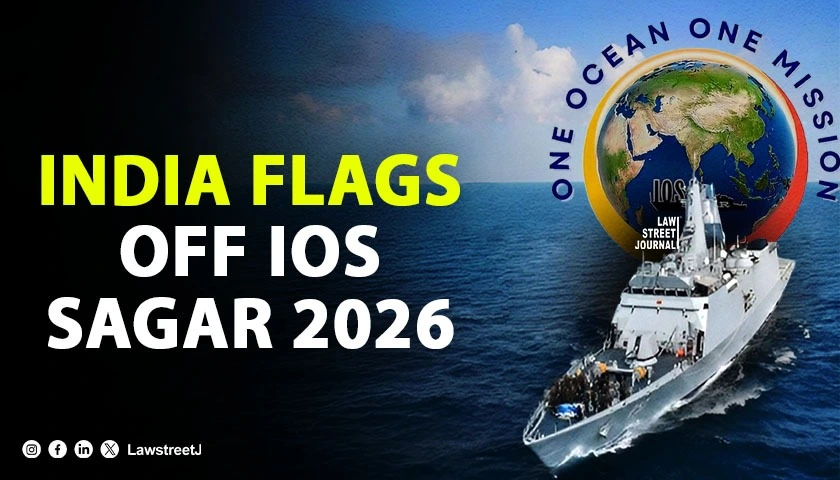
New Delhi: On April 2, 2026, the Indian Navy’s offshore patrol vessel INS Sunayna was formally redesignated as the Indian Ocean Ship (IOS) SAGAR and flagged off from the Naval Dockyard in Mumbai. The ceremony was presided over by Minister of State for Defence Sanjay Seth and Chief of Naval Staff Admiral Dinesh K. Tripathi. The vessel carries Indian Navy personnel along with representatives from 16 friendly foreign countries, marking a significant step in India’s maritime diplomacy.
The mission is scheduled to last 50 days, with planned port calls in Sri Lanka, Indonesia, and Singapore, and will include joint training exercises, Visit, Board, Search, and Seizure (VBSS) operations, and disaster response drills.
Strategic Context and Legal Framework
The launch comes at a time when the West Asia conflict has entered its fifth week, causing instability in the Strait of Hormuz, a critical maritime chokepoint for global energy supplies. India’s initiative seeks to mitigate risks of disruption by reinforcing collective maritime security in the Indian Ocean Region (IOR).
Legally, the IOS SAGAR initiative operates within the framework of the United Nations Convention on the Law of the Sea (UNCLOS), which governs freedom of navigation, maritime cooperation, and collective security responsibilities. India’s leadership also aligns with its chairmanship of the Indian Ocean Naval Symposium (IONS), assumed in February 2026, giving it a formal mandate to coordinate multilateral naval cooperation.
The initiative is further embedded in India’s MAHASAGAR framework (Mutual and Holistic Advancement for Security Across the Regions), which emphasizes lawful, cooperative, and transparent maritime practices.
Human Dimension and Regional Impact
The IOS SAGAR program is not limited to military exercises; it also emphasizes humanitarian assistance, disaster relief, and capacity building. Sailors from participating nations are integrated into shipboard tasks, fostering interoperability and trust.
The initiative also reflects India’s broader vision of “One Ocean, One Mission,” symbolizing collective responsibility for maritime safety. By including diverse nations from the IOR, the mission strengthens regional solidarity against piracy, trafficking, and illegal fishing, while ensuring lawful maritime trade routes remain open.
Economically, the mission is significant: the Indian Ocean handles nearly 80% of global seaborne oil trade, and disruptions in chokepoints like Hormuz or Malacca could have severe consequences. IOS SAGAR’s cooperative drills aim to safeguard these routes, ensuring compliance with international maritime law and minimizing risks of unilateral enforcement.
The IOS SAGAR 2026 initiative represents India’s evolving role as a maritime security provider in the Indian Ocean Region. By combining legal frameworks (UNCLOS, IONS, MAHASAGAR) with practical joint operations, India is reinforcing the principle of collective security and lawful cooperation.
As the mission progresses over the next 50 days, its outcomes will be closely watched by regional and global stakeholders, particularly given the ongoing instability in West Asia. The initiative underscores India’s commitment to ensuring that the Indian Ocean remains a zone of peace, lawful trade, and cooperative growth.