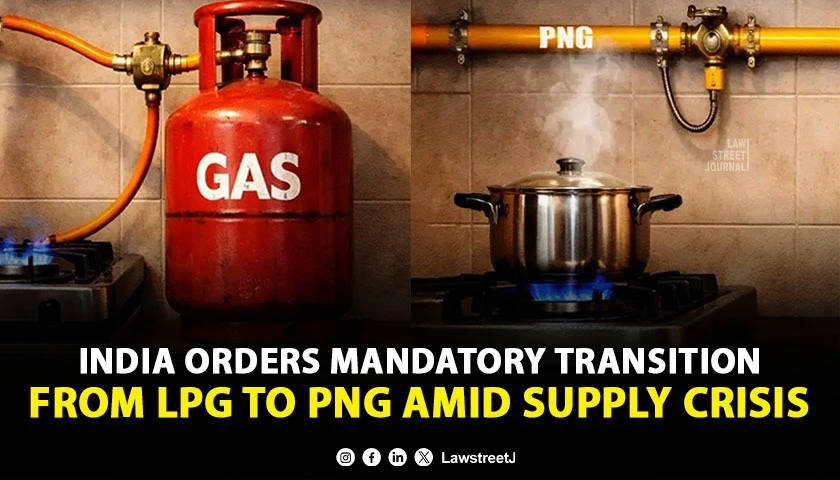
New Delhi: The Government of India has issued a legally binding directive mandating households and commercial establishments to switch from Liquefied Petroleum Gas (LPG) cylinders to Piped Natural Gas (PNG) wherever infrastructure is available. The order, notified on March 24, 2026, under the Natural Gas and Petroleum Products Distribution Order, 2026, sets a 90-day deadline for compliance. LPG supply will be discontinued for non-compliant consumers after the deadline, marking one of the most significant policy shifts in India’s energy distribution framework in recent years.
Government Directive and Legal Framework:
The Ministry of Petroleum and Natural Gas has invoked its powers under the Essential Commodities Act, 1955, to regulate the distribution of petroleum products during crises. The order stipulates that households and commercial users must adopt PNG connections where pipelines are available. LPG distributors are legally bound to enforce the transition, and households refusing PNG adoption will lose LPG supply.
The directive provides exceptions only in cases where PNG is technically infeasible, such as structurally unsuitable buildings or remote areas without pipeline connectivity. Violations by distributors may attract penalties, while consumers who fail to comply risk termination of LPG connections.
This legal framework underscores the government’s authority to intervene in energy distribution during emergencies, positioning the order as a non-negotiable measure under national energy security provisions.
Energy Security and Supply Disruptions
India imports over 55% of its LPG requirements, making the domestic market highly vulnerable to geopolitical instability. The ongoing conflict in West Asia has disrupted supplies from major exporters, leading to shortages and price volatility.
PNG, by contrast, is sourced from domestic natural gas fields and diversified LNG imports, offering greater resilience. It provides a continuous supply through pipelines, eliminating dependence on cylinder refills and reducing logistical bottlenecks.
According to the Petroleum Planning and Analysis Cell (PPAC), urban centres such as Delhi, Mumbai, Bengaluru, and Ahmedabad already have extensive PNG networks, covering millions of households. The government’s target is 70% urban coverage by 2030, reducing reliance on imported LPG.
Fuel price data from March 2026 shows that LPG cylinders are subject to global supply shocks, while PNG tariffs remain comparatively stable. This stability is a key factor in the government’s push for accelerated adoption.
Economic and Social Implications
- Economic Impact
Government estimates suggest that PNG is 10–15% cheaper than LPG cylinders over time. The transition is expected to reduce subsidy burdens, as LPG subsidies have historically cost the exchequer billions annually. By shifting households to PNG, the government aims to rationalise subsidies and redirect fiscal resources toward infrastructure expansion. - Social Considerations
The directive has raised concerns among consumers in semi-urban and rural areas where PNG infrastructure is limited. Reports from Kanpur, Ranchi, and other Tier-II cities indicate long queues for LPG refills, highlighting the urgency of the transition.
Authorities have assured that households will not be forced to switch unless PNG is technically feasible; however, the three-month ultimatum has created anxiety among users dependent on LPG.
- Legal Enforcement
Distributors failing to comply with the directive may face penalties, while households refusing PNG adoption in connected areas will lose LPG supply. The government has emphasised that the order is legally binding and enforceable, leaving little room for negotiation.
Broader Policy Context
The directive aligns with India’s long-term energy diversification strategy. The government has been expanding the national gas grid, aiming to connect over 70 million households by 2030. PNG adoption also supports India’s climate commitments, as natural gas emits fewer pollutants compared to LPG.
The Petroleum and Natural Gas Regulatory Board (PNGRB) has accelerated licensing for new pipeline projects, prioritising states facing acute LPG shortages. Industry experts note that the transition will require rapid infrastructure expansion, particularly in Tier-II and Tier-III cities, where PNG penetration remains limited.
The order also reflects India’s broader strategy to reduce import dependence, strengthen domestic energy resilience, and mitigate vulnerabilities exposed by geopolitical conflicts.
The Natural Gas and Petroleum Products Distribution Order, 2026 marks a decisive shift in India’s energy policy, prioritising pipeline-based natural gas distribution over LPG cylinders. While the government frames the move as essential for energy security, reduced import dependence, and subsidy rationalisation, its success hinges on rapid infrastructure expansion and effective consumer outreach.
With a 90-day compliance window, households in urban areas must prepare for the transition or risk losing LPG supply. The directive underscores India’s determination to safeguard energy security in the face of global disruptions while laying the foundation for a more resilient and sustainable fuel distribution system.

![Bombay HC Upholds Refusal To Recognize TikTok As Well-Known Trademark Citing Government Ban [Read Order]](/secure/uploads/2025/06/lj_5767_Bombay_HC_Upholds.webp)
.webp)