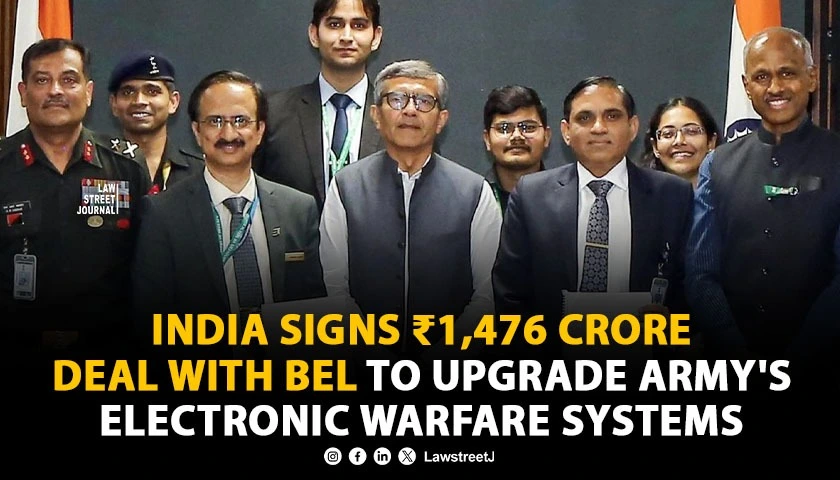
The Ministry of Defence of India took a decisive step forward in the country's defence modernisation journey on May 5, 2026, when it signed a contract with Bharat Electronics Limited (BEL), Hyderabad, for the procurement of five Ground-Based Mobile Electronic Systems (GBMES), valued at ₹1,476 crore, for the Indian Army, with a minimum of 72 per cent indigenous content. The contract, falling under the Buy (Indian-Indigenously Designed, Developed and Manufactured) category, was formalised in the presence of Defence Secretary Rajesh Kumar Singh at Kartavya Bhawan-2, New Delhi. https://x.com/i/status/2051655834153984284
The signing of this agreement places India's electronic warfare modernisation firmly on record, at a time when the nature of battlefield dominance has shifted from conventional firepower to information superiority and spectrum control. The procurement comes amid a broader push by the Indian armed forces to strengthen electronic warfare capabilities, particularly along sensitive borders where spectrum dominance and real-time intelligence are becoming critical. Modern conflicts increasingly rely on the ability to disrupt enemy communications and radar systems, making electronic warfare systems a key component of future combat operations.
The Technology: What the GBMES System Does
The GBMES is a totally indigenous, state-of-the-art system designed and developed by the Defence Electronics Research Laboratory (DLRL), Hyderabad, and manufactured by BEL. Configured as an integrated ELINT (Electronic Intelligence) and ESM (Electronic Support Measures) platform, the system is designed to detect and decode the electromagnetic battlefield around it. It scans the electromagnetic spectrum, searching for radar emissions from enemy aircraft, air defence systems, missile batteries, surveillance radars, and other battlefield sensors.
Using advanced digital receivers and direction-finding technology, the system can search, intercept, measure, monitor, analyse, identify, and accurately locate radar emitters across the required frequency bands. The GBMES works through a networked architecture consisting of three Receiving Stations and one Control Station. One receiving station also acts as a backup control station, ensuring mission continuity. A repeater radio link extends the operational range between stations, allowing wider area coverage and better survivability in combat conditions.
As a vehicle-mounted electronic intelligence platform, the system features high-sensitivity receivers, 360-degree coverage, and 3D mapping for rapid battlefield situational awareness. The networked intelligence system is capable of detecting, classifying, and locating all types of radars, and can also intercept and analyse communication signals, significantly enhancing situational awareness and air defence capabilities. With features such as precise direction-finding and radar fingerprinting, GBMES is expected to act as a force multiplier, improving early warning, targeting support, and situational awareness on increasingly network-centric battlefields.
The Legal Framework: Buy (Indian-IDDM) and Defence Acquisition Procedure 2020
The legal architecture governing this procurement is rooted in India's Defence Acquisition Procedure (DAP) 2020, which superseded the Defence Procurement Procedure of 2016. DAP 2020 introduces the Buy (Indian-IDDM) category as the top priority for defence procurement. It is designed to promote the indigenous defence industry, streamline acquisition processes, and boost transparency in procurement decisions. This classification mandates a minimum indigenous content of 72 per cent, aligning with the government's Aatmanirbhar Bharat and Make in India initiatives. The Buy (Indian-IDDM) category is the highest priority tier under DAP 2020, meaning it takes precedence over all other procurement categories. Placing this contract under that classification carries legal weight, it obligates the vendor to ensure that the design, development, and manufacture of the procured systems have taken place domestically, without dependence on foreign technology transfer.
The Defence Procurement Manual (DPM) 2025, which complements DAP 2020, simplifies revenue procurement norms, reduces liquidated damages for indigenisation, removes outdated No Objection Certificate requirements, and enables digital workflows. Together, both instruments form the procurement backbone that governed this ₹1,476 crore contract. BEL, as a Navratna Defence Public Sector Undertaking operating under the Ministry of Defence, is also bound by SEBI's Listing Obligations and Disclosure Requirements regulations. The company disclosed this development through a regulatory filing dated May 5, 2026, under those regulations.
The Public Procurement (Preference to Make in India) Order, 2017, issued by the Department for Promotion of Industry and Internal Trade, mandates that preference be given to domestically produced goods and services in public procurement, and it applies to defence procurement as well, in line with the objectives of DAP 2020. This contract, therefore, is not merely a commercial agreement between two parties — it is a procurement exercise that flows from and is governed by a layered legal framework involving the Ministry of Defence, India's procurement procedures, capital acquisition policies, and securities disclosure obligations.
The Broader Picture: India's Indigenous Defence Manufacturing Record
This contract does not stand alone. It arrives as part of a far larger and sustained national effort to build indigenous defence capabilities from the ground up. Domestic defence production reached a record high of ₹1.54 lakh crore in Financial Year 2025-26, with defence exports touching an all-time high figure of ₹38,424 crore. Defence Minister Rajnath Singh noted that 25 per cent of the Defence R&D budget has been allocated to the industry, academia, and start-ups, and that these entities have already utilised over ₹4,500 crore of the budget. The DRDO has transferred 2,200 technologies to various industries to date. In July 2025, the Defence Acquisition Council cleared 10 capital acquisition proposals valued at approximately ₹1.05 lakh crore, including Electronic Warfare Systems, Surface-to-Air Missiles, Mine Counter Measure Vessels, and Submersible Autonomous Vessels — all approved under the Buy (Indian-IDDM) category. The GBMES contract follows directly in that line of acquisitions.
In FY 2025-26, ₹1,11,544.83 crore, three-fourths of the modernisation budget has been allocated for procurement through domestic sources. This is a structural shift from earlier years when import dependence was far more pronounced, and it provides the economic foundation that makes contracts like the BEL GBMES deal both viable and necessary. BEL, the company at the centre of this agreement, has played a consistent role in India's defence electronics landscape. As a Navratna PSU, it operates with significant financial and operational autonomy, and its track record in delivering mission-critical systems to the armed forces spans several decades. The contract is expected to further strengthen BEL's role in delivering advanced systems while boosting domestic supply chains and ancillary industries.
The agreement signed on May 5, 2026, at Kartavya Bhawan-2 in New Delhi, represents a clear and documented intersection of national security policy, procurement law, and defence technology. Five systems, one contract, ₹1,476 crore and a measurable step toward the kind of electronic battlefield awareness that modern warfare demands.