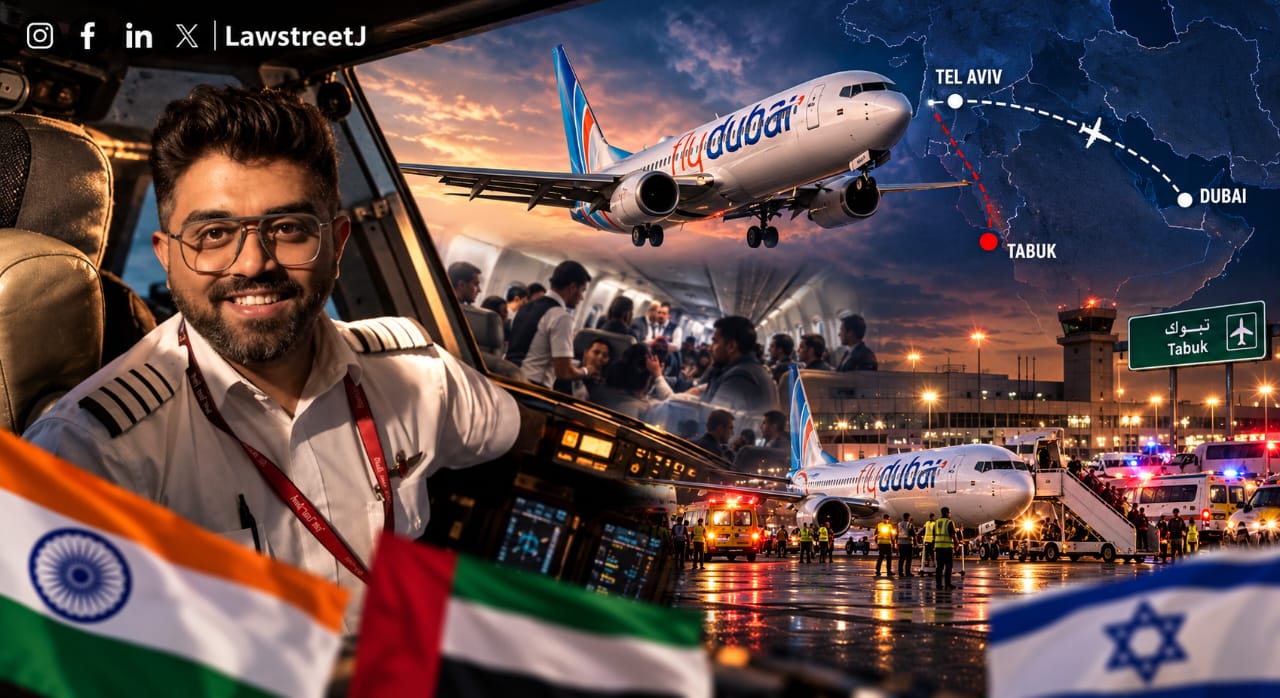
Tabuk / Dubai / Tel Aviv — Captain Smit Machchhar, an Indian pilot flying for the UAE-based carrier Flydubai, is in stable condition and receiving treatment at a hospital in Tabuk, Saudi Arabia, after he was stabbed by his co-pilot during a violent confrontation in the cockpit of Flydubai flight FZ1073. The aircraft, travelling from Dubai to Tel Aviv with approximately 174 people on board, was diverted and landed safely in Saudi Arabia after passengers and crew members intervened to subdue the attacker.
What Happened on Flight FZ1073
Flight FZ1073, operated with a Boeing 737 MAX 8, was more than two hours into its journey from Dubai International Airport to Ben Gurion Airport in Tel Aviv when the confrontation occurred on Wednesday, September 30, 2026. According to officials involved in the investigation, the co-pilot stabbed Captain Machchhar and attempted to seize control of the aircraft in what Israeli authorities have described as an apparent attempt to crash the plane. The aircraft briefly transmitted a transponder code indicating possible unlawful interference, which raised concerns of a hijacking and prompted a major security response.
Despite his injuries, Captain Machchhar managed to unlock the cockpit door, which allowed passengers and cabin crew to enter and help overpower the co-pilot. Flydubai confirmed that on-duty crew members travelling on the flight secured the aircraft and diverted it to Tabuk Airport in northwestern Saudi Arabia, where it landed safely. All passengers and cabin crew were reported safe.

Captain Machchhar, who has more than a decade of commercial aviation experience and previously flew for an Indian carrier before joining Flydubai, is based in Dubai. He was treated for severe wounds after landing, a dentist present at the time, identified as Shota Musev, assisted in treating him before he was transferred to hospital care in Tabuk. The Indian Embassy in Saudi Arabia confirmed that Machchhar was admitted to a hospital in Tabuk city and was receiving the necessary medical attention, describing him as brave and wishing him a speedy recovery.
Israeli officials identified the co-pilot accused of the attack as an Omani national who had been employed by Flydubai for approximately nine months. He was arrested by Saudi authorities shortly after the aircraft landed and has since been interrogated. Israeli Prime Minister Benjamin Netanyahu said the co-pilot would be questioned by Saudi authorities and indicated that he was expected to be moved to Dubai as the investigation proceeds. Netanyahu also said Israel would be permitted to join the investigation and to question the Omani pilot alongside the United Arab Emirates.
Oman and Israel do not maintain diplomatic relations, and investigators are examining how an Omani national came to be assigned to crew a flight bound for Israel, along with the broader hiring and security-clearance procedures followed by Flydubai for crew operating such routes.
Official Reactions

Netanyahu described the incident as a highly severe security incident and credited Captain Machchhar's actions with helping prevent what he called a disaster, crediting the pilot with saving the lives of the 174 people on board, most of them Israeli citizens. He praised Machchhar as a true hero who showed extraordinary bravery. Israeli Defense Minister Israel Katz described the incident as an attempted jihadist terrorist attack, while other officials have cautioned that the investigation into the exact sequence of events and the motive behind the attack remains ongoing.
Flydubai confirmed it had opened its own internal investigation into the incident and had notified Israeli authorities. The airline has urged against premature speculation regarding the cause or motive of the confrontation while the formal investigation continues. In the aftermath, Flydubai flights to Israel were temporarily suspended as authorities in Saudi Arabia, Israel and the United Arab Emirates examined the circumstances of the incident. Passengers from the diverted flight were later transported to Israel aboard a separate Flydubai aircraft, which landed at Ben Gurion Airport.
In response to the incident, Israel announced it would introduce tighter security checks on pilots operating flights into the country, applying the measure to both Israeli and foreign carriers. A spokesperson for the Israeli prime minister's office said that going forward, authorities intend to verify the identities of every pilot flying into Israel and conduct a form of security check on them. Israel's Transport Ministry said a joint investigation into the incident would be conducted together with the country's defence establishment, and the Israel Police Operations Division ordered the establishment of a joint command centre involving multiple security agencies.
Regulatory and Jurisdictional Framework

Flydubai is certified and regulated by the United Arab Emirates' General Civil Aviation Authority, which the European Union Aviation Safety Agency has confirmed holds responsibility for the airline's certification and ongoing safety oversight. As the aircraft involved was registered and operated under UAE authority, the GCAA is expected to play a central role in the technical and regulatory aspects of the investigation.
Several areas of international aviation law are relevant to an incident of this kind. The Convention on Offences and Certain Other Acts Committed on Board Aircraft, signed in Tokyo in 1963, governs jurisdiction over criminal acts and acts that jeopardise safety committed on board an aircraft in flight, and empowers the aircraft commander to take reasonable measures, including restraint, against any person the commander has reasonable grounds to believe has committed or is about to commit such an act. Under this framework, the state in which an aircraft lands following such an incident, in this case Saudi Arabia, is generally entitled to exercise jurisdiction to investigate and, where applicable, prosecute.
The Convention for the Suppression of Unlawful Acts Relating to International Civil Aviation, concluded in Beijing in 2010, and its related instruments build on earlier treaties addressing the hijacking and sabotage of aircraft, criminalising acts of violence against persons on board an aircraft in flight that are likely to endanger its safety. Annex 17 to the Convention on International Civil Aviation, maintained by the International Civil Aviation Organization, sets out international standards and recommended practices for safeguarding civil aviation against acts of unlawful interference, including security vetting of flight crew, a subject now under direct scrutiny following this incident.
The transponder code transmitted by the aircraft during the confrontation is an internationally standardised signal under ICAO protocols used to alert air traffic control authorities to a situation of unlawful interference, triggering heightened monitoring and coordination among the air traffic control agencies of the countries whose airspace the aircraft was transiting.
Any eventual prosecution of the co-pilot would likely involve coordination between the jurisdictions connected to the flight, including Saudi Arabia as the state of landing and interrogation, the United Arab Emirates as the state of aircraft registration and the operator's home jurisdiction, and potentially Oman as the accused's state of nationality, depending on how the investigation and any extradition or transfer arrangements proceed.
As of October 1, 2026, Captain Smit Machchhar remains hospitalised in stable condition in Tabuk, Saudi Arabia, and is being hailed as a hero in India and by Israeli officials for his role in helping prevent the aircraft from being brought down. The co-pilot, an Omani national, remains in the custody of Saudi authorities and is being interrogated, with Israeli officials indicating he may be moved to Dubai as the multinational investigation continues.
No official, confirmed motive for the attack has been established, and Flydubai has asked the public and media to avoid speculating on the cause while the investigation is ongoing. Israel has announced it will implement stricter identity verification and security screening for all pilots operating flights into the country, and Flydubai's service to Israel remains under review pending the outcome of the joint investigation being conducted by Saudi, Emirati and Israeli authorities.