


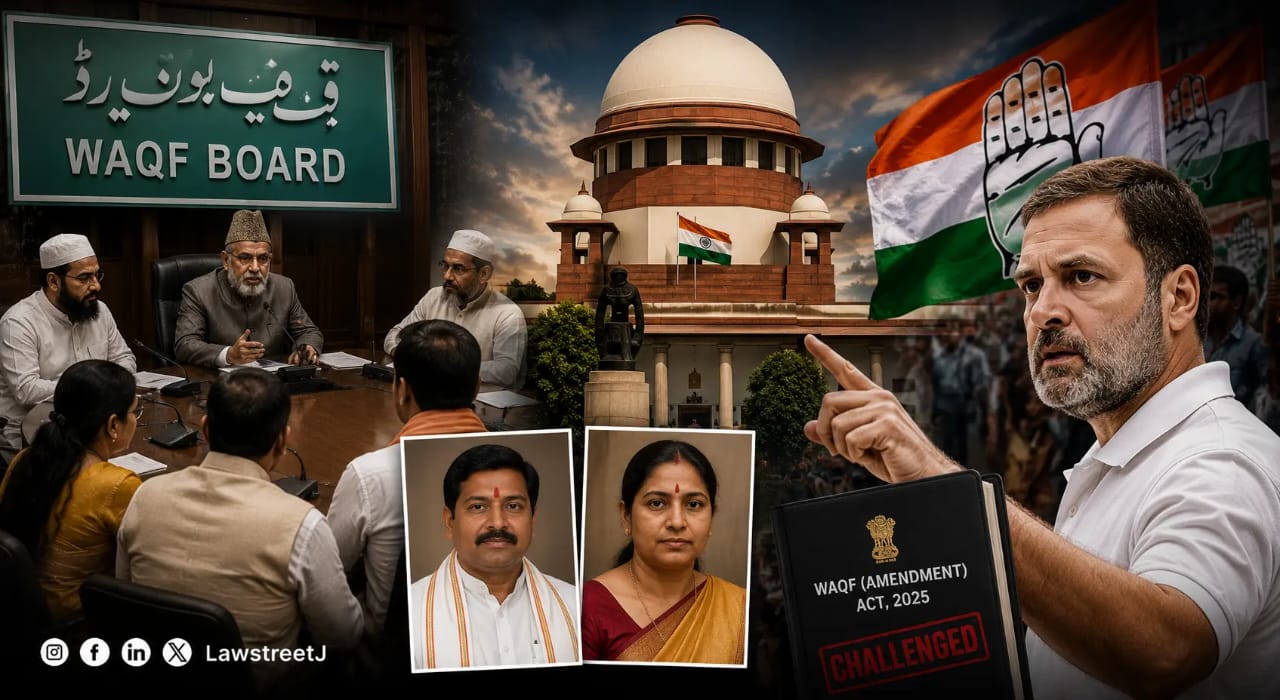
Bhopal: Madhya Pradesh has become the first state in India to reconstitute its Waqf Board under the provisions of the Waqf (Amendment) Act, 2025, Chief Minister Mohan Yadav announced on July 5. The newly constituted 10-member board includes two Hindu members for the first time in the history of any state Waqf Board in the country, a move the ruling BJP has described as a reform toward greater transparency and accountability, and which the Congress has condemned as legally questionable, announcing its intention to challenge the reconstitution before the Supreme Court.
The state government issued a formal notification in the Madhya Pradesh Gazette exercising powers conferred by Section 13(1) of the Waqf Act, 1995, as amended in 2025, constituting the board in accordance with Section 14 of the Act.


The New Board: Composition and Key Appointments
The newly constituted Madhya Pradesh Waqf Board has Sanwar Patel as its chairman, serving his second consecutive term in the role. The board's ten members as notified in the Madhya Pradesh Gazette are as follows: Sanwar Patel as chairman, former Union Minister Najma Heptulla from New Delhi, MLA Atif Aqueel from Bhopal North, Faizan Khan from Ujjain, Sister Fatema Chaudhary from Indore, Shaista Sultan who serves as a councillor in Berasia, Bhopal, Shabana Khan who serves as a councillor in Ratlam, Manoj Malpani from Indore, and Animesh Bhargava from Raghogarh in Guna district. The Commissioner of the Backward Classes and Minority Welfare Department serves as an ex-officio member of the board.
Manoj Malpani is described as an industrialist and social worker based in Indore. Animesh Bhargava is from Guna district. Both are Hindus. Their inclusion constitutes the first instance of non-Muslim members being appointed to a state Waqf Board anywhere in the country since the Waqf Act was first enacted.
The new board also includes two women, Sister Fatema Chaudhary and Shaista Sultan, marking a further departure from the composition of previous boards.
What the Waqf Amendment Act 2025 Changed
The Waqf (Amendment) Act, 2025, officially renamed by the central government as the UMEED Act, short for Unified Waqf Management, Empowerment, Efficiency and Development was passed by Parliament on April 4, 2025, after marathon debates of over twelve hours in the Lok Sabha and fourteen hours in the Rajya Sabha. President Droupadi Murmu gave her assent to the bill on April 5, 2025.
The Act is the most extensive reform of India's Waqf legislative framework since the Waqf Act of 1995. Among its many changes, the provision directly relevant to Madhya Pradesh's reconstitution is Section 14, which now mandates the inclusion of at least two non-Muslim members on every State Waqf Board. Before the amendment, state Waqf Boards were composed exclusively of Muslim members. The central government has argued that this change is aimed at broadening representation in bodies responsible for regulating Waqf properties across India, properties that number approximately 870,000 and cover close to one million acres. Waqf is an inalienable charitable endowment in Islamic law, through which property is permanently dedicated for religious or charitable purposes. Once declared Waqf, a property cannot be sold, gifted, or inherited.
The Waqf Board is a statutory body established to manage and protect Waqf properties in the state. Its main functions are to maintain records of Waqf properties, monitor their use and income, protect them from illegal encroachments, resolve disputes related to Waqf properties, and ensure their use for religious, educational, and social welfare purposes. The restructured board is expected to oversee the management of Waqf properties, monitor their administration, maintain official records, and carry out other statutory responsibilities under the amended legislation.
The Supreme Court's Interim Order: A Critical Legal Caveat
The reconstitution of the Madhya Pradesh Waqf Board takes place in a legally significant context that all reporting on this development must acknowledge. The constitutional validity of the Waqf (Amendment) Act, 2025 is currently pending before the Supreme Court of India, with over 65 petitions having been filed against it by politicians, religious organisations, civil society groups, and advocates. The petitions include those filed by AIMIM president Asaduddin Owaisi, the All India Muslim Personal Law Board, Jamiat Ulama-e-Hind, the DMK, and several members of Parliament.
On September 15, 2025, a bench comprising Chief Justice B.R. Gavai and Justice A.G. Masih delivered an interim order in the matter. The court declined to stay the Act as a whole, holding that no prima facie case had been made out against the 2025 Amendment in its entirety. However, the court stayed specific provisions of the Act, including Section 3(r), which required a waqif to prove they had been practising Islam for at least five years before creating a waqf, and certain provisions of Section 3C relating to government property identified or declared as Waqf.
Most significantly for the Madhya Pradesh reconstitution, the Supreme Court's September 15 order also specifically directed that the Central Waqf Council and State Waqf Boards should not consist of more than four and three non-Muslim members respectively, and that the Waqf Boards must "strive to ensure" that the ex-officio chairperson is from the Muslim community. The Madhya Pradesh board has two non-Muslim members, which falls within the Supreme Court's stated ceiling of three and Sanwar Patel, who has been reappointed as chairman, is a Muslim. The board's composition therefore appears to fall within the parameters set out in the Supreme Court's interim directions, though Congress has indicated it will argue otherwise in court.
Political Reaction: BJP Defends, Congress Plans Supreme Court Challenge
The BJP has welcomed the reconstitution of the board with considerable enthusiasm. State minister Vishwas Sarang said it was heartening that Madhya Pradesh had become the first state to implement the Waqf Act and include two Hindu members, describing the move as one that would have far-reaching and positive consequences. Sanwar Patel, the reappointed chairman, said the board had been reconstituted in strict adherence to legal provisions and accused opposition parties of provoking people and politicising the issue.
Congress MLA Arif Masood pointed out that the matter related to the Waqf Act is already pending before the Supreme Court and that a final decision is yet to be given. "Such appointments should not have been made until the final decision of the apex court," he said. He added: "The Madhya Pradesh government's reorganisation of the Waqf Board and inclusion of non-Muslim members is inappropriate and raises several legal questions. We will approach the Supreme Court and challenge the formation and appointment of the Waqf Board members."
Former minister and senior Congress leader PC Sharma criticised the BJP more broadly, alleging the ruling party has no issues other than "Hindu-Muslim" and "India-Pakistan," and claiming the decision was aimed at diverting public attention from the theft of offerings at the Ram Temple in Ayodhya and from allegations against Chief Minister Yadav. BJP leaders rejected these characterisations entirely.
The Legal Questions That Remain Unresolved
Congress MLA Arif Masood's point about the timing of the Madhya Pradesh reconstitution is legally significant. While the Supreme Court declined to stay the Act as a whole in its September 2025 interim order, the constitutional validity of the non-Muslim membership provision specifically, Section 14 of the Act, is among the questions still pending final adjudication. The court identified in its September order that the inclusion of non-Muslim members to the Central Waqf Council and State Waqf Boards and whether this violates Articles 26(b) and 26(d) of the Constitution, which protect the right of religious denominations to manage their own affairs is among the central questions the bench must decide.
Article 26 of the Constitution guarantees every religious denomination the right to manage its own affairs in matters of religion. Whether a Waqf Board, which is a statutory body rather than a purely religious institution falls within the protection of Article 26 is itself a contested legal question. The central government has consistently argued that Waqf Boards regulate the secular, administrative aspects of Waqf properties rather than the religious substance of the institution, and that reforms to their composition are therefore constitutional exercises of parliamentary authority.
Petitioners have argued the opposite that the management of Waqf properties is inseparable from the religious character of the endowment itself, and that mandating the inclusion of non-Muslim members in bodies that oversee Islamic charitable endowments constitutes impermissible interference with the Muslim community's right to manage its own religious affairs.
The Supreme Court has not yet delivered its final ruling on any of these questions. Until it does, the legal status of Madhya Pradesh's reconstituted board and the status of any similar reconstitutions that other states may choose to undertake before the final verdict remains legally provisional, subject to whatever the apex court ultimately decides.
What Comes Next
Madhya Pradesh's decision to reconstitute its board is widely expected to be followed by other BJP-governed states in the coming weeks, all of whom will be watching the Congress's anticipated Supreme Court challenge closely for signals about whether the court will issue any fresh interim directions specifically addressing state-level reconstitutions.
The broader Waqf Amendment Act case before the Supreme Court is among the most consequential pending constitutional cases in India today, with the court's final ruling set to determine the degree of state control that Parliament may legally exercise over the administration of Waqf properties and whether the inclusion of non-Muslim members in Waqf Boards is constitutionally permissible. That ruling, when it comes, will determine the durability of everything Madhya Pradesh has set in motion.

.jpeg)

.jpeg)

