


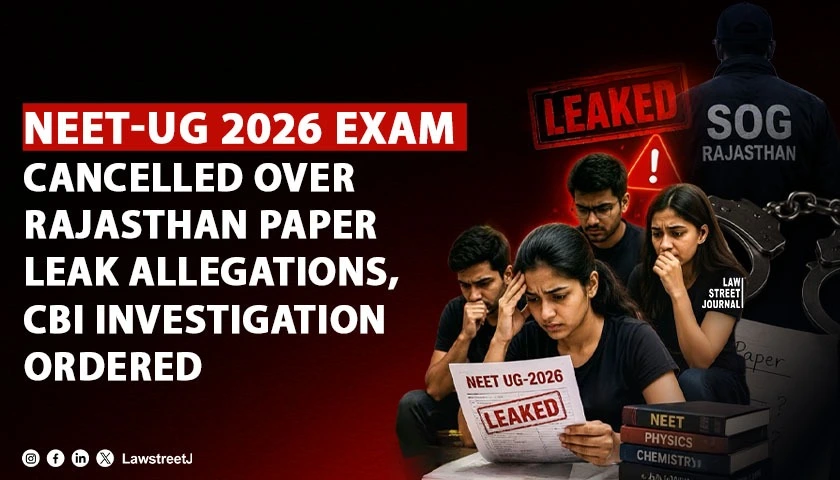
NEET-UG 2026, one of India’s biggest entrance examinations conducted for undergraduate medical admissions, has been cancelled after serious allegations of a paper leak emerged from Rajasthan. The examination, which was held on May 3 and attended by nearly 22 lakh students across the country, now stands invalid after investigations pointed towards possible malpractice and compromise of the examination process.
The National Testing Agency (NTA), while announcing the cancellation on Tuesday, stated that information gathered by law enforcement agencies indicated that the “present examination process could not be allowed to stand.” The agency further confirmed that the examination would be reconducted, with fresh dates expected to be announced soon.
The controversy gained momentum after Rajasthan Police’s Special Operations Group (SOG) launched a probe into allegations that the NEET-UG question paper had leaked days before the examination. According to details emerging from the investigation, a handwritten “guess paper” circulating in Rajasthan’s Sikar district reportedly matched a significant portion of the actual examination paper.
Investigators found that nearly 140 questions — carrying approximately 600 marks out of the total 720 — were allegedly similar to the questions that eventually appeared in the exam. The handwritten material was reportedly circulated two to three days before the May 3 examination, raising serious concerns over the integrity and security of one of the country’s most important competitive exams.
Earlier, the NTA had acknowledged that it was aware of the Rajasthan Police investigation into “alleged irregularities around NEET (UG) 2026.” The agency also stated that it had itself received inputs regarding possible malpractice shortly after the examination and had informed relevant law enforcement authorities.
Following the developments, the government has now ordered a CBI probe into the matter, escalating the investigation at the national level.
However, beyond the investigation and administrative actions, the biggest concern remains the future of students. Over 22 lakh aspirants spent months and years preparing for this examination with hopes of securing admission into medical colleges. The cancellation has once again raised serious questions about the credibility, transparency and security of India’s examination system.
Law Street asks the government — how many more times will students have to suffer because of leaks, irregularities and systemic failures? Who takes responsibility for the mental pressure, uncertainty and emotional stress faced by lakhs of students and their families? India speaks of becoming a global leader and building the future, but how can that future be secure when the dreams of students continue to be disrupted by repeated examination controversies .


![SC cancels bail of Rajasthan Cong MLA's son, two others in gang rape of minor girl from SC/ST community [Read Judgment]](/secure/uploads/2023/08/lj_9238_e7f8b2f2-fdeb-4dbd-b88d-013fb1447ba3.jpg)
![Caste can't be used to show leniency in child sexual assault case: Supreme Court [Read Judgement]](/secure/uploads/2023/10/lj_3102_Caste_of_an_accused_be_considered_for_mercy.jpg)




Kaustubh May 12, 2026
When exams lose integrity, students lose trust in the system. Lakhs of NEET aspirants deserve fairness, not uncertainty
Arsh May 12, 2026
Informative!
Arsh May 12, 2026
Informative!
Arsh May 12, 2026
Informative!