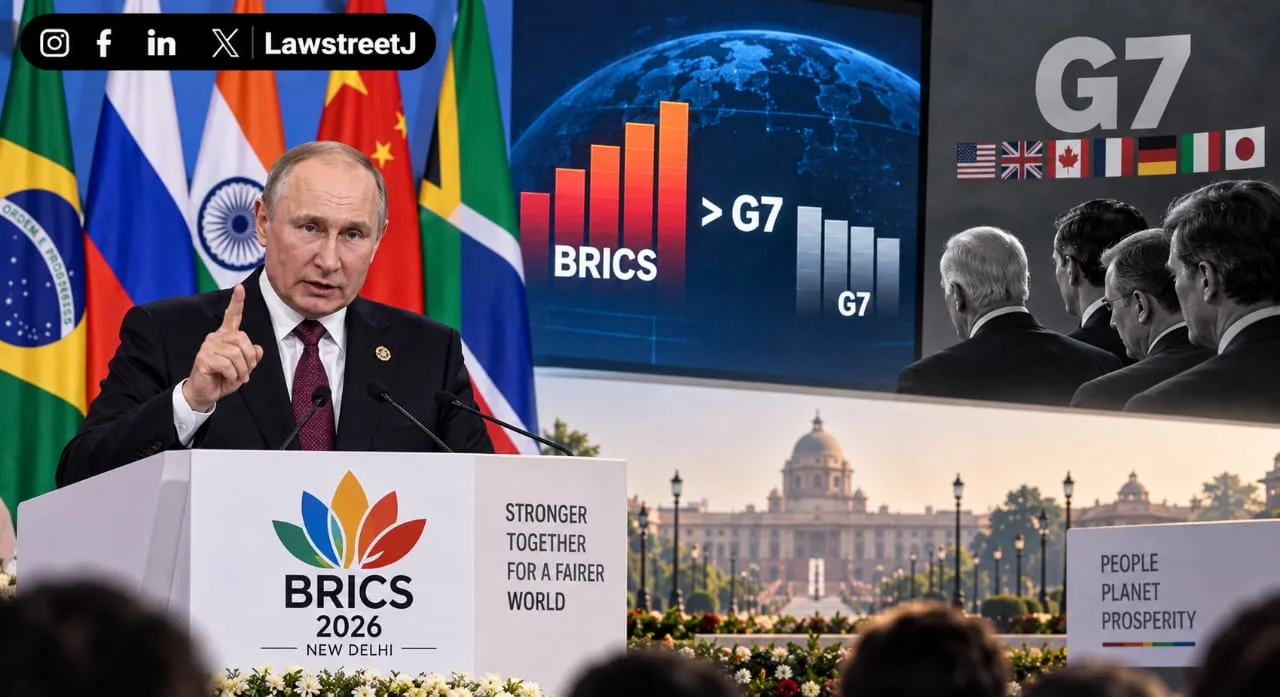
NEW DELHI: Russian President Vladimir Putin used his address at the BRICS Business Forum on Friday to make a pointed economic case for the grouping he's part of, telling the New Delhi gathering that BRICS nations have produced more than 40 percent of world GDP over the last five years, compared to just 29 percent from the G7. He didn't stop there, he also took a dig at the group's very name. "The contribution of the so-called G7, the Group of Seven, I don't know why they call that the Group of Seven, stands at only 29 per cent," he said, drawing attention from the room.
What Putin Actually Said
Putin's speech leaned heavily into the idea that the world's economic centre of gravity is shifting away from the traditionally dominant Western economies and toward BRICS. He said more than half of all global economic growth over the past five years had come from BRICS countries, while the G7's share of that growth was only 18 percent.
Framing it as an inevitable historical shift rather than a sudden reversal, he said the "old leaders" that powered global growth through the latter half of the twentieth century were now being replaced by newer engines. He was careful to add that this didn't mean those older economies had become weak, he specifically pointed out that they still hold strong infrastructure, technological depth and research capacity, but said the trend was simply "the nature of things."
He also spoke about the mechanics behind BRICS's rise, not just the headline numbers. According to Putin, mutual investment among BRICS countries has grown sixfold over the past decade, the bloc's combined investment in the global economy has doubled, and its total exports now account for roughly 20 percent of world exports. He gave Russia's own trade figures as an example of that momentum, saying trade with BRICS partners had grown 40.5 percent to cross $230 billion, with growth accelerating to 35.6 percent in just the first half of this year. Putin framed reliable business-to-business ties as "the backbone of international economic relations," arguing that stronger commercial links between BRICS nations were central to solving global economic problems more broadly.
The Room He Was Speaking To
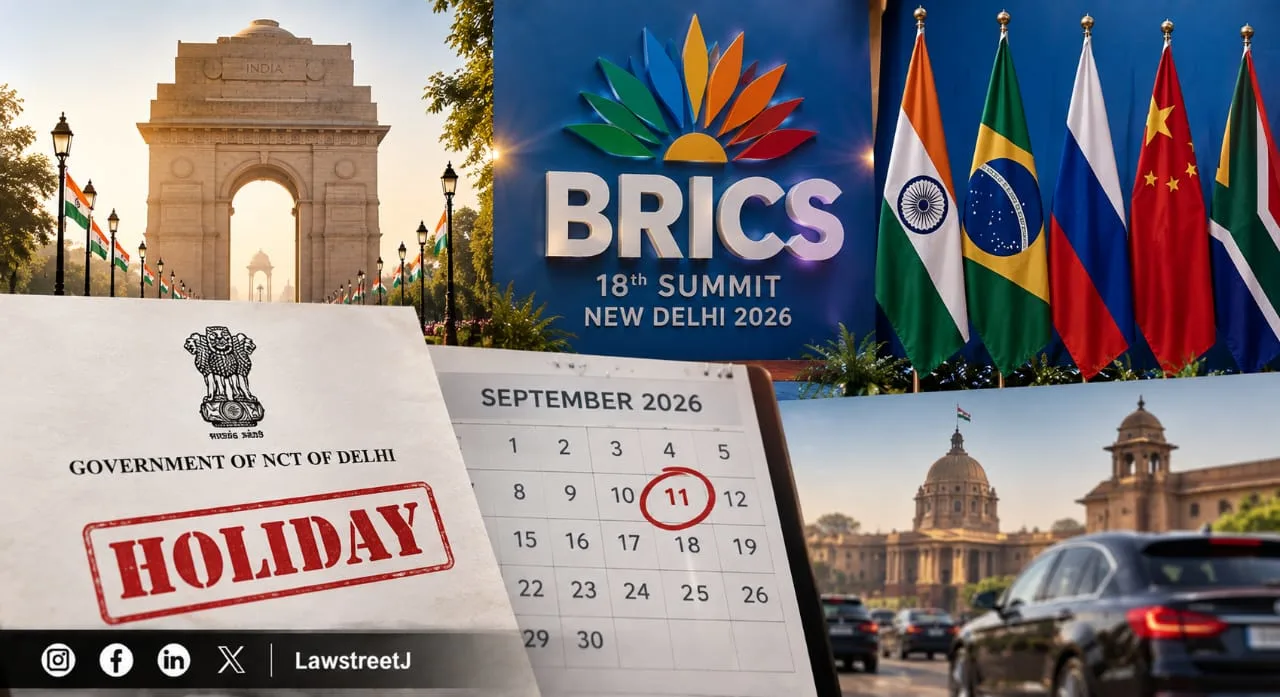
Putin wasn't addressing an empty hall. The BRICS Business Forum 2026 brought together Prime Minister Narendra Modi alongside other BRICS heads of state, and the guest list read like a snapshot of the bloc's current diplomatic weight, Iranian President Masoud Pezeshkian, South African President Cyril Ramaphosa, External Affairs Minister S Jaishankar, Commerce and Industry Minister Piyush Goyal, Brazilian Foreign Minister Mauro Vieira, and the chairs of the BRICS Business Council and the BRICS Women's Business Alliance were all present. The forum served as the economic curtain-raiser ahead of the formal 18th BRICS Summit, which India is hosting at Bharat Mandapam on September 12 and 13.
Earlier the same day, Modi and Putin held a bilateral meeting in New Delhi, where the two leaders discussed deepening India-Russia ties across trade, defence, energy, space and manufacturing, reportedly including a push toward a $100 billion bilateral trade target. In a lighter moment during their meeting, Modi presented Putin with a copy of the Thirukkural, the classical Tamil text by poet-philosopher Thiruvalluvar, a gift tied to the work's historical significance and its Russian translation.
A Number Worth Reading Carefully
Putin's 40-versus-29 comparison is a striking soundbite, but it's worth understanding what kind of GDP measure produces that gap, since the picture looks different depending on how you count it. Figures like the ones Putin cited are typically calculated on a purchasing power parity, or PPP, basis, which adjusts each country's output for local cost of living and tends to favour large, populous developing economies like India and China.
On a nominal GDP basis, the more commonly used measure in everyday financial reporting, based on actual market exchange rates rather than adjusted purchasing power, the picture flips, the G7 still holds the larger share of the global economy, at around 45 percent as of 2025, down from 65 percent in 2000, while BRICS and the Shanghai Cooperation Organisation have been gaining ground but have not yet overtaken it on this particular measure. In per-capita terms, the gap remains wider still, BRICS's average per capita income was projected at roughly $9,437 for 2025, compared to $53,623 for the G7, even as BRICS's own per capita figure has grown considerably from just over $2,000 in 2000.
None of this makes Putin's underlying point baseless, BRICS's share of the global economy genuinely has grown fast by most measures, but the specific 40-to-29 framing reflects one particular way of counting, not the only one, and it's not the first time Putin has made a similar comparison, he cited a near-identical figure at June's St. Petersburg International Economic Forum, describing BRICS's global output share as having doubled from 20 percent at the turn of the century to nearly 40 percent today.