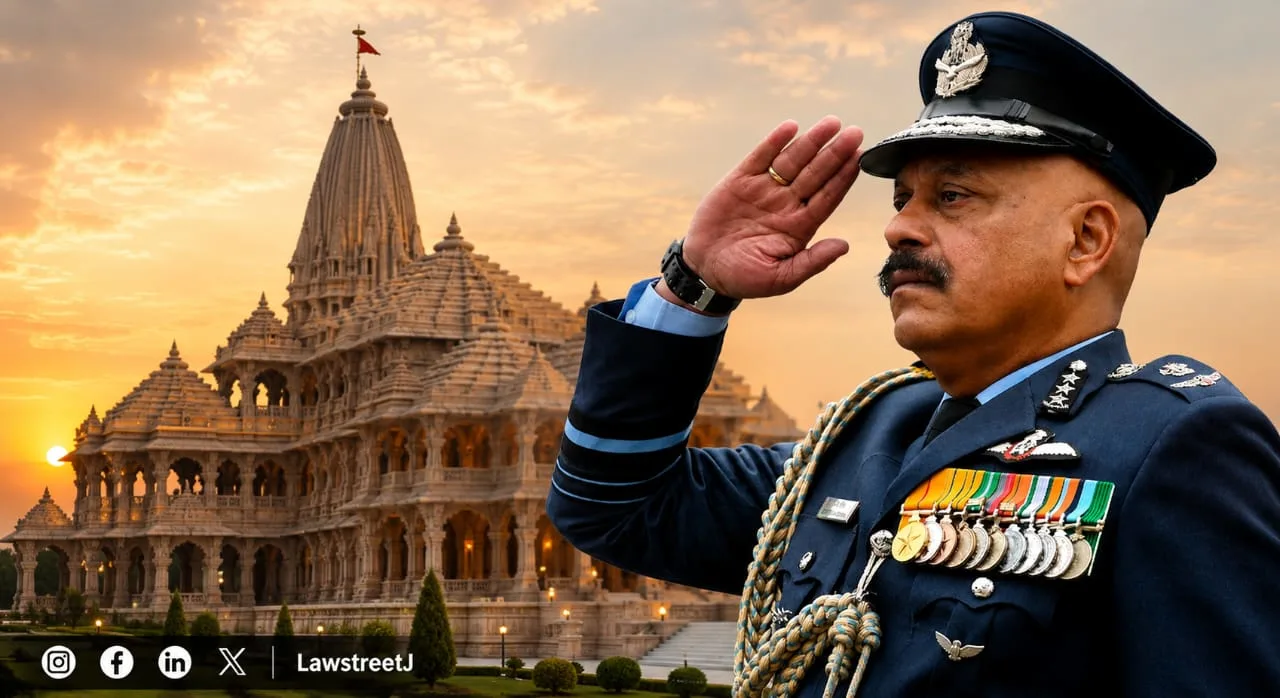

Ayodhya - A decorated Indian Air Force veteran who once commanded the skies during Operation Sindoor has now been handed charge of one of India's most visited religious sites on the ground. Retired Air Marshal Jeetendra Mishra has been appointed the first full-time Chief Executive Officer of the Shri Ram Janmabhoomi Teerth Kshetra Trust, the body that administers the Ram Temple in Ayodhya. The decision was taken unanimously during a Trust meeting held in Ayodhya on Wednesday, September 2, 2026, closing out a nearly two-month search that began with more than five thousand applicants and ended with a fighter pilot at the helm of temple administration.

The announcement was made public at a meeting held at Mani Ram Das Chhawani, the residence of Trust president Mahant Nritya Gopal Das, and attended by Ayodhya District Magistrate Shashank Tripathi among other senior office-bearers. What makes this reshuffle particularly significant is that the CEO's appointment was not the only major change to come out of that meeting. In the same sitting, the Trust elevated Swami Govind Dev Giri Maharaj to the post of General Secretary, the very position vacated by Champat Rai in June, while Mahesh Bhagchandka, one of three newly inducted trustees, was simultaneously handed charge as the Trust's new Treasurer. Alongside Bhagchandka, the Trust also inducted Ayodhya-based Madan Mohan Pandey and Shikohabad-based Nirmala Yadav as trustees, filling three vacancies that had opened up following the departures earlier this year.
From 5,585 Applicants to One: Inside the Selection Process

Few realise just how competitive the race for this newly created post actually was. The Trust had thrown open applications for the CEO's position in July, and the response overwhelmed even its own expectations, drawing 5,585 applications from across the country. What followed was a layered, almost military-style filtration process: 1,580 candidates were found eligible after paper scrutiny, only 108 made it through to an online interactive round, and just 16 finalists were called in for face-to-face interviews in Ayodhya. Interestingly, reports in the weeks leading up to the announcement had floated names like former IPS officer Rajesh Pandey and retired IAS officer Yogeshwar Ram Mishra as front-runners, underlining just how open the contest was until the very last stage.
The search committee steering this process was constituted on July 6, 2026, and was headed by retired Supreme Court judge Justice Pramod Kohli, with retired Lieutenant General Vishnu Kant Chaturvedi and former scientist Suresh Haware as members. After weeks of interviews, background checks and deliberation, the committee handed over a report running to 75 pages to Trust treasurer Govind Dev Giri on September 1, 2026, along with the names of three shortlisted candidates. The full Trust reviewed the recommendations the very next day and settled unanimously on the Air Marshal. Committee secretary Sameer Panda confirmed that all three finalists had been "highly qualified," which only underlines how closely contested the final decision was. Trust members, in a press briefing following the appointment, specifically highlighted his more than 39 years of distinguished service in the Air Force as the deciding factor behind entrusting him with the shift from military command to institutional leadership.
The Man Behind the Uniform: A Test Pilot, a War Medal, and a Middle-Class Upbringing
There is more to the new CEO than his most recent job title suggests, and much of it rarely makes the headlines. Commissioned into the Indian Air Force as a fighter pilot on December 6, 1986, he went on to become both a Fighter Combat Leader and an experimental Test Pilot a rare, high-risk specialisation reserved for officers who evaluate aircraft still being developed or modified. He trained at the National Defence Academy in Khadakwasla, the Air Force Test Pilots School in Bengaluru, the Air Command and Staff College in the United States, and the Royal College of Defence Studies in the United Kingdom, a training pedigree that places him among the IAF's most academically decorated officers.
Over nearly 39 years in uniform, he flew more than 18 types of aircraft and clocked over 3,000 flying hours, holding postings that ranged from squadron command to Deputy Chief of Integrated Defence Staff, first for Doctrine, Organisation and Training, and later for Operations. On January 1, 2025, he took over as Air Officer Commanding-in-Chief of the Western Air Command, succeeding Air Marshal Pankaj Mohan Sinha. Four months later, following the Pahalgam terror attack, he found himself directing one of the most consequential military operations in recent Indian history, Operation Sindoor, from that very command. For it, he was awarded the Sarvottam Yudh Seva Medal on Independence Day 2025, a decoration reserved exclusively for distinguished wartime service. What makes this honour genuinely rare is that it has been conferred on only ten officers across the Indian Armed Forces since it was instituted in 1980, and seven of those ten medals, including his, were awarded together in 2025 for Operation Sindoor, the first time the medal had been given out since the Kargil War. He also holds the Ati Vishisht Seva Medal from 2024 and the Vishisht Seva Medal from 2013, and he retired from active service on April 30, 2026.
Away from the cockpit, his story is a strikingly modest one. He comes from a middle-class family in Bhopatpura village, in the Bankata block of Bhatpar Rani tehsil, Deoria district, a village that lies barely a three-hour drive from Ayodhya, the temple town he will now help run. His father worked as a lecturer, a detail that has surfaced repeatedly in profiles of him this week as commentators note the symbolism of a small-town upbringing culminating in the administration of India's most prominent temple.
Why This Appointment Matters: The Donation Scandal That Preceded It
This appointment does not exist in a vacuum. It arrives roughly three months after allegations of embezzlement involving devotee donations rocked the Trust's administration. The controversy erupted in June 2026 over claims that cash offerings collected at the temple were being diverted during the counting process. The Uttar Pradesh government responded by setting up a three-member Special Investigation Team on June 13, 2026, led by Lucknow Divisional Commissioner Vijay Vishwas Pant, alongside Inspector General of Police Kiran S and Special Secretary (Finance) Neel Ratan Kumar.
A case was registered under multiple sections of the Bharatiya Nyaya Sanhita and the Prevention of Corruption Act. Eight people connected to the donation-counting process were arrested, CCTV footage examined by investigators reportedly showed several of them concealing cash bundles in their clothing during counting sessions. Close to Rs 80 lakh, precisely Rs 79,85,493, according to one court filing, was eventually recovered from the accused, and the investigation later expanded to scrutinise how the counting staff had been hired in the first place, along with the role of certain bank officials.
The fallout reached the very top of the Trust's administration. General secretary Champat Rai and trustee Anil Mishra resigned from their posts on June 27, 2026, with the Trust formally accepting the resignations in early July. Multiple public interest litigations followed in the Supreme Court, seeking a CBI-monitored probe and the preservation of evidence such as donation registers and bank records. The apex court declined to fast-track the matter but did direct the state to include an independent auditor in the SIT's investigation. By mid-August, the SIT's final report gave a clean chit to both Champat Rai and Anil Mishra, vindication that came after hundreds of seers in Ayodhya had publicly rallied in Rai's support. Around the same time, the Trust disclosed that it had spent close to Rs 3,264 crore on the temple's construction and related operations, part of a broader push toward financial transparency.
It is in this climate of scrutiny, resignation and reform that the Trust chose to create, for the first time in its history, a professional, full-time CEO role, while simultaneously restructuring its top leadership by elevating Swami Govind Dev Giri to General Secretary and installing Mahesh Bhagchandka as Treasurer. With three new trustees in place and a former fighter pilot now heading day-to-day administration, the temple's governance structure has undergone its most significant overhaul since the trust's formation in 2020, one where a man who once safeguarded India's western skies will now be responsible for the daily affairs of Ram Lalla's abode.