
KOLKATA — The Election Commission of India has broken the Trinamool Congress in two.
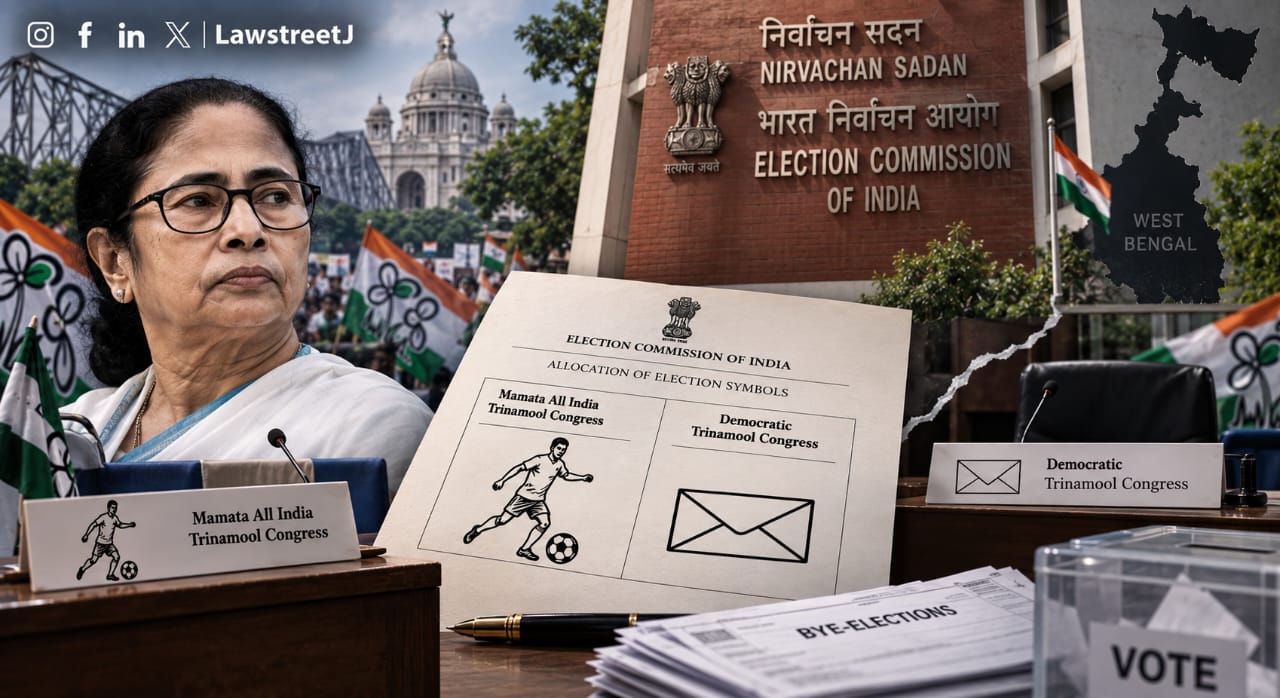
On Friday, September 18, 2026, the poll body formally allotted new names and symbols to the party's two warring factions, a decision that marks one of the sharpest institutional fractures West Bengal politics has seen in decades. Mamata Banerjee's group will now be known as "Mamata All India Trinamool Congress," running under the symbol of a football player. The rival camp, led by Ritabrata Banerjee, becomes "Democratic Trinamool Congress," contesting under an envelope. Both remain recognised political parties in West Bengal, Meghalaya and Tripura, just not under the name and symbol millions of voters have known for the better part of three decades.
This didn't happen overnight, and it didn't happen without a clear legal trigger. A day earlier, on Thursday, September 17, the Commission issued an interim order freezing both camps out of the original party name, All India Trinamool Congress, and its instantly recognisable "Flower and Grass" symbol, known in Bengali as "Jora Ghas Phul," until the underlying leadership dispute is settled through a full hearing. Friday's order was the direct follow-through on that freeze, giving both factions something concrete to actually campaign under in the interim, rather than leaving them in limbo with no usable identity at all heading into a live election cycle.
How a 28-Year-Old Party Ended Up Fighting Itself

The seeds of this crisis were planted in May 2026, when the Trinamool suffered a defeat in the West Bengal Assembly elections. That loss did something the party had never experienced across its entire history, dating back to January 1, 1998, when Mamata Banerjee walked out of the Indian National Congress to build her own political outfit from scratch. It split, for the first time in 28 years.
The defeat didn't just cost the party seats. It cracked open long-simmering tensions within its ranks, and by June, those tensions had a clear numerical winner. Fifty-eight rebel MLAs voted to install expelled leader Ritabrata Banerjee as Leader of Opposition in the West Bengal Assembly, rejecting the Mamata camp's own candidate for the post, veteran leader Sovandeb Chattopadhyay, in the process. That single vote is the reason the ECI's language this week reads the way it does.
The Commission has formally tagged Mamata Banerjee's group, which includes her nephew and longtime party general secretary Abhishek Banerjee, as the "original but minority" faction, acknowledging their historical claim to the party's founding leadership while noting they now command fewer legislators. Ritabrata's camp gets the opposite label, "rebel but majority," a designation that captures both its breakaway origin and its current numerical strength inside the Assembly. It is, in effect, a contest between legacy and numbers, and the ECI's own categorisation makes that tension explicit rather than papering over it.
The Symbol Fight Had Its Own Small Drama

Under Para 15 of the Election Symbols (Reservation and Allotment) Order, 1968, the ECI asked both factions to submit their preferred names and symbols ahead of Friday's ruling, and then picked from what each side offered rather than imposing entirely new options of its own.
Mamata Banerjee's side put forward three name options, Mamata All India Trinamool Congress, All India Trinamool Congress Mamata, and Trinamool Mamata Congress, alongside two possible symbols, a football player and a cricket bat. The Commission ultimately went with their first-choice name paired with the football player symbol, giving the faction a relatively clean outcome on both fronts.
Ritabrata Banerjee's camp had a slightly messier experience with the process. "The Election Commission approved the third choice given, 'Democratic Trinamool Congress'. Our first choice of symbol was the 'envelope' which was allotted," Ritabrata Banerjee said afterward, publicly acknowledging that his group's preferred name had been passed over twice before the Commission settled on their third option. He used the moment to push back at critics who had dismissively referred to his group simply as "the Ritabrata faction," framing the symbol allotment, if not the name, as a small vindication of his faction's standing.
This isn't just a symbolic reshuffling of letterheads. Both factions are about to test their actual strength at the ballot box, and soon.
The Nandigram and Rejinagar Assembly bypolls in West Bengal, located in East Midnapore and Murshidabad districts respectively, are scheduled for October 6, with vote counting set for October 9. Candidates from both camps will appear on ballots under their newly assigned names and symbols rather than the old flower-and-grass identity voters have relied on for decades to identify Trinamool candidates at a glance. Mamata's faction will also field a candidate in the Nagaon Lok Sabha bypoll in Assam, again contesting under the football player symbol rather than the party's traditional branding.
Returning officers overseeing all three constituencies have been directed to strictly enforce the Commission's order during the scrutiny of nominations and the formal allotment of symbols to candidates. There is no ambiguity built into the order and no room for either side to quietly revert to the old identity on ballot papers or campaign material during this interim period.
Reactions Split Exactly Where You'd Expect
Mamata Banerjee's camp is furious, and the reaction was immediate. The faction registered strong protest against the ECI's order almost as soon as it was announced, and it is not hard to understand why. Losing even temporary access to a name and symbol that has anchored the party's entire public identity since 1998 is no small blow for any political organisation, regardless of how the Commission's eventual final ruling on ownership plays out.
West Bengal's BJP unit, unsurprisingly, is enjoying watching its rival unravel. Party leaders described the decision as "divine justice," a line that says as much about how thoroughly this internal Trinamool crisis has already become fuel for opposition messaging as it does about the actual legal merits of the Commission's order. For a party that has spent years positioning itself as the primary challenger to Trinamool dominance in the state, a very public split within the ruling party's ranks, now formalised by the country's election authority, is about as favourable a talking point as it could hope for.
The bypolls will answer one question fairly quickly: does the "rebel but majority" faction's numerical strength inside the Assembly actually translate into votes on the ground, or does Mamata Banerjee's name and decades of personal political brand still carry more weight with ordinary voters than her camp's shrinking legislative numbers might suggest? Nandigram in particular carries symbolic weight, having been the site of a bruising and closely watched contest in West Bengal's 2021 election cycle, and a result there will likely be read as a bellwether for how the broader split is playing out with the electorate.
The bigger question, who permanently gets to keep the All India Trinamool Congress name and its flower-and-grass symbol once and for all, remains entirely unresolved. That ruling will take considerably longer to arrive, involving a fuller hearing of both sides' claims to the party's original identity, and it is ultimately the decision that will determine what West Bengal's political map looks like once this interim arrangement expires and the next full election cycle approaches.

![Calcutta HC Sets Aside Speaker’s Order; Declares Mukul Roy Disqualified Under Tenth Schedule From June 11, 2021 [Read Order]](/secure/uploads/2025/11/lj_6211_Calcutta_HC_Sets_Aside.jpeg)