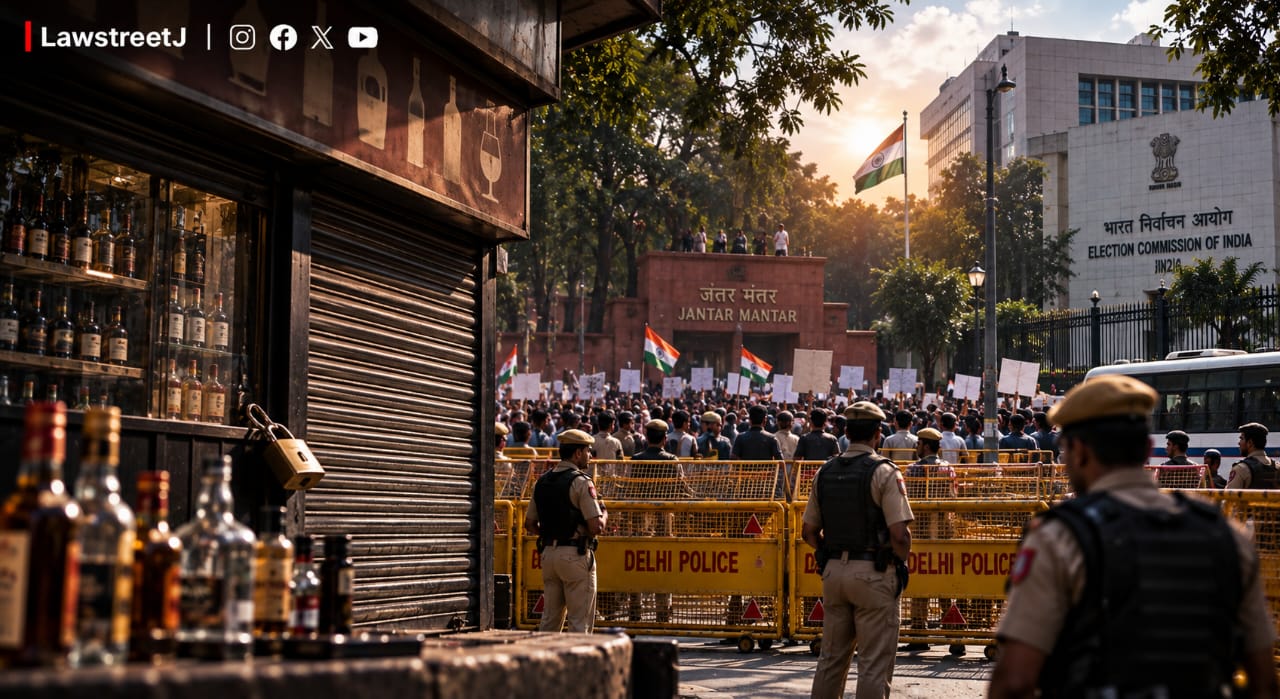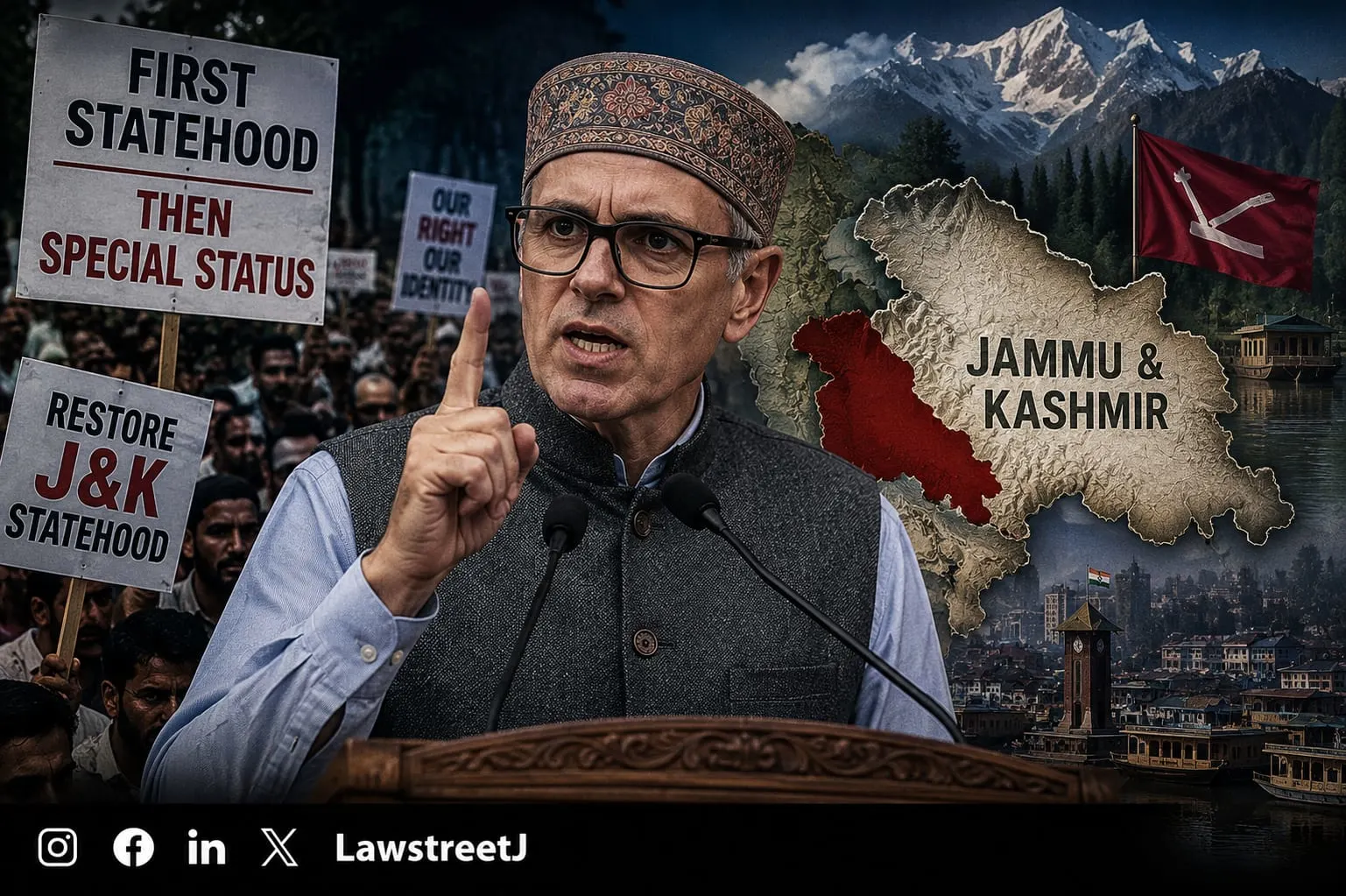

New Delhi / Srinagar: Jammu and Kashmir Chief Minister Omar Abdullah said on Monday that his party's political campaign would begin with the demand for statehood and eventually extend to the restoration of the region's special constitutional status, framing what he described as the beginning of a sustained, long-term movement rather than a one-day demonstration. The statement came even as police disrupted a National Conference protest at Jantar Mantar in New Delhi, where NC president Dr. Farooq Abdullah had gathered party leaders and workers on the opening day of the Monsoon Session of Parliament to demand what Omar Abdullah called the fulfilment of a promise made by the Centre before the 2024 elections.
"We won't leave our agenda. First statehood and then special status," Omar Abdullah said, calling the protest the beginning of a sustained campaign. He accused authorities of denying even a peaceful demonstration in the capital. "We have come to the capital of our country to demand what is rightfully ours. Unfortunately, even here we are not being allowed to hold a peaceful protest. Democracy is being strangled."
The protest, led by NC president Dr Farooq Abdullah, began at Jantar Mantar but was disrupted after permission was denied. Leaders attempted to move towards the Constitution Club, where Omar alleged police used tear gas as workers tried to continue.
A Promise Made Before the Elections and Not Yet Kept
The statehood demand is not new. What is new is the NC's decision, nearly two years into Omar Abdullah's government to take the campaign to Delhi's streets rather than continue to wait for the Centre to act.

The roots of the demand lie in the events of August 5, 2019, when the BJP-led Central government revoked Article 370, which had granted Jammu and Kashmir special constitutional status since 1949, and simultaneously bifurcated the erstwhile state into two Union Territories, Jammu and Kashmir, and Ladakh, both to be governed directly by the Centre through a Lieutenant Governor.
The Supreme Court, in its landmark judgment of December 11, 2023 upholding the revocation of Article 370, directed the Centre to conduct assembly elections in Jammu and Kashmir by September 30, 2024, and to restore statehood "at the earliest." The elections were held in September and October 2024, with the National Conference winning 42 of 90 seats and forming a government. After winning, Omar Abdullah called on Prime Minister Narendra Modi to fulfil his earlier promise of restoring Jammu and Kashmir's statehood, which was stripped in 2019. "Prime Minister had assured the people of Jammu and Kashmir that statehood would be restored. Now, with the conclusion of these elections, it is time for the government to live up to that promise," Omar said.
In a significant political development, the Jammu and Kashmir cabinet passed a resolution calling for the restoration of statehood during its first meeting under Chief Minister Omar Abdullah. The resolution was drafted by Omar Abdullah himself and urged the Central government to restore statehood at the earliest. He subsequently travelled to Delhi to formally present it to Prime Minister Narendra Modi.
Omar Abdullah went further in June 2025, saying he was ready to recommend the dissolution of the J&K Assembly if statehood was restored, an extraordinary offer that amounted to putting the Assembly's own existence on the table as a measure of how seriously he takes the demand.
On August 15, 2025, at Independence Day celebrations in Srinagar, Abdullah announced he would launch a door-to-door signature campaign to demand the restoration of Jammu and Kashmir's statehood, covering all 90 assembly segments over eight weeks. "From today, we will go door to door for a signature campaign on the restoration of statehood. If people are not ready to sign the document, I will accept defeat," he declared.
Exactly a year after taking oath as Chief Minister, Omar Abdullah renewed the demand, saying while his administration had stayed true to its electoral commitments, the Centre had yet to deliver on its pledge. "We were hopeful that the Centre would restore statehood within the first year of our government, but it has not happened. I once again appeal to the Prime Minister and his team to fulfil the promise made to the people of Jammu and Kashmir."
The July 20 protest in Delhi is therefore not a new position, it is a political escalation of a position that has been consistently articulated for nearly two years with no substantive response from the Centre.
What Statehood Would Legally Mean
The distinction between a Union Territory and a State in India's constitutional framework is fundamental and carries significant practical consequences for governance, legislative authority, and the protection of citizens' rights.
A full state under the Indian Constitution has an elected legislature with the power to legislate on subjects in the State List and the Concurrent List of the Seventh Schedule, a council of ministers headed by a chief minister that is collectively responsible to the legislature, and a governor who acts on the aid and advice of the elected government on state subjects. The High Court of the state has superintendence over all subordinate courts within its jurisdiction.
Jammu and Kashmir, as a Union Territory with a legislature, currently occupies an intermediate category. Its legislature can legislate on certain matters, but the Lieutenant Governor, a Central appointee, retains significant powers that override those of the elected government in key domains including public order, police, and the All India Services. The LG's executive powers in these domains mean that the elected government of Omar Abdullah cannot exercise the kind of authority over law enforcement and administration that the chief minister of a full state would normally have.
This governance asymmetry has been a consistent source of friction. The elected government has on multiple occasions been publicly at odds with the LG on administrative and law enforcement decisions, a friction that would be largely resolved by the restoration of full statehood, which would bring J&K under the standard constitutional framework under which elected governments have primacy over the administration they are accountable to.
Omar also reminded the Centre of its assurances in Parliament and before the Supreme Court that statehood would be restored "as soon as possible, at the earliest." The Supreme Court's direction is not legally binding on the Centre in the sense of imposing a specific deadline, the court used the phrase "at the earliest" rather than setting a date. But the political and moral weight of a Supreme Court direction issued in 2023, and still unimplemented nearly three years later, is the foundation of the NC's current campaign.
"First Statehood, Then Special Status": The Two-Step Agenda
Omar Abdullah said the NC's political campaign would begin with the demand for Jammu and Kashmir's statehood and eventually extend to the restoration of its special constitutional status. The explicit sequencing, statehood first, special status second is a carefully calibrated political position.
Statehood is, by itself, a constitutionally straightforward restoration of a category that J&K occupied before 2019 and that the Centre has already publicly committed to restoring. It does not require the reversal of the Article 370 abrogation, which the Supreme Court upheld. It is a demand that even some BJP-aligned voices have found difficult to publicly oppose, since the Centre itself made the commitment.
The restoration of "special constitutional status", which implicitly references the pre-2019 framework of Article 370 is a far more politically and constitutionally complex demand. The Supreme Court upheld the revocation of Article 370 as constitutionally valid. Any restoration of something analogous to that special status would require either a fresh constitutional amendment or a political negotiation of a kind that has no recent precedent in Indian constitutional history.
By sequencing statehood first and special status second, Omar Abdullah is making a demand that is politically defensible, constitutionally grounded, and practically achievable in the near term, while signalling to his constituency that the longer-term aspiration for a restored relationship between J&K and the Indian constitution goes beyond mere statehood.
The Centre's Position and the Road Ahead
The Union government has repeatedly stated that statehood will be restored "at an appropriate time", a formulation that has been consistent across ministerial statements but that has not been accompanied by a timeline, a set of conditions, or a formal legislative process. Home Minister Amit Shah stated in Parliament in 2023 that statehood would be restored after "normalcy" was achieved.
The definition of "normalcy" in a post-Article 370 J&K has not been formally articulated. Pahalgam attack of April 2025, which killed 26 people and triggered Operation Sindoor, was cited by the Supreme Court in August 2025 as a "ground reality" that petitioners should be mindful of while pressing the Centre on the statehood timeline, a reference that Omar Abdullah publicly rejected as inappropriate.
AAP MLA Mehraj Malik backed the demand at Monday's protest, saying every citizen of Jammu and Kashmir wanted statehood. "No MLA has come here for personal reasons. We are here to represent the sentiments of the people. This struggle for the rights of Jammu and Kashmir will continue," he said.
With the Monsoon Session of Parliament now under way and the NC's campaign formally escalated to the national capital, the political pressure on the Centre to provide a concrete response, not another "at an appropriate time" formulation has increased measurably. Whether that pressure translates into action before this Parliament session concludes will be among the most closely watched political developments in J&K in the months ahead.
![Pro Pakistan National Conference Leader Files Affidavit in Supreme Court Upholding Constitutional Provisions [Read Affidavit]](/secure/uploads/2023/09/lj_9984_45bb41a2-65b2-4702-9b8d-a13d04f4a05e.jpg)