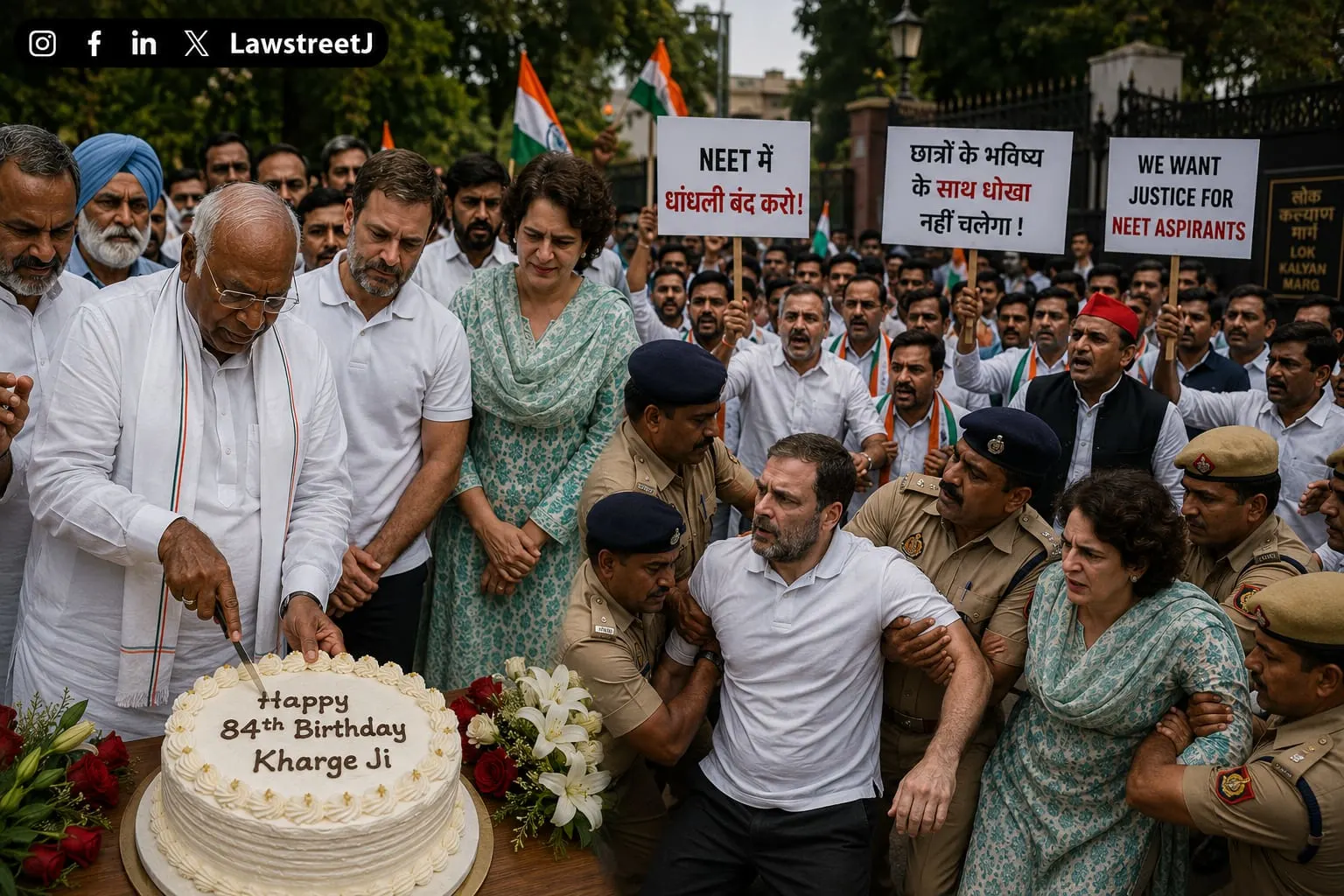
New Delhi: What began as a birthday gathering at Mallikarjun Kharge's residence on Rajaji Marg ended with Congress's Leader of the Opposition, his sister, and the chief of a major opposition party being physically removed by Delhi Police from outside the Prime Minister's residence, detained, processed, and eventually released hours later into the night.
July 21, 2026, the day after the Cockroach Janata Party's "Sansad Chalo" march left Delhi's streets marked with tear gas and lathi charge injuries was Mallikarjun Kharge's 84th birthday. Congress leaders, who had gathered to wish their president, converted the occasion into a political flash protest, marching from Kharge's home directly toward 7, Lok Kalyan Marg, the official residence of Prime Minister Narendra Modi.
How It Unfolded: From Rajaji Marg to Lok Kalyan Marg
The Congress intensified its campaign against the Centre by marching towards the Prime Minister's residence at Lok Kalyan Marg, a day after the Cockroach Janta Party-led demonstration over alleged NEET and other examination paper leaks. The march was led by Congress president Mallikarjun Kharge, Leader of the Opposition Rahul Gandhi, and Priyanka Gandhi Vadra.
The march was unannounced, described in the political press as a "flash protest", meaning no advance notice was given to Delhi Police and no permission was sought. The leaders made their way from Kharge's official residence in a group, with party workers and supporters joining along the route, swelling the numbers as they moved toward the Prime Minister's official home.
Kharge joined the protest at 7, Lok Kalyan Marg. Rahul Gandhi and Priyanka Gandhi marched near the PM's residence, demanding the PM's resignation. This represented an escalation of the demands beyond what the CJP had been seeking, the CJP's three stated demands were the release of Wangchuk, the resignation of Education Minister Dharmendra Pradhan, and compensation for NEET victims' families. Congress now added to those the resignations of Prime Minister Modi himself and Home Minister Amit Shah.
Before his detention, Rahul Gandhi appealed to people to join the protest, describing the police action against students as "an attack on every Indian family." He accused the government of avoiding accountability and demanded justice for the students.
The Negotiation and Its Breakdown
A senior government minister arrived at the protest site in what appeared to be an attempt to defuse the standoff through dialogue. According to Congress leaders, the discussions ended without any breakthrough. The minister later claimed Gandhi had initially agreed to call off the protest if the government allowed a parliamentary discussion on NEET and other examination paper leaks, but later added a new demand seeking the resignation of Union Education Minister Dharmendra Pradhan. Congress did not immediately respond publicly to the minister's claim before police dispersed the protest.
The breakdown of talks, whether because Congress shifted its position or because the government was unwilling to concede even a parliamentary discussion commitment, is disputed between the two sides. What is not disputed is the outcome.
The Detention: 6:40 p.m., Lok Kalyan Marg
Police detained Rahul Gandhi, Priyanka Gandhi, and several opposition leaders around 6:40 p.m. after Gandhi reportedly refused to leave the protest site. Samajwadi Party chief Akhilesh Yadav was also detained and removed from the protest site.
Visuals showed Congress leader and Leader of the Opposition Rahul Gandhi being forcibly escorted away from the protest site by police personnel. The images, of the Leader of the Opposition being physically removed from the vicinity of the Prime Minister's residence by Delhi Police circulated widely across social media and television news channels, becoming the defining visual of the day.
Rahul Gandhi later stepped up his criticism of the government, demanding the resignations of both Prime Minister Narendra Modi and Home Minister Amit Shah.
All the detained leaders were subsequently released from police custody. The Congress did not announce any specific further protest action for July 22 before the evening news cycle closed.
What Congress Is Demanding and Why July 21 Mattered
Congress's decision to convert Kharge's birthday gathering into a protest march was deliberately chosen for its optics. A birthday is a moment of celebration turning it into a political act of civil disobedience sends a signal that the party's leaders consider the moment serious enough to sacrifice a personal occasion for a political cause.
The demands Congress brought to the Prime Minister's doorstep on July 21 were: a parliamentary discussion on the NEET paper leak and examination irregularities; the resignation of Education Minister Dharmendra Pradhan; and added as the evening progressed, the resignations of Prime Minister Modi and Home Minister Shah.
The expansion of demands from Pradhan's resignation alone to the resignations of both the Prime Minister and Home Minister is a significant political escalation. It shifts the Congress framing from one of specific ministerial accountability, a demand that is bounded, concrete, and has a defined resolution, to one of government-wide culpability, which has no mechanism of resolution short of a general election and is therefore more a political statement than a negotiable demand.
Congress MP Karti Chidambaram said: "What the youth want is a fair opportunity to succeed. I think that because of the failure in the integrity of the examination, they are being cheated. So, Rahul Gandhi is alluding to that."
The Shiv Sena (UBT) said the ongoing agitation marks the beginning of a revolution, with "millions of cockroaches" joining the movement.
The Broader Pattern: NEET, CJP, and the Opposition's Political Strategy
The Congress flash protest on July 21 was the third major protest event in central Delhi in two days. July 20 had seen the CJP's "Sansad Chalo" march, with tear gas, lathi charges, 70-plus detentions, and Parliament adjourned four times. July 21 saw Congress take the same political energy and route it to the Prime Minister's doorstep, a direct escalation of the geographical and symbolic target of the agitation.
The pattern suggests a coordinated opposition strategy in which the student-led CJP movement provides the grassroots energy and public sympathy, while the mainstream opposition parties use that energy as cover and legitimacy for their own political demands. Whether that coordination is explicit or merely opportunistic is a question different political analysts are answering differently but the sequencing of the two protest events in consecutive days, with Congress explicitly citing the CJP march and the police action against it as part of its own rationale for marching, makes the political linkage undeniable.
The Monsoon Session of Parliament continues. The NEET issue remains unresolved on the floor of either house. Wangchuk remains hospitalised and fasting. The Education Minister has not resigned. And the Leader of the Opposition has now been detained outside the Prime Minister's residence, a fact that will be referenced in Parliament, in party literature, and in electoral messaging for the foreseeable future.

.jpeg)