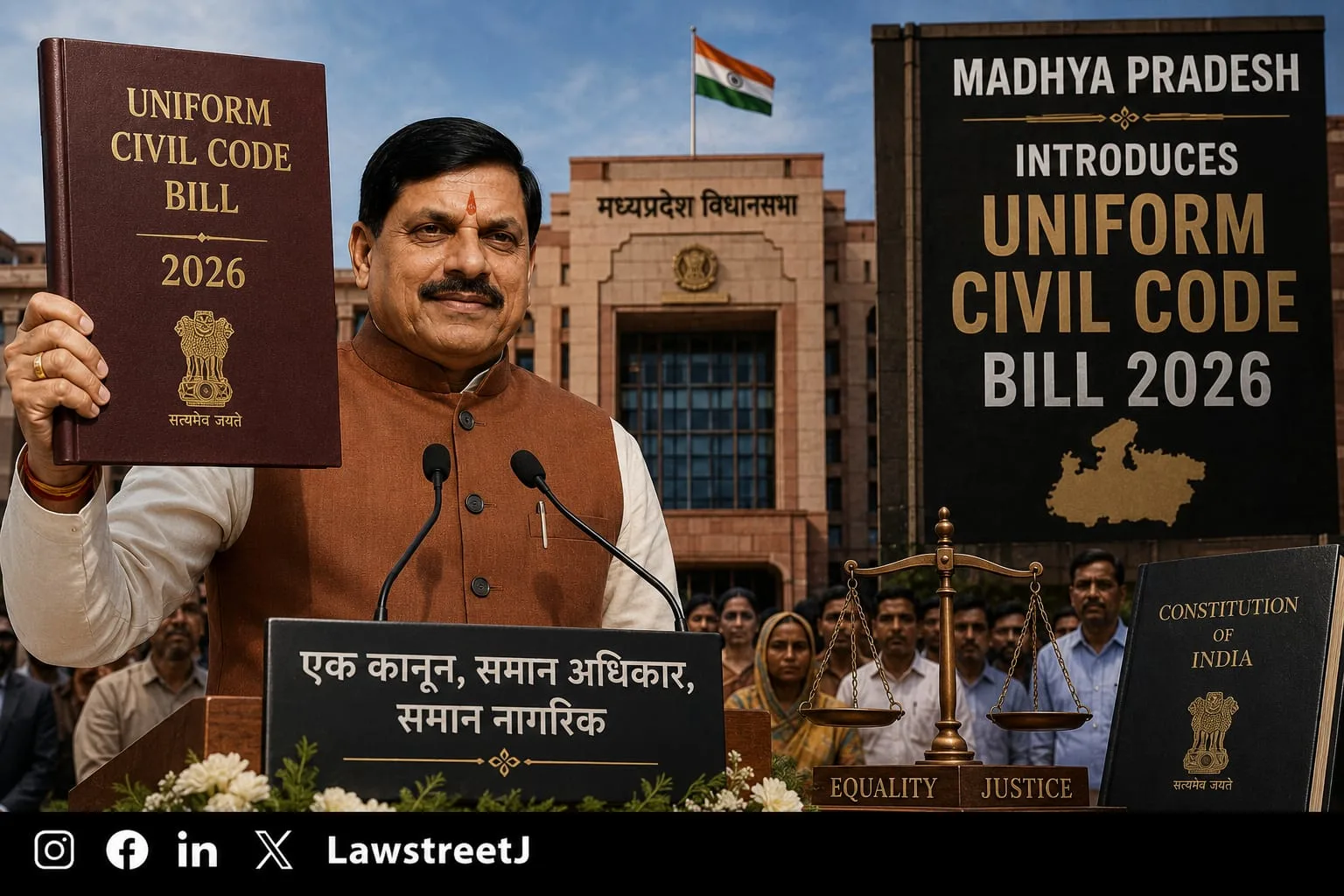

Bhopal: The Madhya Pradesh cabinet on Sunday unanimously approved the draft Uniform Civil Code 2026, paving the way for its introduction in the state legislative assembly during the Monsoon Session, which began on Monday July 20. State Minister Gautam Tetwal presented the Bill on the floor of the Assembly on Monday, following cabinet approval chaired by Chief Minister Mohan Yadav the previous day.
If passed into law, Madhya Pradesh will become one of the few Indian states to legislate a Uniform Civil Code, after Uttarakhand, the first and so far most comprehensively implemented state UCC and Gujarat, Assam and Goa. The Bill was prepared on the recommendations of a seven-member expert panel led by retired Supreme Court Justice Ranjana Prakash Desai, the same jurist who chaired the Uttarakhand UCC drafting committee, bringing continuity and legal rigour to the process.
Chief Minister Mohan Yadav, who chaired the cabinet meeting at the historic Jagdishpur Fort, previously known as Islam Nagar said the UCC was aimed at ensuring equal rights for every citizen. "Whether Ram or Rahim, the UCC has been brought to ensure equal rights for all," he told reporters.
What the UCC Bill Proposes: A Provision-by-Provision Account
Marriage: Monogamy Across All Communities
The Bill includes a complete ban on polygamy, triple talaq, and nikah halala, alongside mandatory registration for all marriages and divorces, with a clarified minimum marriage age of 21 for men and 18 for women.

Upon implementation, there will be compulsory registration of all marriages irrespective of religion. The Bill ensures that only monogamous relationships are recognised, restricting people from contracting other marriages while they still have an existing marriage that is legally binding. Practices like triple talaq and nikah halala will not be recognised within the new UCC. The objective is to ensure uniformity in the laws regarding marriage and divorce.
Chief Minister Yadav stated that divorce would not be granted by merely uttering "Talaq" thrice and would only be possible through a proper legal process. The Bill introduces a uniform judicial process for divorce applicable across all communities, replacing the multiple divorce frameworks currently operating under different personal laws.
Polygamy: Banned Across All Religions
The Bill seeks to prohibit polygamy and simultaneously multiple marriages across all communities. This provision is directed most significantly at Islamic personal law, under which a Muslim man may marry up to four wives subject to conditions, but it applies equally across all communities, including provisions that currently permit certain forms of plural marriage under customary tribal law, though Scheduled Tribes are separately exempted from the Act's provisions.
Triple Talaq and Nikah Halala
Triple talaq, the practice of instantly dissolving a marriage through the repetition of the word "talaq" three times, was already criminalised at the national level through the Muslim Women (Protection of Rights on Marriage) Act, 2019, which made the practice a cognisable and non-bailable offence. The MP UCC Bill goes further by refusing to recognise any such dissolution as valid for civil law purposes, meaning a marriage attempted to be dissolved through triple talaq would remain legally intact under the UCC framework regardless of the criminal law position.
Nikah halala, the practice under which a woman who has been divorced through triple talaq and wishes to remarry her original husband must first marry a second man, consummate that marriage, and be divorced by him, is similarly barred from recognition under the UCC.
Inheritance: Equal Rights for Men and Women
The Bill includes equal inheritance rights for men and women. Under the Hindu Succession Act as amended in 2005, daughters already have equal inheritance rights in ancestral property. The UCC Bill extends this principle to cover communities whose personal laws still provide unequal inheritance, most significantly, Islamic personal law under which daughters typically receive half the share of sons in inheritance. The UCC would replace these differential frameworks with a single inheritance structure applicable across communities.
Live-In Relationships: Registration Made Mandatory
There is a provision for compulsory registration of live-in relationships. According to the State government, the process of registering the live-in relationship is expected to ensure clarity about the rights and duties of the parties concerned.
The Bill provides for imprisonment and fines for violations of provisions related to live-in relationships. The specific regulatory framework covers requirements for couples in live-in relationships to register their relationship with relevant authorities, with the stated objectives of protecting the legal rights of both parties and establishing the legal status of children born from such relationships.
Legal recognition is provided for children born from live-in relationships. Under existing law, children born outside registered marriage occupy an uncertain legal position in many community-specific personal law frameworks. The UCC Bill establishes that such children have full and equal legal standing for purposes of maintenance, inheritance, and succession.
Adoption
The Bill introduces a uniform framework for adoption applicable across communities. Currently, adoption law varies significantly by religion, Hindu law permits adoption under the Hindu Adoptions and Maintenance Act, 1956, while Muslim personal law does not formally recognise adoption in the same sense, instead recognising the institution of kafalah, which is guardianship rather than full legal adoption. The UCC Bill would bring adoption under a single framework.
Who Is Exempted: Scheduled Tribes and Constitutional Protections
The law will not apply to Scheduled Tribes notified under Article 342 of the Constitution. Furthermore, communities whose traditional rights are protected under Part XXI of the Constitution have also been specifically exempted.

Scheduled Tribes in Madhya Pradesh including the Bhil, Gond, Korku, Baiga, Sahariya, and Bharia communities, are exempted from the provisions of the UCC Bill, allowing them to continue following their customary laws and traditions.
The exemption of Scheduled Tribes is constitutionally significant and mirrors the approach taken in Uttarakhand's UCC. The tribal communities of central India have rich and distinct customary legal traditions governing marriage, divorce, inheritance, and property, traditions that are constitutionally protected under Fifth Schedule provisions and under various state Acts that codify tribal customary law. Subjecting these communities to a UCC without their informed participation and consent would raise serious constitutional questions under Articles 13(3) and 342 read with Fifth Schedule protections.
The Uttarakhand UCC, in its first year of implementation after coming into force on January 27, 2025, similarly exempted Scheduled Tribes and implemented an amendment ordinance in January 2026 to make procedural, administrative, and penal improvements.
The Legislative Debate: What the Opposition Said
The Congress party criticised both the method of tabling the Bill and its provisions. The Bill was introduced during the ongoing Assembly proceedings and was not part of the original session agenda.
Congress MLA Atif Aqueel argued that Muslims should receive an exemption from the UCC similar to that granted to Scheduled Tribes, stating: "Babasaheb and the Constitution have granted us freedom. Since that freedom exists, just as the ST community was exempted from the UCC, Muslims should also be exempted." He also challenged the government's drafting methodology.
Congress MLA Masood questioned the live-in relationship provisions, asking: "Why are live-in relationships allowed? Ban marriage instead! You are making something that is legally valid illegal. This will not work. Live-in relationships are being allowed while marriage is being restricted, what kind of logic is that?"

This particular argument, that regulating live-in relationships through a UCC framework simultaneously legitimises and burdens them reflects a genuine legal tension in the Bill's approach. By mandating registration of live-in relationships, the government is simultaneously acknowledging their legal existence and subjecting them to state scrutiny in a way that critics argue may deter such relationships rather than protect the parties within them.
The All India Muslim Personal Law Board, which has opposed every state-level UCC proposal, reiterated its position that the UCC is against Shariah and against the constitutional rights of minorities. The Board's argument rests on Articles 25 and 26 of the Constitution, which guarantee the freedom to practise, profess, and propagate religion and the right of every religious denomination to manage its own affairs in matters of religion.
The Constitutional Framework: Article 44 and the State's Authority
Article 44 of the Directive Principles of State Policy encourages the State to strive for a Uniform Civil Code for all citizens. The Directive Principles, contained in Part IV of the Constitution, are not justiciable — they cannot be enforced by courts — but they constitute the aspirational framework within which legislation is assessed. A state government legislating a UCC is acting within the spirit of Article 44 and, by invoking that provision, claiming a constitutional mandate for the reform.
The question of whether a state government can legislate on matters covered by personal laws — which are generally treated as falling within the Concurrent List of the Seventh Schedule — involves complex constitutional issues about the intersection of Entry 5 of the Concurrent List (marriage, divorce, and certain related matters) and the personal law regime that has historically governed those areas. Uttarakhand's UCC Act has been challenged before the Uttarakhand High Court on these grounds, with the case still pending. That challenge will inform whether any legal challenge to the Madhya Pradesh UCC proceeds on similar grounds.
The Broader Pattern: BJP States and the UCC
Madhya Pradesh's introduction of the UCC Bill is the latest in a consistent pattern of BJP-governed states advancing UCC legislation as a political and constitutional priority.
Uttarakhand enacted India's first comprehensive state-level UCC in March 2024, which came into force on January 27, 2025. In its first year, over 80,000 marriages and live-in relationships were registered under the framework. Gujarat introduced its UCC in 2025. Assam has enacted legislation covering specific aspects of the UCC framework. Goa has had its own distinct civil code, inherited from Portuguese colonial law and preserved through the Goa, Daman and Diu (Administration) Act, which serves as a de facto UCC for Goan residents.
With Madhya Pradesh now tabling its Bill, the UCC has ceased to be a purely aspirational constitutional provision and is becoming an active legislative reality in an increasing number of Indian states, a development that makes the eventual question of a national UCC increasingly a matter of political timing rather than legal possibility.

![Supreme Court Frees Death Row Convicts Due to Flawed Investigation in 2013 Kidnap Murder Case [Read Judgment]](/secure/uploads/2023/09/lj_8975_1adddeb4-b0a7-46df-a9cc-4af7ecac44ec.jpg)
![Supreme Court Upholds Stringent Standards for Police Employment, Rejects Man's Plea After POCSO Act Acquittal in Madhya Pradesh [Read Judgment]](/secure/uploads/2023/09/lj_4880_7f215c01-85ff-4067-aba6-2efff4635636.jpg)
.jpeg)