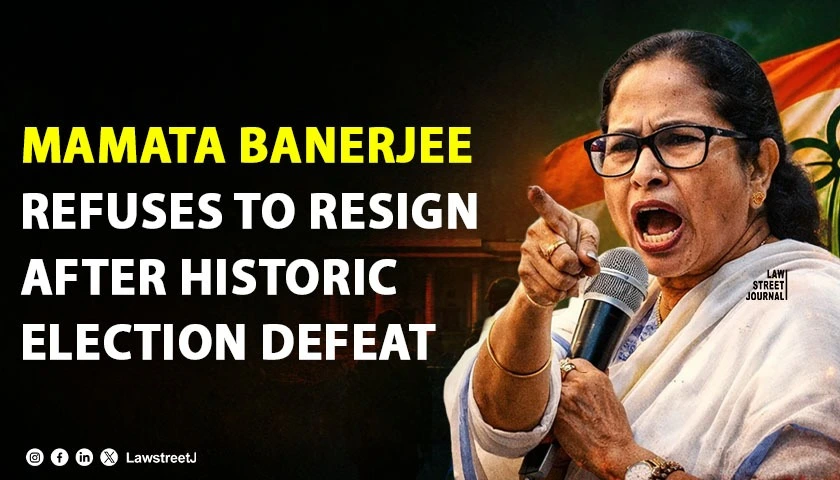
In a development that has no direct precedent in the recent political history of India, outgoing West Bengal Chief Minister and Trinamool Congress supremo Mamata Banerjee has publicly refused to submit her resignation following her party's comprehensive defeat in the 2026 West Bengal Legislative Assembly elections. The announcement, made at a press conference on Tuesday, has triggered a fresh wave of constitutional debate across the country, with legal experts and political observers weighing in on the implications of a sitting chief minister declining to follow the conventions that ordinarily govern the transfer of power after an election.
The election results, declared on May 4, 2026, delivered a decisive verdict. The Bharatiya Janata Party secured a commanding 207 seats in the 294-member West Bengal Legislative Assembly, while the Trinamool Congress was reduced to just 80 seats. The majority mark stands at 147. Smaller parties remained largely peripheral in the final tally, with the Congress and Aam Janata Unnayan Party picking up two seats each. The scale of the defeat marks the end of fifteen years of uninterrupted TMC rule in the state.
The Election Results and What Happened at Bhabanipur
West Bengal's polling was held in two phases, on April 23 and April 29. The counting of votes took place on May 4, 2026, across 77 counting centres spread throughout the state.
Perhaps the most symbolically significant result of the election came from the Bhabanipur constituency, long considered a stronghold of Mamata Banerjee herself. In a decisive outcome, BJP's Suvendu Adhikari defeated Banerjee by a margin of 15,105 votes. Adhikari secured 73,917 votes against Banerjee's 58,812. This was the very seat that Banerjee had previously won in a by-election in 2021 after losing the Nandigram constituency to Adhikari in that year's state assembly polls.
The defeat at Bhabanipur is particularly significant because it means that Banerjee is no longer a member of the state legislature. Banerjee also lost the high-profile Bhabanipur seat to BJP's Suvendu Adhikari. Losing her own seat while her party recorded its worst electoral performance in over a decade has placed Banerjee in an especially difficult constitutional position, separate from the question of her resignation as Chief Minister.
The Election Commission of India also confirmed that repoll was ordered in 15 booths across two constituencies, Magrahat Paschim and Diamond Harbour on May 2, 2026, following complaints about irregularities. Additionally, due to heavy breaching of election procedures and EVM tampering, the entire assembly constituency of Falta was scheduled for a repoll on May 21, with counting and results on May 24.
Banerjee's Refusal: What Was Said and What Was Alleged
At her press conference on Tuesday, Mamata Banerjee made her position unambiguous. She ruled out stepping down, claiming that the verdict was not a genuine public mandate but the result of a conspiracy. Her exact statement, as reported by multiple news organisations, was: "I have not lost, so I will not go to Raj Bhavan. I will not tender my resignation." Banerjee alleged large-scale irregularities in the counting process, claiming that the mandate in nearly 100 seats was "looted" and that counting was deliberately slowed down to demoralise her party. She further maintained that the TMC had won the election morally and that the officially declared results did not reflect the true will of the electorate.
She also accused the Election Commission of India of bias, saying votes were looted, and claimed that the BJP's victory was unjust. She reiterated her stance on Tuesday, saying that her fight was with the poll body and not against the BJP. Tensions escalated at the Sakhawat Memorial counting centre, where BJP representatives accused Banerjee of violating Election Commission protocols by entering without proper identification and carrying a mobile phone into a restricted zone.
By contrast, the two other prominent chief ministers who faced election defeats on the same day took a different path. Unlike Mamata Banerjee, both Pinarayi Vijayan of Kerala and M.K. Stalin of Tamil Nadu resigned from their chief ministerial posts immediately after their respective results. The contrast has been widely noted by constitutional scholars and the media.
The Legal and Constitutional Framework
The constitutional question at the centre of this situation is whether a chief minister is legally obligated to resign after their party loses a legislative assembly election, and what happens if they do not.
In the event of a chief minister's resignation, which conventionally occurs after a general election or during a phase of assembly majority transition, the outgoing chief minister holds the informal title of "caretaker" chief minister until the governor either appoints a new chief minister or dissolves the assembly. The critical word here is "conventionally." There is no specific provision in the Indian Constitution that mandates a sitting chief minister to resign upon their party's election loss. The obligation is rooted in parliamentary convention and democratic practice, not in an explicit statutory or constitutional directive.
Under Article 164 of the Constitution, the Chief Minister is appointed by the Governor. The term of the Chief Minister is not fixed and he or she holds office during the pleasure of the Governor. However, this pleasure operates within defined constitutional limits. The Chief Minister and other Ministers hold office during the pleasure of the Governor, but in practice the Chief Minister stays in office until he or she enjoys majority in the House. When the House passes a vote of no-confidence, he or she has to resign. The incoming legislature has yet to be convened. Until the new assembly meets and a floor test or confidence vote takes place, the constitutional machinery continues to operate. Political critics have already raised questions about whether Banerjee is planning to approach the court regarding her complaints. However, it is as yet unclear what action will be taken by the Raj Bhavan if she does not resign as per procedure.
Another legal provision that has been discussed in this context is Article 164(4) of the Constitution. Article 164(4) provides that a minister who is not a member of the legislature for a period of six consecutive months shall cease to be a minister at the end of that period. Since Banerjee has lost her own Bhabanipur seat, she is no longer a member of the West Bengal Legislative Assembly. Under this provision, even if she were to remain in office without resigning, she would be constitutionally required to secure election to the legislature within six months or vacate the post of Chief Minister automatically.
Under Article 356 of the Constitution of India, if a state government is unable to function according to constitutional provisions, the Union government can take direct control of the state machinery. Whether circumstances reach that point will depend on the Governor's actions and how the formation of the new government proceeds. Prime Minister Narendra Modi hailed the BJP's sweeping victory in West Bengal as a "historic fulfillment." The BJP has announced that the new Chief Minister of West Bengal will be sworn in on May 9, which coincides with Rabindra Jayanti.
The situation continues to evolve rapidly. As of the morning of May 5, 2026, Mamata Banerjee has not submitted her resignation to the Governor's office. The constitutional clock on the new government formation has begun, and the Raj Bhavan is expected to act in accordance with established procedure in the days ahead. The political and legal developments in West Bengal over the coming week are being watched closely across the country.

![Calcutta High Court judge directs Supreme Court's Secy Gen to produce transcripts of his interview [Read Order]](/secure/uploads/2023/04/lj_1579_7e4dbb08-78fb-4ca1-9c70-c7173a6c80a9.jpg)
![BREAKING: "Grossly disappointed" on Sandeshkhali sexual assaults, Calcutta HC takes suo motu cognizance [READ ORDER]](/secure/uploads/2024/02/lj_6301_ac5d1dbf-6b90-4dd3-b485-5c7a8fe5112f.jpg)
![AIBA cautions West Bengal about President's Rule over Sandeshkhali [Press Release]](/secure/uploads/2024/02/lj_4198_Presidents-Rule-in-West-Bengal.webp)