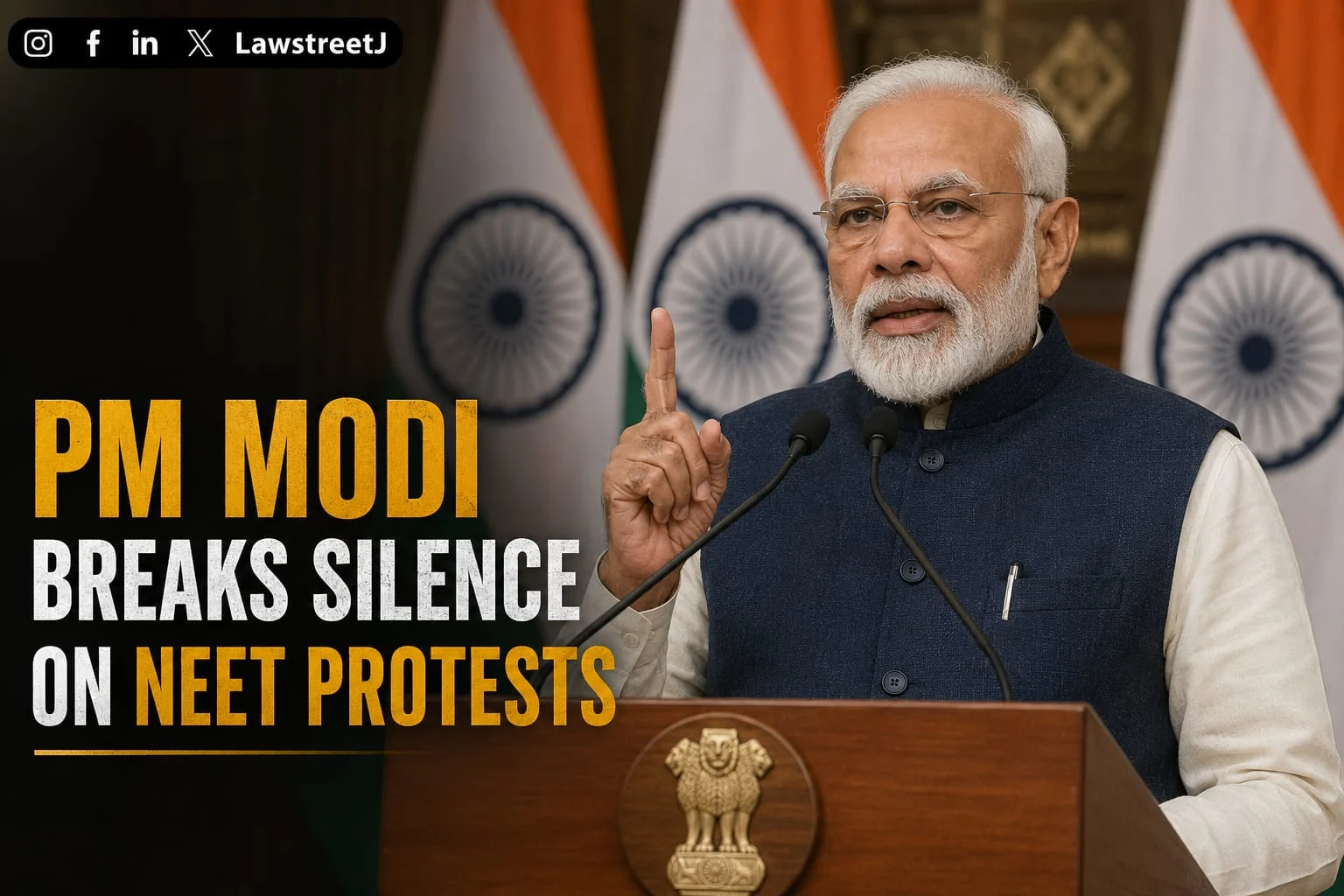
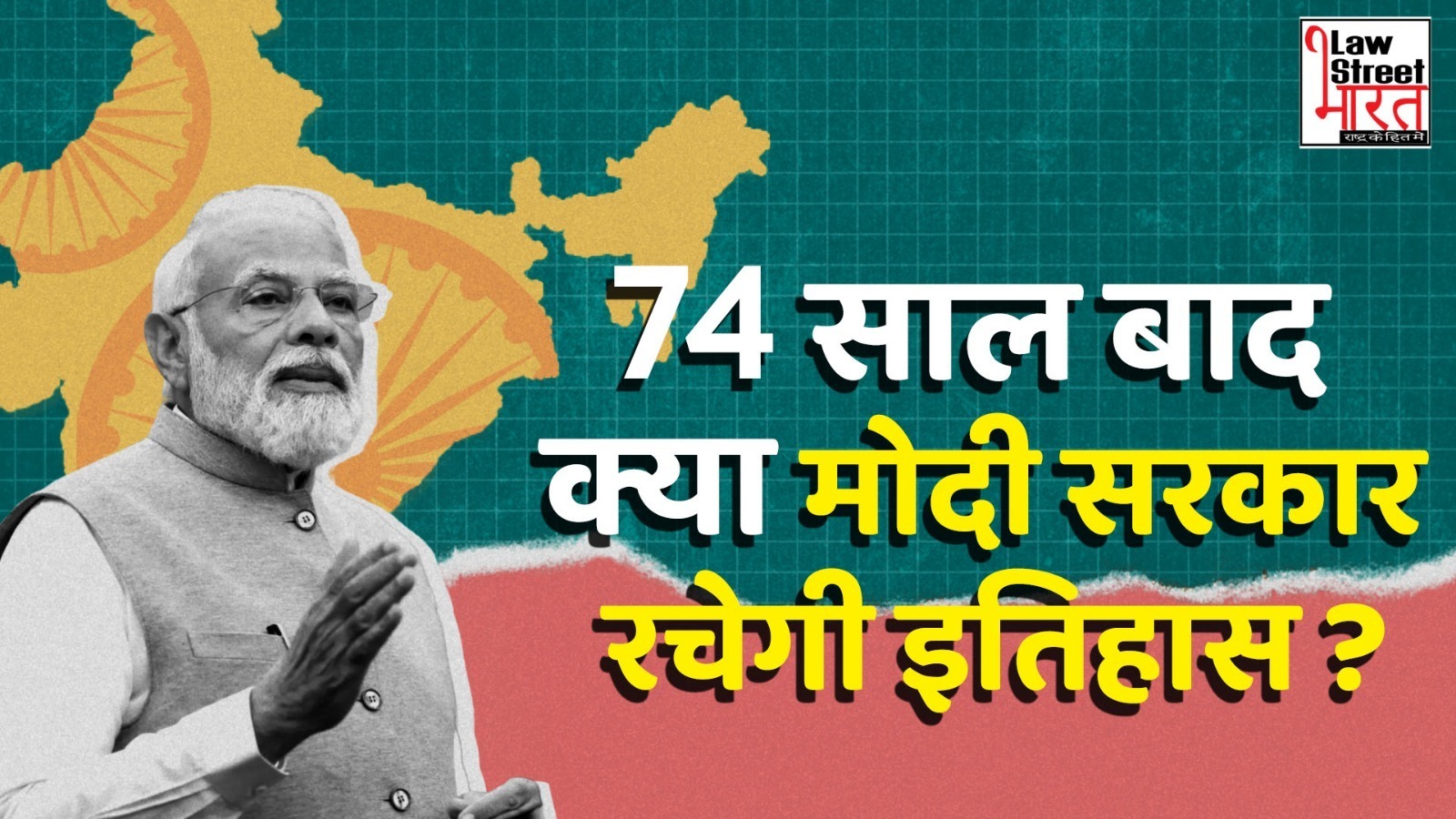
New Delhi: July 23, 2026 Three days after tear gas outside Parliament. Two days after the Leader of the Opposition was physically removed from the Prime Minister's doorstep. One day before the Lok Sabha is due to debate the NEET paper leak. Prime Minister Narendra Modi posted on X on Thursday morning and broke what had been a studied public silence on the controversy that has consumed India's streets and its Parliament since July 20.

"Nothing is more important than the welfare and future of our youth! We have decided to set up fast-track courts to ensure swift and stringent punishment for those involved in paper leaks. Have directed the concerned authorities and officials to take all necessary steps in this regard," Modi wrote on X on July 23, 2026.
The post is the Prime Minister's first direct, public engagement with the NEET controversy at the level of personal statement and it represents a significant calibration of the government's public posture on an issue that has so far been communicated through ministers and spokespeople rather than the Prime Minister himself.
What Modi Said: The Full Statement
The post on X, published on the morning of July 23, the fourth day of the Monsoon Session, contained three distinct elements.
The first was the opening declaration: "Nothing is more important than the welfare and future of our youth." The framing is deliberate, it appropriates the moral centre of the student protest movement, which has consistently positioned itself as a voice for India's youth, and places the Prime Minister on the same side of that value proposition.
The second was the policy announcement: fast-track courts specifically for paper leak cases. The establishment of fast-track courts in India does not require fresh legislation, the Supreme Court has encouraged their creation, and the government can direct their constitution through the High Courts under existing judicial infrastructure. The announcement is therefore immediately actionable and signals that the Prime Minister is treating the paper leak as a criminal justice matter requiring accelerated prosecution rather than merely an administrative failure requiring examination reform.
The third was the directive: "Have directed the concerned authorities and officials to take all necessary steps in this regard." This framing, "I have directed", places accountability for implementation squarely on the executive machinery while positioning the Prime Minister as the driving force behind action rather than someone reacting to external pressure.
What Kiren Rijiju Said on Modi's Behalf: The Parliamentary Context
Before Modi posted on X, Parliamentary Affairs Minister Kiren Rijiju outlined the government's position in Parliament, communicating what he described as the Prime Minister's response to the NEET controversy.
On the NEET examination, Rijiju said the Prime Minister indicated the government acted immediately after reports of irregularities surfaced, leading to the arrest and imprisonment of 13 individuals. He added that, keeping students' futures as the top priority, a re-examination was conducted promptly and the results were declared without delay.
Rijiju added that the Prime Minister also outlined the stringent measures being implemented to prevent future paper leaks.
The government's position as outlined by Rijiju contains three claims: that the government acted swiftly upon discovering the irregularities; that 13 people have been arrested and imprisoned in connection with the paper leak; and that the retest was conducted promptly. These claims are being contested by opposition parties, who argue that the retest did not address the underlying systemic failures in the NTA's examination conduct framework and that 13 arrests do not constitute accountability at the ministerial level.
The Four-Day Context: Why Modi's Post Matters Now
The timing of the Prime Minister's X post is as significant as its content. Modi did not post on July 20, the day of the "Sansad Chalo" march, the tear gas, and the four adjournments of Lok Sabha. He did not post on July 21, the day Rahul Gandhi, Priyanka Gandhi, and Akhilesh Yadav were detained outside his official residence. He did not post on July 22, the day Parliament continued to be disrupted and the NEET issue dominated proceedings across both houses.
He posted on July 23, the fourth day of the session, the day Lok Sabha is set to debate the Supreme Court (Number of Judges) Amendment Bill and the day Congress MP KC Venugopal has given an Adjournment Motion Notice specifically over the NEET-UG paper leak and the police lathi charge during the July 20 protest.
The sequencing suggests the post is a response to two simultaneous pressures that have been building for four days: the street-level protest pressure from the CJP and allied movements, and the parliamentary pressure from the opposition, which has effectively prevented substantive legislative business from being conducted in the Monsoon Session's first week.
What the CJP Said in Response
The Cockroach Janata Party's response to Modi's post was measured but pointed. The party welcomed the fast-track court announcement as an acknowledgment that criminal wrongdoing had occurred in the NEET paper leak, but immediately noted that the announcement addresses the prosecution of alleged leakers, not the accountability of the minister under whose watch the leak occurred.
CJP's three demands remain unchanged: Sonam Wangchuk's unconditional release from Safdarjung Hospital, the resignation of Education Minister Dharmendra Pradhan, and Rs 1 crore compensation for families of NEET aspirants who died by suicide. None of those three demands are addressed by the fast-track court announcement.
Thousands of young people have continued to join the protests, with crowds swelling in support of the movement that has cornered the Modi government since the police crackdown on protesters during the Parliament March on July 20.
What the Opposition Said
Congress and the INDIA alliance parties read Modi's post as a political defensive manoeuvre rather than a substantive response to the NEET controversy. Their argument is that the fast-track court announcement, while welcome in principle, does not resolve the central demand for ministerial accountability and that a minister who presides over a systematic failure of the examination infrastructure cannot deflect responsibility by directing the prosecution of exam paper leakers.
The comparison they draw is a familiar one in Indian political discourse: when a minister's portfolio fails, the convention of collective ministerial responsibility, which holds that a minister is responsible to Parliament for the conduct of their department requires accountability at the political level, not merely at the level of the officials or private actors who committed the specific acts.
The BJP, meanwhile, has announced that NDA Members of Parliament will gather at Makar Dwar of Parliament on Thursday to stage a counter-protest against Congress, specifically in response to the Congress sit-in outside the Prime Minister's residence on July 21. The staging of a ruling party protest against the main opposition party, inside Parliament premises, on the fourth day of a Monsoon Session that has barely conducted any legislative business, captures the degree to which the NEET controversy has paralysed the normal functioning of India's legislature.
The Fast-Track Court Announcement: What It Actually Means
Fast-track courts in India are specialised courts constituted with the express purpose of disposing of specific categories of cases more quickly than the regular court system allows. The Supreme Court of India has, on multiple occasions, directed High Courts to establish fast-track courts for heinous offences, sexual violence cases, and cases involving public servants accused of corruption. The mechanism is well-established.
In the NEET context, the CBI is already investigating the paper leak. Thirteen individuals have been arrested and are in judicial custody. The cases will move through the criminal justice system on the standard timeline unless fast-track courts are specifically constituted and the cases transferred to them. Modi's announcement, if implemented, would accelerate that timeline significantly, potentially meaning that the paper leak accused face trial and judgment within months rather than years.
What a fast-track court cannot do is determine ministerial accountability, resolve the structural failures in the NTA's examination conduct framework, or compensate the families of students who took their own lives in the aftermath of the leak. Those are administrative, political, and legislative matters and the Prime Minister's post on X, whatever its political significance, does not address any of them.
The conversation between the government and the students it says nothing is more important than the youth of India, has not ended. It has only moved, on July 23, from the streets of central Delhi to a post on X. Whether that constitutes dialogue, the CJP and its millions of supporters are not yet prepared to say.

.jpeg)