Kolkata: West Bengal's newly elected Bharatiya Janata Party government passed two landmark public order laws on June 29, 2026, which came into force at midnight on July 13. The West Bengal Public Safety and Control of Anti-Social Activities Act, 2026, widely referred to as the Gunda Daman Act and its companion legislation, the West Bengal Maintenance of Public Order (Amendment) Act, 2026, represent the most significant overhaul of the state's public safety legal framework in decades, and the first major legislative intervention of a BJP government in a state that had been governed by the Trinamool Congress for fifteen consecutive years.
The BJP, which won the April 2026 West Bengal Assembly elections in a historic landslide, winning 215 of 294 seats in the most consequential state election of the year had campaigned explicitly on a law-and-order platform that promised to bring to Bengal a framework similar to the Uttar Pradesh model of anti-crime legislation. Chief Minister, addressing a gathering in Murshidabad on the eve of the law's commencement, announced the government's "zero tolerance policy against all kinds of vandalism." Within days, district police administrations across the state received formal notifications and began enforcement.
The bills passed 176 to 41 in the assembly, reflecting the ruling party's dominant majority. The Acts received the Governor's assent and came into force at midnight on July 13.
What the Law Actually Does: A Provision-by-Provision Account
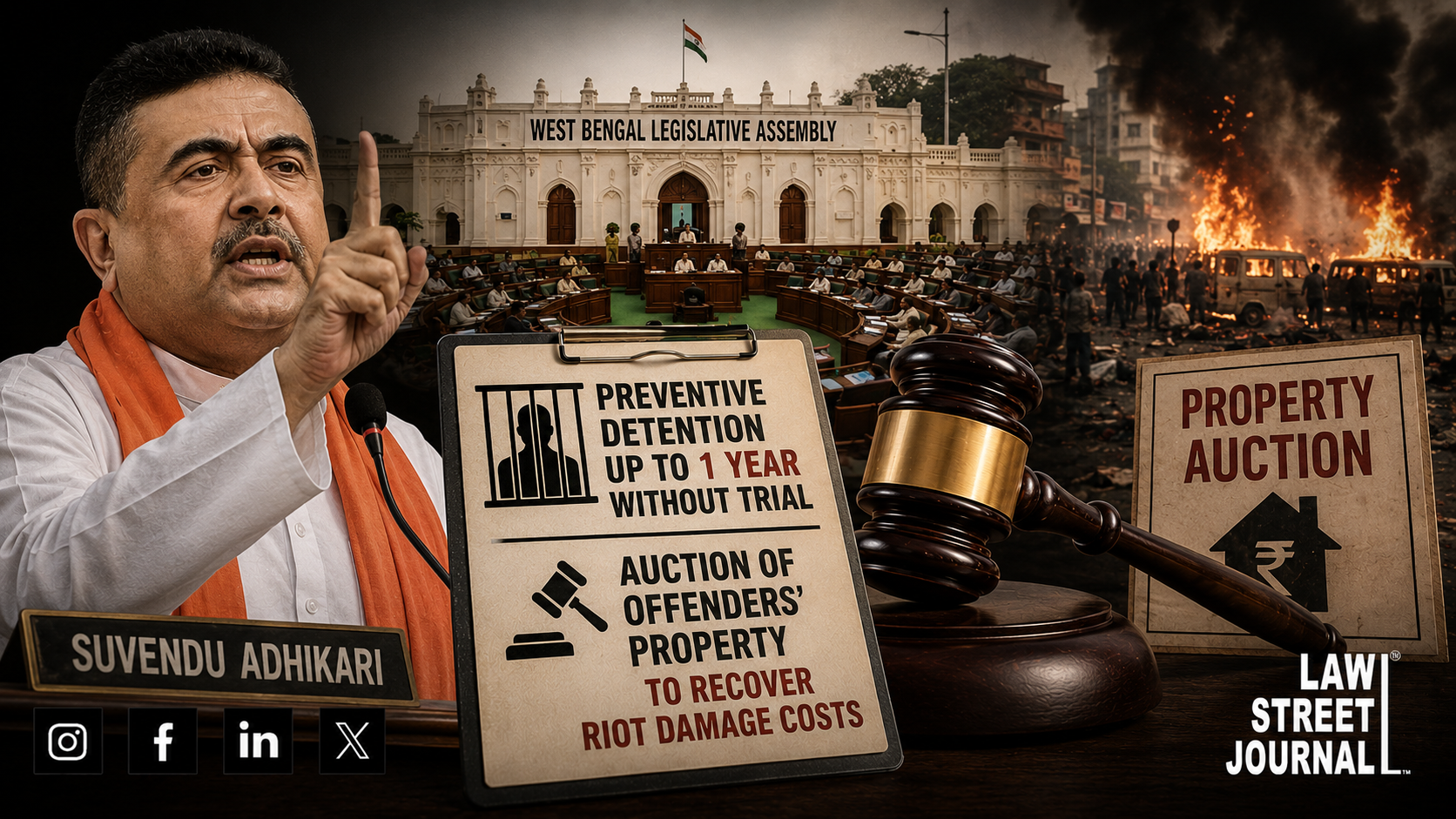
Preventive Detention for Up to 12 Months Without Trial
The most far-reaching provision of the Gunda Daman Act is Section establishing preventive detention. The Act allows the state government to detain any individual classified as an "anti-social person" or a danger to public safety for a period of up to twelve months without a conventional criminal trial. This is the provision that has drawn the most immediate constitutional scrutiny.
Preventive detention in India is constitutionally permitted under Article 22(4), but subject to strict procedural conditions. The Act builds in a three-week Advisory Board review requirement, with the Board composed of sitting or retired High Court judges. The Advisory Board must review every detention order within this period and provide its opinion on whether the detention is justified.
However, as legal analysts at Sansa Legal have noted, the real value of this safeguard depends entirely on how independently the Board is constituted and how rigorously it applies the sufficiency-of-cause standard. Supreme Court precedent under Article 22 requires that the grounds for detention be communicated to the detainee in writing, that they have a genuine opportunity to make a representation, and that the Advisory Board review is substantive rather than a rubber stamp. The history of preventive detention jurisprudence in India is replete with cases where courts have found advisory board reviews procedurally adequate on paper but practically ineffective.
Definition of "Anti-Social Activities": The Vagueness Problem
The Act defines "anti-social activities" broadly, covering acts that disturb public order, economic offences, cyber-enabled crime, and organised extortion. Once a person is classified as an "anti-social offender" under the framework, the state can detain them preventively for up to 12 months.
The breadth of this definition is legally significant. Under Article 14 of the Constitution, which guarantees equality before law and the equal protection of laws, legislative provisions that vest excessive discretion in executive authorities or that are so vague that they cannot be objectively applied are vulnerable to being struck down. The Supreme Court has consistently held that a law imposing criminal consequences must be sufficiently certain and definite. A definition that covers "acts that disturb public order" without specifying the threshold of disturbance or the manner of assessment provides wide executive latitude and wide latitude, in preventive detention law, is constitutionally dangerous.
Non-Bailable Offences and Article 21
The Act converts a wide range of offences into cognizable and non-bailable categories, a change with immediate practical consequences for anyone arrested under its provisions. Where an offence is non-bailable, the police officer making the arrest cannot grant bail; the matter must go before a magistrate or sessions court. In a preventive detention context, non-bailable status means that even if the detained person challenges their detention, they cannot be released as a matter of right pending the challenge.
Legal experts have raised the argument that converting offences to non-bailable status without corresponding procedural safeguards, particularly for offences defined in broad and non-specific terms, risks running afoul of Article 21, which guarantees that no person shall be deprived of their personal liberty except according to a procedure established by law. The Supreme Court has consistently interpreted Article 21 to require not merely a procedure on paper, but a fair, just, and reasonable procedure. Whether the broad non-bailable classification combined with the broad definition of anti-social activities constitutes such a procedure is a question the Calcutta High Court is expected to be asked to address through writ petitions.
Property Confiscation Without Prior Conviction
The Act empowers authorities to confiscate property linked to anti-social activities without requiring a prior conviction. This provision is among the most legally controversial in the entire statute.
Confiscation of property in Indian law is generally a post-conviction remedy, a punishment attached to a criminal finding of guilt. Confiscation without conviction, operating on the basis of a mere classification as an anti-social person or a finding that property is linked to anti-social activity, raises a serious constitutional question under Article 300A, which guarantees that no person shall be deprived of their property except by the authority of law. More fundamentally, confiscation without conviction inverts the presumption of innocence, a presumption the Supreme Court has read into the fundamental right to life and personal liberty under Article 21.
There are analogies with the Prevention of Money Laundering Act and the Narcotic Drugs and Psychotropic Substances Act, both of which permit property attachment and confiscation in connection with specific offences and under specific procedural frameworks. Whether the Gunda Daman Act's confiscation mechanism is similarly structured or whether it operates without the procedural protections those statutes include, will be central to any judicial challenge.
Recovery of Damage During Riots and Protests
The Act includes a provision enabling the state to recover the cost of damage caused during riots or protests from those held responsible. This mechanism is similar to provisions introduced in Uttar Pradesh and other BJP-governed states in recent years. It has been praised by supporters as a deterrent against organised vandalism and criticised by opposition groups as a tool to financially burden political protesters and their communities.
The Constitutional Framework: Three Legal Battlegrounds
Legal analysts have identified three primary constitutional battlegrounds on which the Gunda Daman Act will be tested.
The first is Article 14, equality and the prohibition on arbitrary state action. The broad definition of anti-social activities and the wide executive discretion it creates are vulnerable to challenge on grounds of arbitrariness. The Supreme Court's expanded interpretation of Article 14, which goes beyond formal equality to prohibit manifest arbitrariness has been used to strike down legislative provisions that vest uncanalised discretion in state authorities, particularly where deprivation of liberty is at stake.
The second is Article 21, the right to life and personal liberty. Non-bailable classification combined with broad definitional vagueness and preventive detention for 12 months without trial creates a suite of arguments under Article 21. The Supreme Court's landmark decision in Maneka Gandhi v. Union of India (1978) established that any procedure depriving a person of personal liberty must be fair, just, and reasonable, not merely formally enacted. The Gunda Daman Act's procedural framework will be measured against that standard.
The third is Article 22, specific protections against preventive detention. Article 22(4) through (7) establish the constitutional framework for preventive detention law: the requirement of an Advisory Board, communication of grounds, the right to make a representation, and limits on the duration of detention. Any preventive detention law must comply fully with these provisions or it is void on its face. The Act's three-week Advisory Board review is the central safeguard, and its adequacy will be tested.
There is also a fourth dimension, federalism. Public order is a State List subject under Entry 1 of the Seventh Schedule, giving state governments the power to legislate on it. But preventive detention touches on subjects that overlap with central legislation, including the Bharatiya Nyaya Sanhita. Under Article 254, where a state law is repugnant to a central law on a concurrent subject, the central law prevails unless the state law has received Presidential assent. The Governor has given assent to the West Bengal law, but whether specific provisions conflict with central legislation in ways that create repugnancy issues is a question legal practitioners are already examining.
Political Reactions: "Draconian" vs "Zero Tolerance"
The opposition response to the Gunda Daman Act has been sharp. CPI(M) central committee member Meenakshi Mukherjee said: "These laws are clearly aimed against the political opponents who would rise up to protest against anti-people measures taken by this Government. First, they will unleash bulldozers on hapless poor demolishing their shops and houses and if they protest, they will be arrested." She also raised concern about the provision restricting the right of detained persons to choose their own legal counsel, noting that detained persons would have to appoint lawyers from a state panel.
Congress leader Adhir Chowdhury drew the sharpest historical comparison available in Indian political discourse, comparing the law with the Rowlatt Act of 1919, the colonial legislation that allowed indefinite preventive detention without trial and that triggered the Jallianwala Bagh massacre. "The democratic minded people of West Bengal will definitely protest against such laws," he said.
The government's stated justification has been rooted in recent events. Chief Minister's reference to riots, vandalism, and arson following the Citizenship Amendment Act protests and the Waqf law controversy specifically positioned the legislation as a response to documented incidents of organised public violence rather than a general expansion of police powers for political purposes.
What Comes Next
Legal challenges before the Calcutta High Court are widely anticipated. Civil liberties organisations, bar associations, and opposition political parties are all expected to file writ petitions challenging specific provisions. The three-week Advisory Board review period means that early detention cases will reach the review stage quickly, creating immediate factual records for judicial examination.
Families of anyone detained under the Act should, according to legal guidance, immediately obtain the grounds of detention in writing, a constitutional requirement that the state must fulfil and approach a lawyer to assess whether a habeas corpus petition offers a more immediate remedy than the Advisory Board process.
The Gunda Daman Act joins a growing body of state anti-crime legislation including the UP Gangsters Act, the Maharashtra Control of Organised Crime Act, and the Karnataka Control of Organised Crime Act that tests the outer limits of state public safety powers under the Indian constitutional framework. Whether West Bengal's version survives judicial scrutiny in full, in part, or not at all will depend on how the Calcutta High Court and ultimately the Supreme Court weigh the state's security interests against the constitutional guarantees that remain, as they have always been, non-negotiable even in the face of genuine public disorder.

![Calcutta HC Stays State Notifications on OBC Classifications and Reservations [Read Order]](/secure/uploads/2025/06/lj_7327_Calcutta_HC_Stays.webp)

![Calcutta HC: Accused Are Entitled to Dignity, Directs DGP to Curb Egg Attacks and Mob Violence [Read Order]](/secure/uploads/2026/07/lj_8813_Calcutta_HC_Accused_Are_Entitled.webp)

.jpeg)