The Supreme Court’s judgment in Aligarh Muslim University v. Naresh Aggarwal has raised significant constitutional questions concerning the interpretation of Article 30(1) of the Constitution and the criteria for determining the minority character of educational institutions. The decision revisited the principles laid down in Azeez Basha v. Union of India, (1968), where the Court had held that the establishment and administration of an institution by a minority community are essential conditions for claiming constitutional protection.
While the majority view adopted a broader approach towards examining the historical and factual circumstances surrounding the establishment of an institution, the judgment has attracted debate regarding the scope of the term “establish”, the relevance of statutory creation, and the application of the doctrine of stare decisis. A separate opinion authored by Justice Dipankar Datta has highlighted certain contradictions within the majority reasoning and has raised questions regarding the need for review of the judgment.
This article examines the constitutional and procedural concerns emerging from the judgment, including the constitution of the larger bench, the interpretation of Article 30(1), and whether the uncontroverted findings in the separate opinion warrant reconsideration.
- Brief Background:
In 1981, in the case titled Anjuman-e- Rahmaniya V. District Inspector of Schools, a two Judge Bench questioned the correctness of Azeez Basha, and directly referred it to a referred to a Seven Judge Bench. Three questions of concern were raised:
- what are the Essential conditions or ingredients of a minority educational institution
- Whether the expression “establish” in Art 30 mean the institution should be established only by a minority without the association of any other community.
- Whether registration under Societies Registration Act 1860 after the establishment of the institution alters its character.
- Constitution of 7 Judges Bench itself is improper:
Three Hon’ble Judges, J. SC Sharma, J. Surya Kant and J. Dipankar Datta have written separate memorable judgments in the AMU case. The finding by Hon’ble Justice Surya Kant (now CJI) in Para 189.3 is absolutely clear in holding that the formation of the seven judges bench was not permissible, and the same suffers from multiple illegalities and judicial impropriety, and is challenge to the authority of the Chief Justice of India
“In essence, the reference by the two-judge bench to a larger bench of seven judges is totally impermissible; such a recourse is directly in the teeth of the dictum of the Constitution bench in Dawoodi Bohra (supra). Such an attempt by a two-judge bench is hit by: (i) the doctrine of predictability; (ii) the doctrine of finality; (iii) the principle of judicial propriety; and (iv) the doctrine of stare decisis.”
Similarly, the conclusions in Para 266 (i) by Justice SC Sharma are enough to question the Constitution of the 7 Judges Bench directly, without the Hon’ble Chief Justice of India being the part of that Bench.
- Hurried Judgment:
Any lawyer who goes through the mindboggling but impressive judgment passed by J Datta would be shocked to see the electric speed in which the seven Judges Bench has pronounced the AMU judgment. He boldly records that the judgment was reserved on 01.02.2024 and the first draft (119 pages) of the judgment was received by him as late as on 17.10.2024. Since the CJI was to demit office on 10.11.2024, therefore not enough time was left to go through the first draft. This was because the daily judicial work consumes a lot of time. The draft judgment had sought to overrule the five decades old judgment in Azeez Basha which had been passed by five judges of the Supreme Court (most of whom were aware of the pre-independence scenario). The CJI thereafter changed the conclusion in one para of the judgment and forwarded the second draft (119 pages again) but not before 25.10.24. Before the second draft could be appreciated, it was amended yet again and the third draft judgment was received by the office of J Datta on 02.11.2024 i.e. just 08 days before the last working day of the CJI. During these 08 days, on 06.11.2024, draft judgments of two more judges i.e. J Surya Kant and J SC Sharma were received by the office of J Datta. Thus, J Datta had only 3 days to go through these two drafts to correctly appreciate and correlate them with the majority opinion. Certainly not enough time was given for writing a judgment deciding an issue of National importance.
- Seven Judges never met to discuss the issue:
When the issue involved is related to minority status of AMU, settled half a century ago in case of Azeez Basha, subsequent to the completion of final arguments the Judges ought to have personally discussed and shared their views on the legal submissions made by the Senior Counsels. A meeting of minds of all the seven judges ought to have taken place as without such meeting and discussion, a decision by all seven judges is not fairly possible. Since the arguments by the sharpest Counsels, were heard by all 7 judges collectively, they ought to have personally discussed the effect of the constitutional submissions. The parties expect that there shall be a meeting of minds of all Judges before pronouncement of judgment. If each judge were to pronounce separate judgments, then it will be very difficult for the parties to comprehend the judgment, to discover the ratio and the principle of law exactly laid down in separate judgments. Also, the very purpose of referring it to a larger Bench fails.
- Mutually conflicting and contrary views:
J Datta while scanning the majority opinion, in para 111, has pointed out the mutually conflicting and contrary views expressed therein. Describing the same as “Chakravyuh orchestrated by Dronacharya”, for reasons recorded therein, in my view is an error apparent on the face of record, enough for review. Indicating Para 73 and 156 of the third draft:
Para 111. “The majority opinion, though extensive, seems to have created an existential impasse, akin to the Chakravyuh orchestrated by Dronacharya. While it is mentioned in paragraph 73 of the revised draft opinion that “Article 30(1) cannot extend to a situation where the minority community which establishes an educational institution has no intention to administer it”, it has been opined at paragraph 156 (could also be 155) that “In the preceding sections we have held that establishment by a minority is the only indicia for a minority educational institution”. To my mind, these two positions create an inherent contradiction which is as perplexing to solve as the Chakravyuh was for Abhimanyu, inasmuch as it lays out mutually exclusive positions of lawwhich cannot possibly co-exist. In view thereof, a question comes to my mind that if a minority community establishes an educational institution and thereafter abandons its administration to rank outsiders, can such an institution be said to merit protection under Article 30(1), if establishment is the only indicium, as held in the majority opinion? From the paradoxical legal test laid out above, the answer remains elusive.”
- Error:
Apparently, the sparkling error arises because of the question which comes to mind that “If a minority community establishes an educational institution and thereafter abandons its administration to rank outsiders, can such an institution be said to merit protection under Art. 30 (1), if establishment is the only indicium, as held in the majority opinion?”
- What was not considered:
The constituent assembly debates and incorporation of AMU in Entry 63 of List 1 in the Seventh Schedule, designation of AMU as institution of National Importance, the Constitution does not recognize AMU as a minority institution and as per Entry 63, it is exclusively the parliament which could exercise exclusive legislative authority over AMU.
- Finding: The Hon’ble Supreme Court in para 120 holds that “AMU is not a minority institution.”
- Final view:
Therefore, the judgment of J Dipankar Datta declaring that “AMU is not a minority institution” is a final view as it has not been disagreed by any of the other Hon’ble Judges on the bench. No other Judge on the Bench has given a finding to the contrary. The majority opinion of the said Judgment has not expressed their disagreement against the opinion of J Dipankar Datta. The issue has been left open. The finding expressed by any judge of the Supreme Court which is not controverted, disagreed or dissented from is to be treated as the judgment of the entire constitution bench. This may also necessitate a clarification and hence a review of the said judgement in the AMU case is required.
- Azeez Bhasha:
It is important to note that Judgment in the case of Azeez Bhasha was based on facts as well as on law. The Supreme Court, half a century ago, had already analyzed the facts and concluded that AMU is not a minority institution when the analysis were done by the Judicial minds who experienced the pre-independence scenario. The Supreme Court had also analyzed the legal provisions in detail and concluded that AMU is not a minority institution. For the past five/six decades, there is no other judicial precedent which holds a different view and therefore the judgment in Azeez Basha having held the field undisturbed and the principle of stare decisis would therefore freeze the said judgment unless there is a change in old facts of 1870s relating to the establishment of AMU University. Further, there is no other judgment which has held that the word “and” in the phrase “establish and administer” is not disjunctive. The identity of MAO College was sought to be extinguished and a university was created by a statute of the Imperial Legislature. The AMU was not created by the same group of persons which had created the MAO College. In any case, same tests cannot be used to measure the minority status of pre-constitution and post constitution educational institutions. It is held decisively that the Muslim Community had no intention to administer AMU which was left to be worked out as per AMU Act. It has been held that AMU is a creature of statute and is required to function as per AMU Act and is also an authority under Art. 12 and as such all other Articles of Part III including Art. 29 (2) would apply.
- AMU not established by minority:
The specific finding in Para 149 stands undisturbed by any other Hon’ble Judge:
“In the light of the above discussion, the claim of the appellants cannot stand. AMU was neither established by any religious community, nor is it administered by a religious community which is regarded as a minority community; hence, AMU does not qualify as a minority institution. Protection under Article 30(1) of the Constitution is, thus, not available. This submission of the appellants has no historic, legal, factual, or logical basis.”
The majority opinion has not controverted this issue nor have given a contradictory finding and hence this view of J Dipankar Datta, as reflected in Para 149 of his judgment is law of the land, binding, must prevail and treated as the uncontroverted view of the 7 Judges on the Bench.
- Letter by Syed Ahmed Khan:
Para 27: Muslims were not recognised as a minority during British rule. Syed Ahmed Khan, the founder of MAO College claimed in a letter that the Muslim community never considered itself as a minority and instead as rulers prior to the British government.
- AMU owes its existence to the Statute. It has no legal Status without the Statute
Para 154. There is a well-marked distinction between a body which is created by the statute and a body which after having come into existence is governed in accordance with the provisions of the statute. In other words the position seems to be that the institution concerned must owe its very existence to a statute which would be the fountainhead of its powers. The question in such cases to be asked is, if there is no statute would the institution have any legal existence. If the answer is in the negative, then undoubtedly it is a statutory body, but if the institution has a separate existence of its own without any reference to the statute concerned but is merely governed by the statutory provisions it cannot be said to be a statutory body.
- Comparison with other Univ Acts:
The Annamalai University Act 1928, and Visva Bharati Act 1951 carry a different phraseology and recognizes the efforts of Sir Annamalai Chettiar and Gurudev Rabindranath Thakur resp. whereas, the AMU Act is woefully bereft of the same. Similar is the case of Sam Higginbottom University of Agriculture, Technology and Sciences Uttar Pradesh Act, 2016, which is “established and administered by the Ecumenical minority Christian society”. Similarly, era University, Lucknow, UP Act 2016, recognizes the minority character as it defines “Trust” as the trust “established and administered by Muslim minority community”. The Judgment in AMU case therefore, needs an immediate review as all these points have been missed by the four majority Judges.
- Ultimate control test :
Further, AMU has been held as an institution unto itself, distinct from MAO College and hence, the legislative authority to establish AMU University was not with the private individuals to set up MAO College. “Being devoid of the authority to establish, the power to do which was the sole preserve of the British Government, the establishment of AMU could not possibly be owed to the Muslim community. The earlier judgment in Very Rev. Mother provincial has not been appreciated. A review thus ought to be filed as factum of establishment has to be factually established, which was dealt with categorically in Azeez Basha. Further, to prove the factum of administration, the test is of ultimate control. If without any dissenting opinion, a deep and pervasive control of the State is established, and if the Central Government and its predecessor have been administering the AMU since 1920, it cannot be a minority institution.
- Apparent Governmental Effort in establishment:
That the minority community must actually and tangibly bring the entirety of the Institution/AMU into the existence. The purpose of the institution must also be predominantly serving the interest of minority community. The actually functional procedure for hiring teachers and policy formation must also be with minority. The judgment in Azeez Basha does not preclude minorities from establishing Universities. The minority may conceptualize the idea of institution however if during negotiation, the governmental effort was predominant in its establishment, then such an institution cannot be said to be established by minority community. Article 30 is not absolute and certainly do not exist in isolation.
- Hindi version of establishment: स्थापना
The Hindi version and meaning of establishment is स्थापना which is used by the Constitution framers. All this has escaped the notice of majority view, and therefore, to do complete justice with the Constitution framers, Entry 63 List 1, and other social issues, the Judgment in the case AMU vs. Naresh Aggarwal calls for a review.
It failed to apply the ultimate control test to AMU's facts despite accepting it as the correct standard, and overlooked that Syed Ahmed Khan himself declared in writing that the Muslim community did not regard itself as a minority.
- J. Datta, by contrast, applied the conjunctive test, engaged with all these materials, and returned the uncontroverted finding in Para 149 that "AMU was neither established by any religious community, nor is it administered by a religious community which is regarded as a minority community" — a finding unchallenged by any other Judge on the Bench and therefore binding as the determination of the entire Court. Since no ratio can be extracted from a self-contradictory majority, and since J. Datta's finding in Para 149 stands uncontroverted, his opinion is the operative law and must prevail.
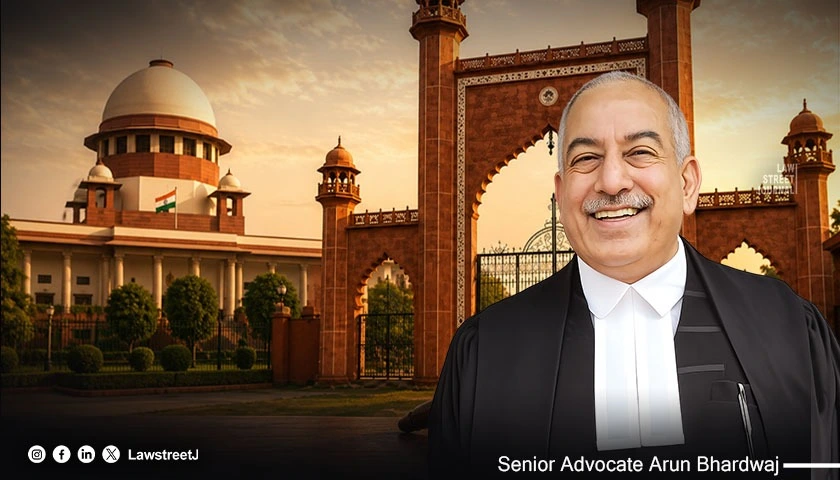
Arun Bhardwaj
Senior Advocate
(Assisted by: Ashu Tiwari and Khushi Sood, Advocates)
Disclaimer: The views expressed in this article are solely those of the author and are based on the author’s interpretation of the law and judicial decisions. They do not necessarily reflect the views of the publisher or editorial team.