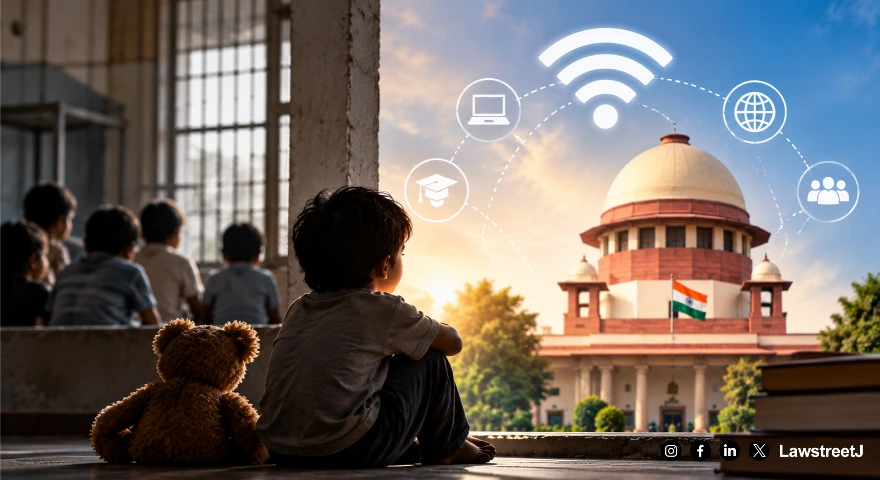
Between June and August this year, I had the opportunity to travel across the seven states of the Northeast as a field investigator with Project Ability Empowerment, at National Law University and Judicial Academy, Assam. Our field work took us into institutions that house persons with intellectual and psychosocial disabilities. Many of them were children, some in government institutions, others in residential schools for children with special needs.
During the visits we noticed that none of the children we met, had access to the internet in any form. There was no supervised hour in a computer room, no shared tablet/phone for a video call home, no filtered connection for a lesson or surf the internet out of curiosity.
On 15 October 2026, the Supreme Court of India held that the right to access and use the internet is a fundamental right of every individual under Article 21 read with Article 19(1)(a) of the Constitution. It added that children, “irrespective of their age”, enjoy the same right. When I read that line, I thought of the children in those institutions. Through this piece I try to hold together, a ruling that deserves to be welcomed, and a ground reality that needs to be changed.
What the Court said, and why it matters
The order came in a case about child sexual exploitation and abuse material (CSEAM). In Just Rights for Children Alliance v. S. Harish (2024 INSC 716), the Supreme Court had held that viewing and storing such material is an offence under the POCSO and IT Acts. The applicants returned this year with reports of CSEAM being promoted through paid redirect links. The resulting order (2026 INSC 1149), by Hon’ble Justices J.B. Pardiwala and K. Vinod Chandran, is mostly about plumbing the issue, hash databases, grievance officers and penalties for platforms.
Then, in Part E, the Court turns to something larger. It notes “a growing yet short-lived tendency across the globe” to keep children off the internet in the name of safety, and consciously declines to endorse it. Safety measures, it says, “must be directed at the harmful material and those responsible for the same, and not at the children themselves” (para 284). Keeping a child offline because platforms have failed “would be to mistake the victim for the problem” (para 285).
The reasoning appears to be three-fold. Article 19(1)(a) includes the right to receive information. Anuradha Bhasin v. Union of India (2020) protected expression through the internet but left open whether access itself is a fundamental right. Pragya Prasun v. Union of India (2025) then held digital access to be “an intrinsic component” of Article 21 for persons with disabilities. From there, the Court declared that the right to access and use the internet belongs to every individual, and that children “irrespective of their age enjoy the same rights” (para 292). To deny it altogether “would be as absurd as saying children below a certain age do not have a conscience worth protecting or a freedom of speech worth expressing.”
Two passages matter especially for children in care. The internet, the Court observed, is often the only source of learning for children in remote areas, and “for children with special needs, the internet is often the only place where they are able to find company in others like them” (para 288). And: “The safety of our children and their freedom are not at odds with each other. Our children are entitled to both” (para 292).
The right is not unqualified. The Court accepts parental oversight, a “child mode”, limits on contact from unknown adults and blocking of inherently harmful content (paras 299–302). What it rejects are blanket bans as in “unproven measures of proven disproportionality” (para 297). The direction say that the default is regulated access, not no access at all.
Child care institutions appear in the order, in a direction that networks be filtered, a measure that “must also extend to hostels, child care institutions, tuition and coaching centres with a greater rigour” (para 315(ix)). That sentence assumes a child care institution has a network to filter. In the institutions we visited, there was nothing to filter at all.
The ground reality
Across the seven states, a pattern held. In residential special schools and in government institutions for children in need of care and protection alike, children had no access to the internet. Not for learning, not for leisure, not to stay in touch with family.
When we raised the question, the management attempted to rationalise. These children, we were told, could be habituated only to certain things, at a certain pace, and with careful supervision. The internet would come later, if at all, once a child was “ready”.
I do know whether to doubt the sincerity of these concerns or not. Some caregivers were doing demanding work with thin budgets and thinner staff. But their expressed less care, and more ignorance. Nobody thought of internet access as something these children need. It had not been weighed and rejected; it had simply never entered the care plan at all.
That absence has great costs and consequences. A video call can be the only realistic way for a child placed far from home to keep a family bond alive. Children with intellectual disabilities or those experiencing autism are among those who gain most from visual, self-paced learning tools and communication apps. For a young person leaving care at eighteen, scholarships, identity documents, welfare transfers and job applications all run online. The lack of access also hinders their capacity building to face the world as adult.
When these children get access in the future, without proper introduction to the world wide web, one cannot help but worry about the likelihood of unfortunate and undesired possibilities. As the Court observed, children barred from the internet do not stop using it; they move to platforms “that are unregulated and even more unsafe” (para 294).
Protection, or thoughtless paternalism dressed as care?
The caregivers were right that children in care need protection in terms of exposure. Where I part ways is the conclusion that protection means absolute absence of access. If safety and freedom “are not at odds”, an institution that secures one by abolishing the other has not solved the problem. It has chosen the easier half of it that was most convenient to impose.
Disability studies named this trap long ago. In 1972, Robert Perske, writing about people with intellectual disabilities in institutions, warned that “overprotection may appear on the surface to be kind, but it can be really evil.” His idea of the dignity of risk holds that the chance to try, to err and to learn is part of being treated as a person: “there can be healthy development in risk taking and there can be crippling indignity in safety.” A child never allowed a supervised encounter with the digital world is shielded from its harms, but also denied the guided practice through which other children learn to handle them.
In Francis Coralie Mullin (1981), a case about a detenu in State custody, the Supreme Court read into Article 21 the right to live with human dignity, including “facilities for reading, writing and expressing oneself in diverse forms, freely moving about and mixing and commingling with fellow human beings.” A child in a care institution is also in the State’s custody in a sense, and in 2026 much of that reading, writing and mixing happens online.
None of this means a ten-year-old with an intellectual disability and a sixteen-year-old preparing to leave care need the same thing. The UN Committee on the Rights of the Child treats evolving capacities as “an enabling principle” and asks that protection be balanced with “the importance of exercising their rights in supported environments” (General Comment No. 25, paras 19–20). For children with disabilities, it warns against prejudice that leads to “overprotection or exclusion” (para 92).
That is the answer to the argument about perceived pace. Pace is a reason for a graded plan, not for no plan at all. “Not yet”, repeated for every child without any criteria for readiness, is simply “never” said politely with a smile.
The law points the way, then falls silent
The legal framework does not forbid internet access in care. Every layer point towards it but none makes it happen in reality.
Article 39(f) of the Constitution directs the State to ensure that children develop “in conditions of freedom and dignity” and are protected against exploitation and “moral and material abandonment”, freedom, dignity and protection in one sentence, as companions not as rivals.
The Juvenile Justice (Care and Protection of Children) Act, 2015 governs some of these homes. Section 3 sets out the principles of “dignity and worth” and participation, and a best-interest standard aimed at helping the child “develop full potential”. Section 53 requires institutions to provide education (including special education), life skills, recreation, an individual care plan and “any other service” reasonably needed. Access to internet fits several of these heads, however fails to find any place in the plans.
The JJ Model Rules, 2016 mention “computer sets” and a “telephone with internet facility” in Rule 29(12), but only among an institution’s “logistical and functional requirements”, alongside photocopiers and record cabinets. The internet is imagined as equipment for running the home, not something its children are entitled to use. This philosophy in itself is a problematic premise t0 build upon.
For children with disabilities, Section 42 of the Rights of Persons with Disabilities Act, 2016 requires accessible electronic media, and Pragya Prasun read such duties into Article 21 as well. Internationally, the Convention on the Rights of the Child protects the right to seek and receive information (Articles 13 and 17), and the Convention on the Rights of Persons with Disabilities requires States to “promote access for persons with disabilities to new information and communications technologies and systems, including the Internet” (Article 9(2)(g)). General Comment No. 25 is explicit, “It is important that children separated from their families have access to digital technologies” (para 87). The correct approach cannot be clearer than that.
Indian courts have been at this juncture and junction before. In Faheema Shirin v. State of Kerala (2019), the Kerala High Court struck down a college hostel’s restrictions on mobile phones, holding that “the right to have access to Internet becomes the part of right to education as well as right to privacy”. The petitioner was an adult, but the principle is clear that a residential institution’s blanket rule (practice for the present argument) cannot extinguish a constitutional right. A year later, the Delhi High Court called the denial of devices and data to poorer students “digital apartheid”. A statement that carries great weight and meaning.
But, where is the operational layer? Without it, the decision falls to each superintendent. Why should the law and the government leave this decision with a person in management and trust them to do the right thing, when it can inculcate the right thing and trust the consistency of the system more than the sole judgement of a person?
How other systems have done it
Several jurisdictions have already written internet access into the standards for children in residential and foster care. Their shared design is what hon’ble justices have also opined that access is the default, and restriction is an exception justified.
For instance, in England, the Guide to the Children’s Homes Regulations provides that children “should have access to a computer and the internet to support their education and learning, unless there are specific safeguarding reasons why this would be inappropriate”.
Ireland, through its HIQA National Standards for Children’s Residential Centres (2018), says, “Each child has appropriate access to a telephone and appropriate media, such as television, newspapers and the Internet.”
The default matters and protection come through trained adults and trusted relationships, not through removing the device.
The Parens Patriae needs to step in
The Court has said what the right is. The Ministry of Women and Child Development must now say how it works inside a children’s home. The order's directions go to the Ministries of Electronics and IT and of Law, and the matter returns to court on 10 December 2026. But children in care are this Ministry’s responsibility, and it need not wait to be told. Following are a few humble suggestions, based on field experience:
- Parliament should amend the JJ Model Rules, 2016 to recognise regulated internet access as part of the education, recreation, life-skills and family-contact services under Section 53, with States following suit.
- Any restriction should be reasoned, proportionate and time-bound, recorded in the child’s individual care plan, and reviewed by the Child Welfare Committee, with the child heard. This will make access the default.
- An SOP should be issued on the how. Shared devices in supervised common spaces; filtered networks, as para 315(ix) already demands; tiers set by age and developmental level; scheduled family video calls where the Committee permits; no blanket surveillance; data handled under the Digital Personal Data Protection Act, 2023. The SOP may contain several such points. Through the field experience we have noticed that institutions do not seem to rise to perform to the promises of the Statute, rathe they fall to the standards set by SOPs. The value of SOPs cannot be overstated.
- In this reformed mechanism accessibility should be built in. Assistive and communication software, screen readers and accessible content, as Section 42 of the RPwD Act requires, planned with special educators.
- The caregivers should be trained. Extend the order’s training mandate for teachers (para 315(x)) to institution staff for example: recognising grooming, responding to disclosure, reporting under Section 19 of the POCSO Act. Display the 1098 and 1930 helplines in every home/hostel.
- The government may choose to Fund and monitor it through mission Vatsalya. Add a Mission Vatsalya budget line for devices, connectivity and assistive technology. Have the Section 54 inspection committees and State Commissions for Protection of Child Rights check access to devices with internet as along with other requirements.
- Prepare the children for leaving care and build digital literacy into aftercare planning under Section 46.
None of the suggestions intend to ask institutions to abandon caution. It asks them to turn caution into a plan, and a plan into a practice.
The Supreme Court has said our children are entitled to both safety and freedom. A right that stops at the gate of a children’s home/hostels is not yet a right of every individual. The constitutional promise has been made and thankfully highlighted. The work now is to carry it through that gate, onto a shared and carefully filtered screen, and into the hands of a child who has waited long enough to be considered ready to at least have the opportunity learn and grow just like the other children at home.
Tushar Azad is a final year B.A. LL.B student at National Law University and Judicial Academy, Assam. The views expressed are the author's own and do not represent those of the Centre for Disability Studies and Health Laws, or National Law University and Judicial Academy, Assam.