Introduction
In constitutional democracies, criminal prosecution is not merely an adversarial contest between the State and the accused. It is a public function carried out for serving justice. Acting on behalf of society, the State bears the responsibility to investigate offences, prosecute offenders and assist courts in administering criminal law fairly and effectively. The legitimacy of the justice system depends as much on protecting the innocent as it does on punishing the guilty.
In India, this responsibility was traditionally governed by the Code of Criminal Procedure, 1973 (hereinafter referred to as the “CrPC”) and now continues under the Bharatiya Nagarik Suraksha Sanhita, 2023 (hereinafter referred to as the “BNSS”), which came into force on 1st July 2024.
While the BNSS introduces procedural reforms intended to improve efficiency, incorporate technology and expand victim participation, it does not depart from the philosophy that has long guided prosecutorial practice.
The purpose of prosecution has never been to secure convictions at any cost. It is to aid the court in discovering the truth, ensure that the guilty are punished in accordance with law and protect the innocent from wrongful suffering. Prosecution must therefore be understood not as an instrument
of executive authority but as a constitutional function grounded in fairness, objectivity and institutional responsibility.
This article examines the State’s evolving role within India’s criminal justice framework in light of the transition from the CrPC to the BNSS. It argues that despite structural reform, the normative foundations of prosecution remains unchanged. A prosecutor is neither a partisan advocate nor a passive administrator. The office carries the responsibility of balancing societal interest, individual liberty and the integrity of the legal process.
Therefore, any examination of this role must begin with the constitutional principles that shape prosecutorial authority in India.
Constitutional Foundations of Prosecution
The legitimacy of the prosecutorial function flows from Articles 14, 20 and 21 of the Constitution of India. Together these guarantee equality before law, guard against Arbitrariness and to protect life and personal liberty. The Supreme Court has repeatedly interpreted these protections to include the right to a reasonable, fair and just trial.
In Maneka Gandhi v. Union of India (1978) 1 SCC 248, the Court expanded Article 21 to require procedural fairness in all State action, including investigation and prosecution. This position was reinforced in Zahira Habibulla H. Sheikh v. State of Gujarat (2004) 4 SCC 158, where the Court
observed that a fair trial must account for the rights of the accused, the interests of victims and the expectations of society. The prosecution therefore occupies a central position within this constitutional balance.
Statutory Continuity under the CrPC and the BNSS
Sections 24 and 25 of the CrPC, which govern the appointment of Public Prosecutors and Assistant Public Prosecutors, find continuity in the Section 18 and 19 of the Bharatiya Nagarik Suraksha Sanhita, 2023. Although the new framework modernises procedure through defined timelines and technological processes, it preserves judicial oversight and prosecutorial accountability as essential features of criminal trials.
The transition does not transform prosecution into a conviction-oriented enterprise. Rather, it affirms the long-settled position that prosecution is a public function performed in aid of justice and subject to constitutional restraint.
Role of the Assistant Public Prosecutor
The Assistant Public Prosecutor (APP), particularly before Magistrate courts, represents the State at the first institutional level of criminal adjudication. The APP is expected to scrutinise police reports, assess the legal sustainability of charge-sheets, assist the court during inquiry and trial and adopt balanced positions on remand, bail and discharge.
In State of Bihar v. P. P. Sharma, 1992 Supp (1) SCC 222, the Supreme Court cautioned that prosecutorial discretion must be exercised independently. The APP is not a conduit for the investigating agency. The duty is owed to the court and ultimately to the cause of justice.
Public Prosecutors as Officers of the Court
The role of the Public Prosecutor assumes heightened significance in Sessions trials and serious offences. The Supreme Court, in Shiv Kumar v. Hukam Chand, (1999) 7 SCC 467, held that a Public Prosecutor is an officer of the court and not a mouthpiece of the investigating agency. The Court
observed that the prosecutor’s primary obligation is to ensure that justice is done, even if such fairness results in acquittal.
This principle was reaffirmed in Babu v. State of Kerala, (2010) 9 SCC 189, where the Court held that prosecutorial fairness is an integral component of a fair trial under Article 21. The BNSS, notwithstanding procedural reform, preserves this settled judicial position.
These roles demand candour, objectivity and professional independence, which must be exercised by prosecutors in the discharge of their duties and in aid of the court
Reconfiguration of the Directorate of Prosecution under the BNSS
The BNSS introduces a notable restructuring of the Directorate of Prosecution with the apparent objective of strengthening supervision and institutional accountability. While Section 25A of the CrPC largely contemplated a State-level structure, Section 20 of the BNSS mandates District Directorates of Prosecution, thereby decentralising oversight across the system.
The introduction of the Assistant Director of Prosecution embeds supervisory review at multiple levels and aligns prosecutorial attention with the gravity of offences. Equally significant is the move away from broad executive discretion toward codified responsibilities. Senior officers are tasked with monitoring serious offences, while structured review mechanisms in place for all other offences.
The requirement that police reports undergo scrutiny before filing serves as an important safeguard against investigative lapses and unsustainable prosecutions. It reinforces the prosecutor’s role as a constitutional check rather than a mere extension of the investigative process.
Eligibility thresholds have also been enhanced, signalling an intent to professionalise the institution. Although the removal of mandatory concurrence with the Chief Justice of the High Court has prompted debate on independence, the Directorate continues to function separately from the Police Department. Section 19 of the BNSS further bars investigating officers from serving as prosecutors and the requirement of notice to victims before withdrawal of prosecution promotes transparency.
Taken together, these measures are a step towards a more structured and accountable prosecutorial framework.
Prosecution Beyond Conviction: Reasserting the Prosecutor’s Constitutional Function
Indian criminal jurisprudence has long rejected the idea that prosecutorial success is measured by conviction rates. In State of Rajasthan v. Kashi Ram (2006) 12 SCC 254, the Supreme Court held that the prosecution must stand on the strength of its own evidence.
The true mandate of prosecution is to identify and prosecute real offenders, including abettors, conspirators, and beneficiaries of crime. Selective prosecution, scapegoating, or the targeting of convenient accused while allowing masterminds or economic beneficiaries to escape liability undermines the legitimacy of the criminal justice system.
The Foundational Principle: Protection of the Innocent
A foundational maxim of criminal law holds that it is better that ten guilty persons escape than that one innocent suffer. This doctrine, articulated by William Blackstone in his Commentaries on the Laws of England (1769), has roots in Roman law and early common law traditions. It reflects the
primacy accorded to individual liberty and the presumption of innocence.
Indian courts have consistently embraced this principle. In V. D. Jhingan v. State of Uttar Pradesh, AIR 1966 SC 1762, the Supreme Court held that the burden of proving guilt beyond reasonable doubt lies squarely upon the prosecution and that any reasonable doubt must operate in favour of the accused. This doctrine continues to inform judicial interpretation under both the CrPC and the BNSS.
International Norms and the Duty to Prosecute
International standards similarly recognise prosecution as integral to the rule of law. The United Nations Guidelines on the Role of Prosecutors emphasise independence, impartiality and respect for due process while acknowledging the prosecutor’s responsibility in protecting human rights.
Contemporary discourse also recognises a duty to prosecute serious violations such as torture, genocide and crimes against humanity. This obligation seeks to combat impunity. Yet it operates within the boundaries of fairness and prosecutions must not proceed where evidence is insufficient or where a fair trial cannot be ensured.
India’s prosecutorial framework broadly reflects these principles. The protection of the innocent and the duty to prosecute are not competing ideals but complementary commitments that sustain the credibility of the justice system.
Conclusion
Within India’s justice delivery system, the prosecution represents more than a procedural actor. It reflects the State’s commitment to the rule of law. The transition from the CrPC to the BNSS does not dilute this responsibility. Instead, it signals an effort to strengthen supervision, accountability,
and institutional coherence.
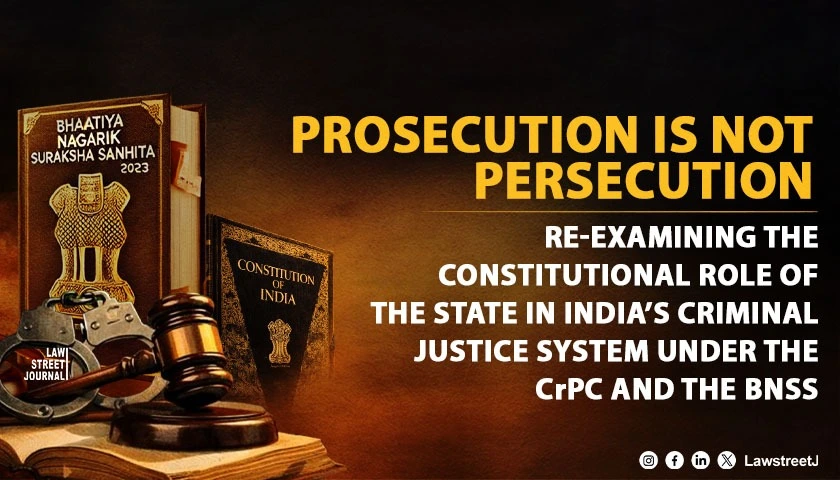
Prosecution is neither persecution nor a metric-driven pursuit of convictions. It is a constitutional function directed toward the orderly administration of justice. Prosecutors assist courts in the search for truth while safeguarding the rights of victims and the accused alike.
The true measure of prosecutorial success lies not in conviction statistics but in the assurance that justice is administered in accordance with law. That the guilty are punished, the innocent are protected and public confidence in the legal system remains secure. This reflects the well-known maxim articulated in the case of R v. Sussex Justices, ex parte McCarthy (1924) 1 KB 256 by Lord Hewart, C.J., Chief Justice of England, that “justice should not only be done, but should manifestly and undoubtedly be seen to be done”.
The author, Adv. Udit Arora, is an Advocate practicing before the Supreme Court of India and regularly appears in constitutional and criminal matters.
Disclaimer: The opinions expressed in this article are solely those of the author and do not necessarily reflect the views of LawStreet Journal.
![Gujarat HC Sets Aside Order Forcing Minor and Mother to Attend Court Weekly for Grandfather’s Visitation [Read Judgment]](/secure/uploads/2026/03/lj_2941_Gujarat_HC_Sets_Aside.webp)
![“Unreserved PWD-LV Post Open to All Eligible Candidates Regardless of Social Category; Merit Sole Criterion: Supreme Court Sets Aside Calcutta HC Ruling [Read Judgment]](/secure/uploads/2026/04/lj_1389_Unreserved_PWD.webp)