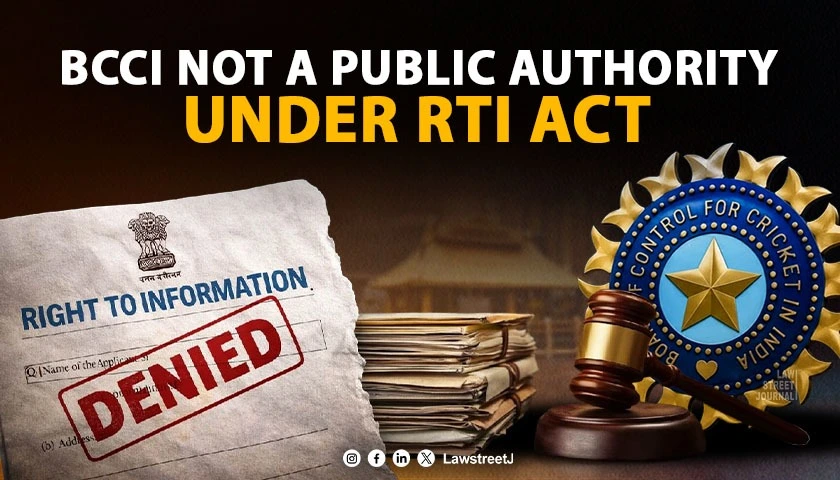
The Central Information Commission has held that the Board of Control for Cricket in India does not qualify as a ‘Public Authority’ within the meaning of Section 2(h) of the Right to Information Act, 2005, and that the provisions of the Act are accordingly inapplicable to it.
Information Commissioner Shri P.R. Ramesh, by order dated 18.05.2026 in Second Appeal No. CIC/MOYAS/A/2018/123236 (Geeta Rani v. CPIO, Ministry of Youth Affairs and Sports and CPIO, BCCI), dismissed the second appeal as devoid of merit.
The matter has a long and chequered procedural history. The appellant, Geeta Rani, had filed an RTI application dated 04.12.2017 before the Ministry of Youth Affairs and Sports seeking information on the authority under which BCCI represents India and selects players, whether players play for India or for BCCI, the basis for governmental provision of infrastructure to BCCI, and whether the National Sports Authority of India exercises any control over the body. The CPIO, by letter dated 14.12.2017, replied that the information sought was not available with the Ministry and that the RTI application could not be transferred to BCCI as it had not declared itself a public authority. The First Appellate Authority upheld this position. The appellant then filed a second appeal before the CIC on 12.04.2018.
The Commission had earlier, by order dated 01.10.2018, held BCCI to be a public authority and directed it to designate CPIOs and put in place mechanisms to receive and respond to RTI applications. BCCI challenged this order before the Madras High Court in W.P.(C) No. 29615/2018. By order dated 17.09.2025, the High Court set aside the CIC’s earlier order and remanded the matter for fresh consideration in accordance with the guidelines of the Supreme Court in Board of Control for Cricket in India v. Cricket Association of Bihar [(2016) 8 SCC 535]. The present order was passed pursuant to this remand.
Before the commission BCCI submitted that it is a society registered under the Tamil Nadu Societies Registration Act, 1975, and not established by the Constitution, Parliament, or any State Legislature, nor constituted through any government notification. Relying on Thalappalam Services Coop. Bank Ltd. v. State of Kerala [(2013) 16 SCC 82] and Dalco Engineering Pvt. Ltd. v. Satish Prabhakar Padhye [(2010) 4 SCC 378], BCCI contended that registration under a statute does not amount to establishment by statute, and that the definition of ‘Public Authority’ under Section 2(h) is exhaustive and restrictive in nature.
It was further submitted that the government exercises no ownership or deep and pervasive control over the BCCI, and that BCCI is wholly financially self-sustaining, generating its revenues from media rights, sponsorships, broadcasting agreements, and ticket sales without any reliance on governmental funds. BCCI also pointed to the National Sports Governance Act, 2025, which expressly stipulates that only sports bodies receiving government grants would be treated as public authorities under the RTI Act, and only to the extent of such grants. Since BCCI receives no such assistance, it does not fall within this statutory extension either.
The Commission, after examining the three criteria under Section 2(h) including the creation, control, and substantial financing held that BCCI satisfies none of them.
On creation, it was found that BCCI owes its existence to private initiative and registration, not to any constitutional provision, legislation, or government order, and that the distinction between ‘establishment’ and ‘registration’ drawn by the Supreme Court in Dalco Engineering is decisive.
On control, the Commission applied the tests in Ajay Hasia v. Khalid Mujib Sehravardi [(1981) 1 SCC 722] and Pradeep Kumar Biswas v. Indian Institute of Chemical Biology [(2002) 5 SCC 111], holding that ‘control’ under Section 2(h) must be substantial and pervasive, not merely regulatory or supervisory. Since the government holds no representation in BCCI’s Working Committee and exercises no authority over its finances, administration, or management, the test of control is not met.
On substantial financing, the Commission relied on the Constitution Bench decision in Zee Telefilms Ltd. v. Union of India [(2005) 4 SCC 649], which had categorically held that practically no financial assistance is given by the government to meet the expenditure of the BCCI. General tax exemptions available to all charitable entities under the Income Tax Act were held to be incidental benefits falling far short of ‘substantial financing.’
The Commission further held that the decision in Cricket Association of Bihar (supra) does not declare BCCI a public authority under the RTI Act; its directions were governance-oriented and reformatory in character, aimed at restructuring cricket administration through the Lodha Committee recommendations.
The Court expressly left the question of bringing BCCI under the RTI framework to the legislature. The Commission also noted that it had consistently held in earlier decisions Anil Chintaman Khare v. BCCI [2008 SCC OnLine CIC 264] and Om Prakash Kashiram v. BCCI [2011 SCC OnLine CIC 10131] that BCCI is not a public authority, and these findings had attained finality.
The appellant’s failure to appear and substantiate her claim further disentitled her to relief, the burden of establishing public authority status lying upon the applicant under the Thalappalam judgment.
The second appeal was accordingly dismissed.
Case Title: Geeta Rani v. CPIO, Ministry of Youth Affairs and Sports and CPIO, Board of Control for Cricket in India, Second Appeal No. CIC/MOYAS/A/2018/123236, Central Information Commission.


![Supreme Court Empowers Accountability: Public Authorities Ordered to Ensure RTI Act Compliance [Read Judgment]](/secure/uploads/2023/08/lj_6382_8aa79779-2163-4b48-b589-6a21f647cf0b.jpg)