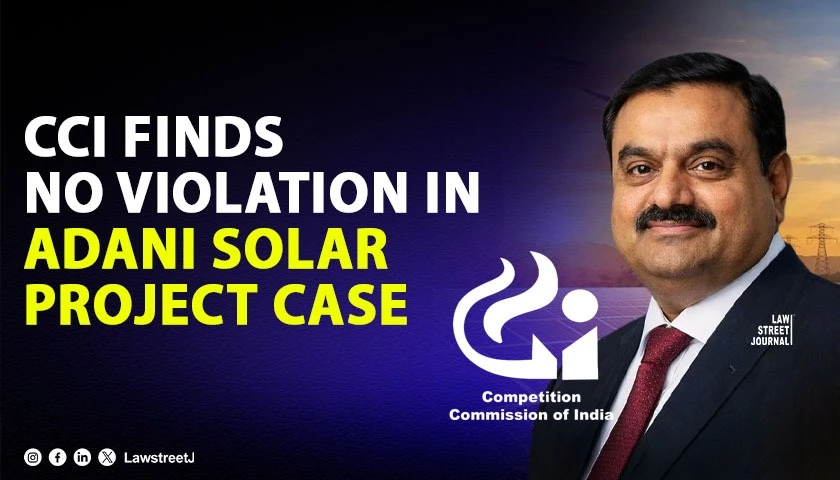
New Delhi: The Competition Commission of India, in an order dated 16th April, 2026 under Section 26(2) of the Competition Act, 2002, has directed closure of a complaint filed by Ravi Sharma alleging bid rigging, abuse of dominant position, and anti-competitive practices by Adani Enterprises Ltd., Adani Green Energy Four Limited, Mr. Gautam S. Adani, Mr. Sagar R. Adani, and Azure Power India Private Limited (OP-1 to OP-5), in connivance with the Solar Energy Corporation of India (SECI/OP-6), several State power distribution companies, and the Government of Andhra Pradesh.
The Commission held that no prima facie case of contravention of the provisions of Sections 3 or 4 of the Act was made out warranting an investigation into the matter.
The information filed by the Informant under Section 19(1)(a) of the Competition Act, 2002 related to a Request for Selection document issued by SECI on 25th June, 2019 for selection of solar power developers to set up 7 GW ISTS-connected Solar PV Power Plants linked with setting up of 2 GW per annum Solar Manufacturing Plants. The scheme comprised two packages: Package A for setting up solar manufacturing plants relating to solar cells and modules of 500 MW each, and Package B for ingots and wafers of 500 MW each. Two blocks were to be allocated under each package, with successful bidders assured Power Purchase Agreements (PPAs) for up to 2,000 MW against each 500 MW solar manufacturing plant under Package A and up to 1,500 MW under Package B. The maximum ceiling tariff under the RfS was Rs. 2.93 per kilowatt hour for 25 years, with the deadline for bid submission being 13th November, 2019.
Upon opening the bids, three bidders qualified: Adani Green Energy Four Limited (OP-2), Azure Power India Private Limited (OP-5), and Navayuga Engineering Co. Ltd. An e-Reverse Auction was held on 22nd November, 2019, and Letters of Award dated 10th December, 2019 were issued to OP-2 and OP-5 at a tariff of Rs. 2.92 per KwH. The LoA awarded to OP-2 was for a cumulative capacity of 2 GW towards manufacturing facilities and 8 GW towards solar power projects, while the LoA to OP-5 was for 1 GW towards manufacturing facilities and 4 GW towards solar power projects. The addendum to the LoAs provided that in the event of no willing buying utility coming forward to enter into Power Sales Agreements (PSAs) with SECI, SECI would have no legal or financial implication and the developers could sell power to any party under intimation to SECI.
The Informant made a series of allegations against the Opposite Parties. It was alleged that the RfS document was designed in a manner to ensure participation of only big players in the market, was prepared in contravention of Ministry of Power guidelines by impermissibly clubbing solar power plants with solar manufacturing plants, and provided a ‘Green Shoe Option’ in contravention of MoP guidelines to favour OP-1, OP-2 and OP-5. It was also alleged that OP-5 had participated as merely a proxy of OP-2 with the intent of re-allocating project capacity to OP-2 at a later stage, and that OP-6 colluded with OP-2 and OP-5 to transfer the entire 12 GW capacity to the Adani Group for extraneous benefits. Further, the Informant relied upon the detailed indictment dated 24th October, 2024 filed by the US Department of Justice and Securities and Exchange Commission, alleging that OP-3, OP-4 and their business executives had bribed Indian government officials to finance lucrative contracts and had also defrauded investors by making false statements about bribery and corruption. The Informant additionally alleged that OP-2’s aggressive greenfield expansion, cross-subsidisation through the broader Adani Group ecosystem, access to below-market capital through group-level financing arrangements, and vertical integration into transmission and distribution amounted to abuse of a dominant position under Section 4(2) of the Act, including by imposing unfair conditions in bidding, limiting market access through capacity hoarding, entering into exclusionary long-term PPAs with state utilities, and monopolising land and transmission infrastructure.
SECI, in its comments forwarded through the Ministry of New and Renewable Energy, stated that it functions as a Renewable Energy Implementing Agency and an intermediary procurer, inviting bids through Tariff Based Competitive Bidding and executing back-to-back PPAs and PSAs. It stated that due processes were followed in issuing LoAs and their addenda, that reducing tariffs voluntarily was in the public interest and not contrary to any law or guideline, and that the Green Shoe Option was specifically directed to be incorporated in the RfS by MNRE vide letters dated 14th August, 2019 and 9th October, 2019 with the approval of the Minister for Power and New and Renewable Energy. SECI also denied that a decision to transfer the 2,333 MW capacity from OP-5 to OP-2 was taken at the joint meeting of 6th July, 2023, stating that the meeting was held to understand OP-5’s concerns, and categorically denied that the 700 MW surrendered by OP-5 under Package I was reallocated to OP-2, calling the allegation completely false.
On the analysis of the allegations, the Commission first examined whether the RfS was designed to favour OP-2 and OP-5 to the exclusion of other competitors. The Commission noted that the Informant had not furnished any cogent evidence in support of the allegation that OP-5 was a cover bidder for OP-2. It further observed that tender design is a function of the procurer’s specific requirements, that the tender was floated three times having been annulled twice in 2019, reflecting the Government’s intent to promote domestic manufacturing, and that the Informant failed to demonstrate how any clause of the RfS or the chain of events described in the Information contravened the provisions of the Act. On the Green Shoe Option, the Commission noted that the CERC had already examined the same issue in Petition No. 286/AT/2021 by order dated 2nd April, 2022, and had held that Section 63 of the Electricity Act, 2003 does not prescribe the type of bid structure to be adopted, leaving it to the Central Government to decide, and that the incorporation of the Green Shoe Option could not be held to be non-compliant with any specific provision of the Act. The Commission accordingly found no anti-competitive conduct in its adoption.
On the allegation of abuse of dominant position by the Adani Group, the Commission observed that power in India is generated through a multiplicity of sources including coal, solar, wind, hydro, and nuclear, and that the relevant power generation market includes numerous significant players both in the public and private sectors such as National Thermal Power Corporation, Power Grid Corporation of India Ltd., Tata Power, Torrent Power, and Reliance Power. The Commission found that the Adani Group could not be considered a dominant player in the broader power generation market in India. Even in the market for power generation from renewable sources, other prominent players such as Tata Power, JSW Energy, and Suzlon Energy were operating. The Commission further found that the Informant had not placed on record any evidence to establish why solar power, or public and private power generation, ought to be treated as distinct relevant markets.
On the specific allegation that OP-2 derives benefits from cross-subsidisation and economies of scale through group affiliations, the Commission held that this does not establish dominant position within the meaning of Section 4 of the Act. On the other allegations of leveraging, exclusion, creation of entry barriers, bid-rigging, and discrimination, no cogent evidence was produced. On the allegation that OP-2 and OP-5 had bribed Indian government officials to facilitate PSAs with State distribution companies so as to allow OP-2 to enter into PPAs with SECI, the Commission held that even if true, such conduct would not qualify as exclusionary or exploitative abusive conduct within the meaning of Section 4 of the Act. The Commission also noted SECI’s position that since there had been no acquisition, amalgamation, or merger between the Opposite Parties, no combination under Section 5 of the Act was triggered, and that there was no basis for presuming a meeting of minds between an intermediary procurer and a project developer or a buying utility so as to constitute an appreciable adverse effect on competition under Section 3 of the Act.
The Commission also referred to its earlier decisions in Case No. 69 of 2016 (Suntec Energy Systems v. National Dairy Development Board) and Case No. 22 of 2018 (G.P. Konar v. Department of Agriculture, Government of Haryana), holding that a procurer has the right to stipulate technical specifications and eligibility conditions in tender documents as per its requirements, which by themselves cannot be deemed anti-competitive. It further noted its decision in Case No. 22 of 2024 (InstaAstro Technology Private Limited v. Astrotalk Services Private Limited) that the dominance of any entity cannot be established solely on the basis of media statements.
Upon consideration of all facts and circumstances, the Commission found no prima facie case of contravention of Sections 3 or 4 of the Competition Act, 2002 and directed closure of the matter under Section 26(2) of the Act. The Secretary was directed to communicate the decision to the Informant and SECI.
Informant: Ravi Sharma, New Delhi
Opposite Parties: Adani Enterprises Ltd. (OP-1); Adani Green Energy Four Limited (OP-2); Mr. Gautam S. Adani (OP-3); Mr. Sagar R. Adani (OP-4); Azure Power India Private Limited (OP-5); Solar Energy Corporation of India (OP-6); Andhra Pradesh Central Power Distribution Corporation Ltd. (OP-7); Andhra Pradesh Eastern Power Distribution Company Ltd. (OP-8); Andhra Pradesh Southern Power Distribution Company Ltd. (OP-9); Government of Andhra Pradesh Energy Department (OP-10); GRIDCO Ltd. (OP-11); Tamil Nadu Generation and Distribution Corporation (OP-12)
Case Title: Ravi Sharma v. Adani Enterprises Ltd. and Others, (Case No. 36 of 2024)


![Fresh Approval Not Needed When CVC Concurs With Unaltered Charge Memo: Delhi HC [Read Judgment]](/secure/uploads/2026/10/lj_9140_Delhi_High_Court_Anti-Corruption_Dossier.png)