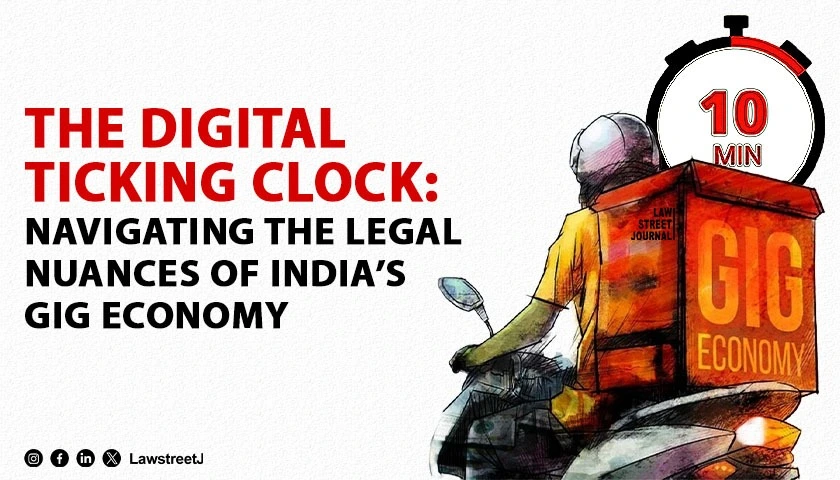
New Delhi: Have you ever stopped to consider, as you track a delivery icon moving across a map on your smartphone, whether the 10-minute delivery guarantee at your fingertips is a miracle of logistics or a high-stakes social experiment? This question became a national flashpoint on 31 December 2025, when over one lakh gig and platform workers across India initiated a nationwide strike, choosing to “log off” during one of the year’s busiest shopping periods to demand fair wages and safety. In a direct response to these protests and growing safety concerns, the Union Labour Ministry on 13 January 2026 officially rolled back the 10-minute delivery model, nudging platforms like Blinkit and Zomato to reconsider fixed time commitments that imperil workers. While this rollback is a significant win for worker safety, it merely scratches the surface of the legal nuances and structural tensions inherent in India’s rapidly expanding gig economy.
The scale of India’s gig economy is staggering. As per the NITI Aayog report titled “India’s Booming Gig and Platform Economy” (published in June 2022), approximately 7.7 million workers were engaged in this sector in 2020–21, a figure projected to rise to 23.5 million by 2029–30. This “structural metamorphosis” is driven by a massive demographic dividend where the traditional formal economy barely creates two million jobs annually for the 20 million people entering the workforce, leaving digital platforms as a vital fallback mechanism for labour absorption. However, as this sector moves from a supplemental “side hustle” to a primary livelihood for millions, the legal framework has struggled to keep pace. The core legal challenge lies in the classification of these workers, whom platforms almost universally designate as “partners” or “independent contractors” rather than employees. This nomenclature is a strategic legal choice that allows aggregators to bypass statutory obligations such as minimum wages, paid leave, and compensation for workplace injuries.
For the first time in Indian history, the Code on Social Security (CoSS), 2020, which became effective on 21 November 2025, formally recognised “gig workers” and “platform workers” as distinct legal categories. Under Section 2(35) of the Code, a gig worker is defined as someone performing work outside the traditional employer–employee relationship, while a platform worker specifically uses an online platform to access tasks and clients. While this recognition is a landmark conceptual step, it does not equate gig workers with formal employees. Consequently, they remain excluded from essential entitlements rooted in laws requiring a clear employer–employee relationship, such as the Industrial Disputes Act, 1947, and the Minimum Wages Act, 1948. The Code essentially provides “protection on paper” without granting enforceable rights to fixed working hours or collective bargaining typically enjoyed by the organised workforce.
One of the most innovative yet debated features of the Code is its funding mechanism for worker welfare. The CoSS 2020 mandates the creation of a Social Security Fund financed primarily through mandatory contributions from platform aggregators. Aggregators are required to contribute between 1% and 2% of their annual turnover, though this is capped at 5% of the total payments made to gig workers. While this turnover-based levy ensures that social security is tied to the commercial success of the platform, legal analysts warn that shifting the entire burden onto the industry without government stakes could threaten the economy’s cost-efficient model or lead to “social security fees” being passed on to consumers. Furthermore, while the fund aims to provide life and disability insurance, health benefits, and old-age protection, its actual implementation remains a vision far from reality as states slowly frame their respective rules.
The legal nuances become even more complex when examining the eligibility criteria proposed in the draft rules released on 30 December 2025. The government has proposed a minimum 90-day work requirement with a single aggregator within a financial year for a worker to access social security benefits. For those working across multiple platforms, the threshold increases to 120 cumulative days. Although a single calendar day where even ₹10 is earned counts as one full “engagement day,” worker unions argue this is a “cliff-edge” rule. Data suggests that many seasonal migrants work in short bursts and average fewer than 45 days annually, meaning 60–70% of the gig workforce could remain outside the social security net despite their contributions to platform growth. This creates a “formalised informality” where workers are visible enough to be regulated but not stable enough to be protected.
Beyond statutory welfare, a significant nuance is the role of algorithmic management, often referred to as the “gamification of labour.” Unlike human supervisors, platform algorithms exercise granular control over work allocation, pricing, and performance metrics. Workers are often subjected to “Quest” bonuses or “Delivery Streaks” that function as psychologically coercive tools, pushing them to work 10–12 hours continuously to unlock essential incentives. These incentives are not “extra pay” but are necessary because basic pay alone is often insufficient. Furthermore, the lack of transparency in these “black box” systems means platforms can quietly reshuffle who gets access to future work based on opaque metrics, leading to algorithmic wage discrimination. The current Labour Codes are largely silent on this algorithmic accountability, leaving workers with no meaningful mechanism to appeal arbitrary deactivations or penalties.
In the absence of robust central implementation, several Indian states have emerged as pioneers in sub-national legislative innovation. Rajasthan was the first to pass the Platform Based Gig Workers (Registration and Welfare) Act in 2023, establishing a dedicated Welfare Board and a fund financed by a welfare tax of 1–2% on each customer transaction. Karnataka followed with a bill that introduces a mandatory 14-day notice period before a platform can terminate or deactivate a worker. Perhaps most crucially, the Karnataka legislation mandates algorithmic transparency, requiring platforms to inform workers in writing about the parameters of their automated monitoring and decision-making systems. These state-level efforts highlight a growing consensus that the gig economy requires a regulatory framework tailored to local workforce demographics and industry dynamics.
The judicial frontier also plays a pivotal role in shaping these rights. The Supreme Court of India is currently hearing a public interest litigation filed by the Indian Federation of App-based Transport Workers (IFAT), which argues that the exclusion of gig workers from formal labour protections violates Articles 14, 21, and 23 of the Constitution. The petitioners contend that the significant control platforms exert over work execution creates a de facto employer–employee relationship, and that the lack of health insurance for hazardous delivery work violates the Right to Life. On 18 February 2025, the Supreme Court directed the government to file a definitive timeline for framing the rules under the Social Security Code, emphasising that the statutory mandate cannot be fulfilled without subordinate legislation. This judicial pressure was a key driver behind the government finally notifying the codes in late 2025.
Internationally, the tide is turning toward a more protective stance. In the UK Supreme Court’s 2021 Uber BV v. Aslam ruling, drivers were classified as “workers” — a middle category between employee and contractor — entitled to minimum wages and paid holidays. Similarly, the European Union is finalising a Platform Work Directive to ensure that platform workers are protected against unfair algorithmic decisions and have the right to collective representation. India appears to be navigating a “middle path” as recommended by NITI Aayog’s RAISE framework, which suggests recognising the varied nature of gig work, allowing innovative financing, and ensuring that benefits are portable as workers move between platforms. However, critics argue that until gig workers are granted the status of “industrial workers” with full collective bargaining rights, they will remain in a state of “independent dependence,” carrying all operational risks while platforms reap the technological rewards.
In conclusion, while the rollback of the 10-minute delivery model is a vital first step, the long-term health of India’s gig economy depends on a more profound constitutional reimagining of labour dignity. The Code on Social Security, 2020, provides a moral and legal foundation, but its effectiveness is contingent on resolving the frictions of the 90-day eligibility rule and the opacity of algorithmic control. India stands at a critical crossroads: it can either continue down a path of greater informalisation or lead the world by creating a balanced legal framework where innovation is matched by accountability. As we look toward the 2030 projection of over 23 million workers, the question for policymakers, platforms, and consumers alike is no longer just about the speed of a delivery, but about the predictability, security, and dignity of the human beings who power the digital age.
[The views expressed in this article are personal and intended for academic and informational purposes only. They do not constitute legal advice or reflect the official position of any institution, organisation, or authority. The analysis is based on publicly available information and existing legal frameworks as on the date of writing.]