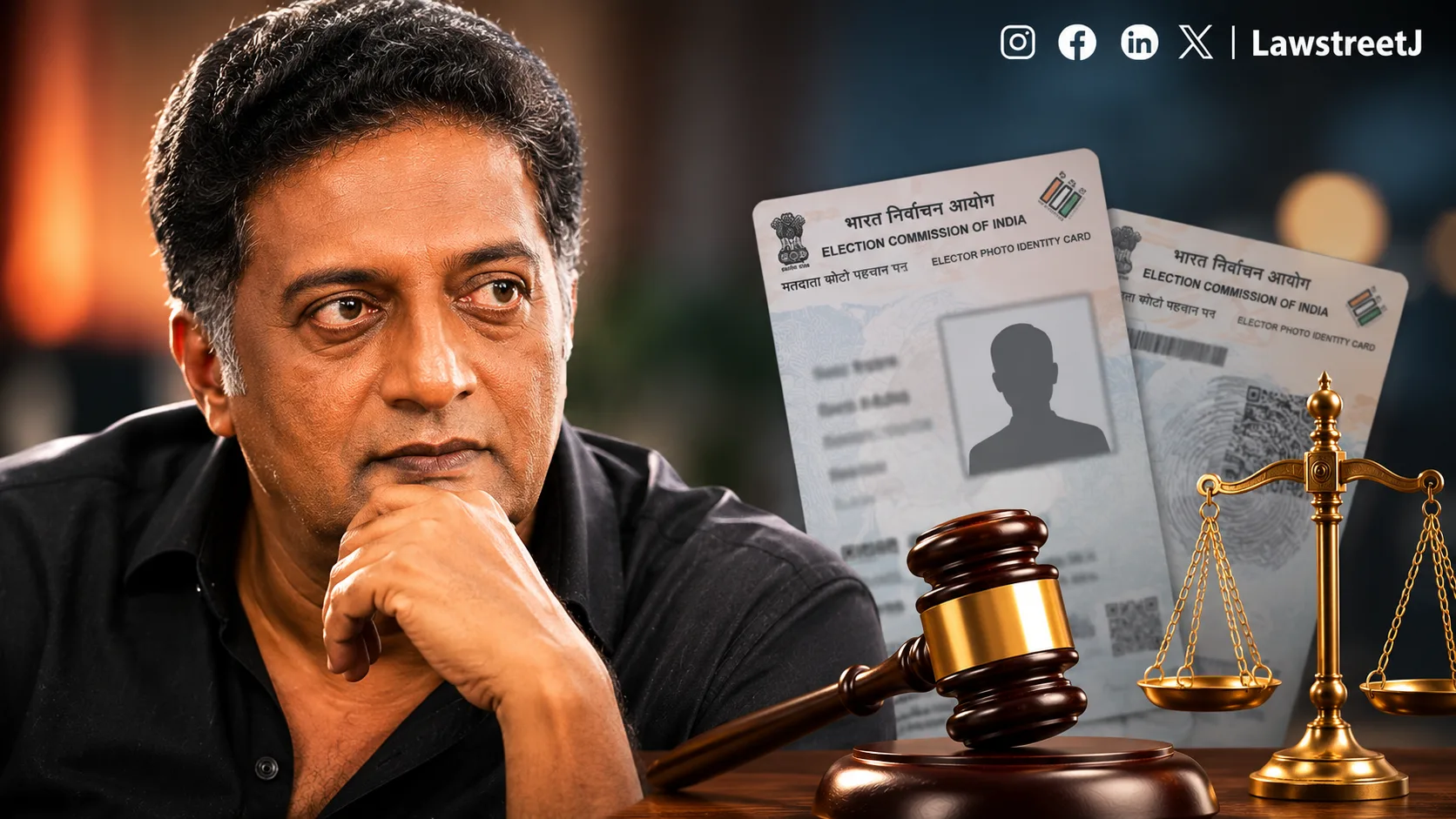
Bengaluru: The 48th Additional Chief Judicial Magistrate (ACJM) court in Bengaluru granted bail to actor and former independent Lok Sabha candidate Prakash Raj. The judicial decision follows a significant legal development regarding allegations that the actor possessed multiple voter identification cards in several states, a practice that reportedly violated established electoral laws.
The court of ACJM Jyoti Shantappa Kale sanctioned the bail application during a session where the actor made a personal appearance to address the ongoing legal proceedings. The court set the bail condition at a cash surety of ₹4,000 and mandated that the actor must be present for all upcoming court hearings as scheduled by the judiciary.
This legal action originated from a private complaint filed by advocate and Bengaluru resident K. Dilip Kumar. The complainant alleged that Prakash Raj was simultaneously enrolled as a voter in four different electoral rolls across the states of Karnataka, Tamil Nadu, and Telangana. Specifically, the accusations pointed to registrations in the Shantinagar Assembly constituency in Bengaluru, the Velachery Assembly constituency in Chennai, and the Serilingampally Assembly constituency in Telangana.
According to the complaint, these multiple registrations were not disclosed in the nomination affidavit filed by the actor during the 2019 Lok Sabha elections, when he contested as an independent candidate for the Bengaluru Central seat. The complainant also alleged that Raj purposefully entered his name in the Shantinagar constituency with the intention of contesting from Bengaluru while maintaining registrations elsewhere.
Sections 17 and 18 of the Representation of the People Act specifically prohibit a person from being registered in more than one electoral constituency or multiple times within a single constituency. Furthermore, the complaint invokes Section 31, which deals with making false declarations during the preparation or revision of electoral rolls, and Section 125A, which pertains to the filing of false affidavits or concealing material information. Section 125A provides for a punishment of up to six months of imprisonment, a fine, or both.
The magistrate had formally taken cognizance of these charges on August 1, 2025, after reviewing evidence presented by the complainant. This evidence included Raj's 2019 nomination affidavit alongside voter registration details from Velachery and Serilingampally. The court determined there was sufficient prima facie material to suggest the actor's name appeared on several electoral rolls during the 2019 election cycle, contrary to his affidavit's disclosures.
During the Friday hearing, Prakash Raj’s legal counsel, advocate Nagarjuna, argued for the recall of a previously issued non-bailable warrant. The defense asserted that Raj had never been served with the initial summons or the subsequent warrants issued by the court. Nagarjuna explained that the actor only became aware of the active legal proceedings through media reports and chose to appear voluntarily to cooperate with the court.
The defense team also informed the court that the voter registration previously held in Tamil Nadu had already been surrendered by the actor. This point was raised to demonstrate Raj's current compliance with electoral regulations, which mandate that a citizen can only be registered as a voter in the constituency where they ordinarily reside.
The procedural history of the case includes three separate non-bailable warrants issued by the trial court after Raj failed to respond to court notices. Summons were initially issued in February 2026, but the actor did not appear on the scheduled dates in March and April. A third NBW was issued on June 12, which eventually prompted the actor to seek immediate relief from the judiciary.
Magistrate Kale’s decision to grant bail brings a close to the immediate procedural issues surrounding the actor's non-appearance and the warrants. However, the trial regarding the substance of the allegations will continue to determine if the multiple enrollments constitute a formal violation of the law.
Case title: K. Dilip Kumar v. Prakash Raj


![Bengaluru Court Orders Twitter (X Corp) to Block 'Liver Doctor' Account Amidst Defamation Lawsuit by Himalaya Wellness Company [Read Order]](/secure/uploads/2023/09/lj_8798_ffedf2a6-87bc-4d90-a3b4-077c76b2dd87.jpg)
.jpeg)