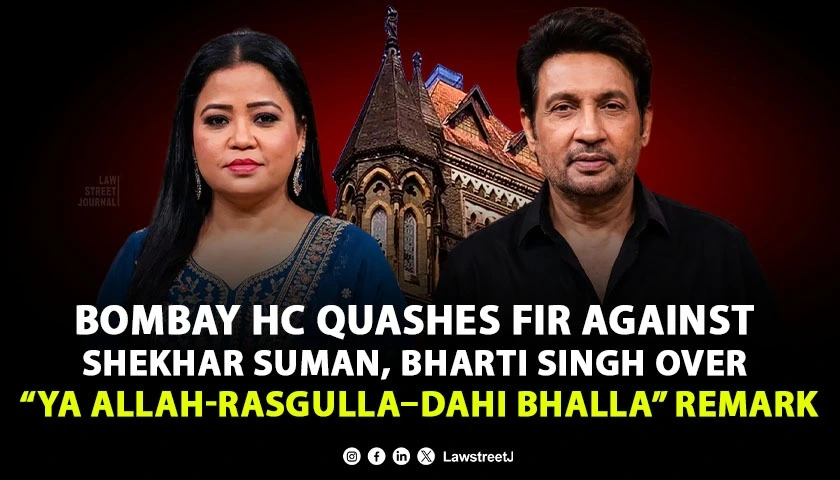
Mumbai: The Bombay High Court has quashed a First Information Report registered in 2010 against actor and television host Shekhar Suman and comedian Bharti Singh, arising from a comic performance on Sony Entertainment Television’s programme “Comedy Circus Ka Jadoo”, in which the words “Ya Allah! Rasgulla! Dahi Bhalla!” were used as rhyming exclamations.
Justice Amit Borkar, while allowing both writ petitions, held that the essential ingredients of a deliberate and malicious intention to outrage religious feelings were conspicuously absent, and that the mandatory sanction required under Section 196 of the Code of Criminal Procedure had not been obtained before proceeding against the petitioners.
The FIR had been registered for offences punishable under Section 295-A read with Section 34 of the Indian Penal Code, on the basis of a complaint lodged by one Mr. Mohd. Imran Dadani Rasabi, who described himself as the President of Raza Academy. The complaint alleged that Episode No. 18 of the programme, telecast on 20 November 2010 at around 9:30 p.m., contained expressions that offended the religious sentiments of members of the Muslim community.
In the episode in question, Bharti Singh performed the character of “Umrao Jaan”, a role inspired by a well-known Hindi motion picture set in a historical period, while her co-performer enacted a character from the film “Dabangg”. Since the original character of Umrao Jaan spoke in Urdu, similar linguistic elements were incorporated into the performance, and the expressions “Ya Allah! Rasgulla! Dahi Bhalla!” were used as comic, rhyming exclamations between the two characters.
On behalf of the petitioners, it was contended that Shekhar Suman had participated only in the capacity of a judge on the programme, and Bharti Singh had performed as an artist under a scripted comic theme, neither of them having authored or deliberately designed the impugned expressions. It was urged that the words “Dahi Bhalla” and “Rasgulla” are common food items consumed across communities without any religious connotation, and that their use in a comedy show for rhyming effect could not, by any reasonable standard, be construed as an insult to any religion.
Reliance was placed on the Supreme Court’s decision in Ramji Lal Modi v. State of Uttar Pradesh, (1957) 1 SCC 591, wherein it was held that only acts actuated by deliberate and malicious intent, and not those which merely incidentally cause offence, attract Section 295-A. It was further urged that no sanction under Section 196 of the CrPC had been obtained, which is a mandatory prerequisite before any court can take cognizance of an offence under Section 295-A.
The State, through the learned APP, opposed the petitions, submitting that the allegations in the FIR, on a plain reading, disclosed the commission of cognizable offences, and that the question of whether the offences were actually made out should be determined at trial upon appreciation of evidence.
Justice Borkar, after examining the complaint and the material on record, found merit in both primary contentions of the petitioners. On the question of the essential ingredients of Section 295-A, the Court held that the provision is not attracted by every utterance that may annoy some person or group. Both the deliberate and malicious elements must co-exist, and the absence of either is fatal to the prosecution. The Court found no material in the complaint disclosing any such intention on the part of either petitioner. The performance, the Court noted, was theatrical in nature and intended for entertainment, which by itself does not create criminality.
On the specific words complained of, the Court was unequivocal. It held that “Dahi Bhalla” and “Rasgulla” are neutral expressions in ordinary social use, known and consumed by people across all communities. Mere mention of food items in a comic act cannot amount to an insult to religion. The Court observed that something more is required—there must be material to show that the words were selected as a weapon of offence—and no such material existed on record.
The Court also underscored the importance of context, observing that a comedy show cannot be judged by the same standards as a doctrinal speech or a political statement. A performance of this nature must be read as a whole, and not by isolating stray expressions from their setting. The Court further noted that the original complainant did not personally appear to have viewed the programme and had acted on representations received from certain persons, and that the FIR was registered without any preliminary verification of the allegations.
On the role of the petitioners, the Court held that Shekhar Suman, as a judge on the programme, did not utter the impugned expressions and had no shared design to insult any religion. Common intention under Section 34 of the IPC, the Court clarified, cannot be assumed from mere presence in or participation in a televised programme; there must be positive material of a shared mind, which was entirely absent. Similarly, Bharti Singh, as a performing artist acting within a scripted comic theme, could not be attributed the requisite mental element for the offence.
On the issue of sanction, the Court held that Section 196 of the CrPC is mandatory and places a clear bar on courts from taking cognizance of offences under Section 295-A without prior sanction of the Central or State Government. The record did not show that any such sanction had been obtained, and this omission was held to go to the very legality of the prosecution. The Court rejected the State’s submission that the matter should proceed to trial, holding that a trial is not a substitute for a legal foundation. Where the complaint itself does not disclose the essential ingredients of the offence and the mandatory sanction is absent, continuation of criminal proceedings would amount to an abuse of process.
Both criminal writ petitions were accordingly allowed. The FIR bearing C.R. No. 265 of 2010 and all consequential proceedings arising therefrom were quashed and set aside.
The petitioners were represented by Mr. Niteen Pradhan, Senior Advocate, with Mr. P.D. Desai. The State was represented by Mrs. Megha Bajoria, Additional Public Prosecutor.
Case Title: Shekhar Suman & Anr. v. The State of Maharashtra and Others, Writ Petition Nos. 1902 and 1906 of 2012


![Husband Can Also Claim Alimony/Maintenance From Wife: Bombay High Court Orders Woman To Pay Alimony To Ex-Husband [Read Order]](/secure/uploads/2022/04/lj_2823_Divorce.jpg)