

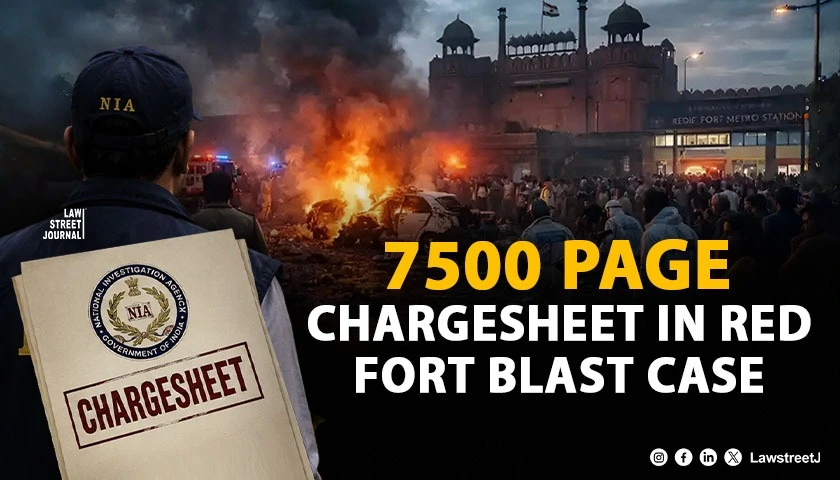
New Delhi: The National Investigation Agency (NIA) has filed an extensive 7,500-page chargesheet before the NIA Special Court at Patiala House Courts, New Delhi, against 10 accused persons in connection with the high-intensity Vehicle-Borne Improvised Explosive Device (VBIED) blast near the Red Fort area on 10 November 2025, which resulted in the deaths of 11 persons. The chargesheet was submitted on 14 May 2026 in NIA Case No. RC-21/2025/NIA/DLI.
According to the NIA, all 10 accused named in the chargesheet, including the deceased main perpetrator, Dr. Umer Un Nabi, were associated with Ansar Ghazwat-ul-Hind (AGuH), an offshoot of Al-Qaida in the Indian Subcontinent (AQIS). AQIS and all its manifestations, including AGuH, were designated as terrorist organisations by the Ministry of Home Affairs in June 2018.
Dr. Umer Un Nabi, a former Assistant Professor of Medicine at Al-Falah University, Faridabad, originally from Pulwama, Jammu and Kashmir, has been identified as the suicide bomber who executed the attack. Since he died in the explosion, the NIA has sought abatement of proceedings against him before the Special Court.
The remaining accused named in the chargesheet are Aamir Rashid Mir, Jasir Bilal Wani, Dr. Muzamil Shakeel, Dr. Adeel Ahmed Rather, Dr. Shaheen Saeed, Mufti Irfan Ahmad Wagay, Soyab, Dr. Bilal Naseer Malla, and Yasir Ahmad Dar. The NIA has highlighted that several of the accused are allegedly radicalised medical professionals who played significant roles in the conspiracy.
The chargesheet invokes provisions of the Unlawful Activities (Prevention) Act, 1967; the Bharatiya Nyaya Sanhita, 2023; the Explosive Substances Act, 1908; the Arms Act, 1959; and the Prevention of Damage to Public Property Act, 1984. The investigation, which was later taken over from the Delhi Police, extended across Jammu and Kashmir, Haryana, Uttar Pradesh, Maharashtra, Gujarat, and the Delhi-NCR region.
The evidentiary basis of the chargesheet comprises 588 witness testimonies, over 395 documentary exhibits, and more than 200 material exhibits seized during the investigation.
As per the NIA press release dated 14 May 2026, the probe uncovered a highly organised and long-standing terror conspiracy linked to the AQIS and AGuH ideological framework. Investigators found that the accused allegedly held a secret meeting in Srinagar in 2022, where they revived the AGuH outfit under the name “AGuH Interim” following the failure of an attempted Hizrat — a religiously motivated migration to Afghanistan through Turkey.
Under this reorganised structure, the accused allegedly launched “Operation Heavenly Hind,” which the NIA describes as a coordinated terrorist campaign aimed at overthrowing the democratically elected Government of India and establishing Sharia rule.
The agency stated that, in furtherance of this operation, the accused recruited members, propagated violent extremist ideology linked to AQIS and AGuH, and accumulated arms and ammunition over several years. The investigation further revealed that the accused manufactured Improvised Explosive Devices (IEDs) using commercially available chemicals and conducted repeated experiments to perfect explosive compositions.
The explosive used in the 10 November 2025 attack was identified as Triacetone Triperoxide (TATP), allegedly manufactured through the clandestine procurement of precursor chemicals and sustained experimentation. The identity of Dr. Umer Un Nabi was conclusively confirmed through DNA fingerprinting after the NIA assumed charge of the investigation.
The investigation also exposed an alleged illegal arms procurement network involving prohibited weapons, including an AK-47 rifle, a Krinkov rifle, and country-made pistols, along with live ammunition. The accused were also found to have experimented with drone-mounted and rocket-mounted IEDs allegedly intended to target security establishments in Jammu and Kashmir and elsewhere in India.
According to the NIA, laboratory equipment and specialised materials such as MMO anodes, electric circuits, and switches were procured through both online and offline channels to facilitate the manufacture of explosives. Forensic and voice analysis examinations were conducted on evidence collected from the blast site, as well as multiple locations connected to Al-Falah University in Faridabad and various places in Jammu and Kashmir.
The NIA further stated that the accused had planned to expand their activities to other parts of the country, which were thwarted following the dismantling of the alleged terror module. So far, 11 persons have been arrested in the case, while efforts continue to trace and apprehend absconding individuals whose involvement surfaced during the investigation.
Reference: NIA Press Release dated 14.05.2026; NIA Case No. RC-21/2025/NIA/DLI; Chargesheet before the NIA Special Court, Patiala House Courts, New Delhi.

![SC dismisses Union govt's plea against bail to Maoist financer in case of attack on police party in Jharkhand [Read Judgment]](/secure/uploads/2024/05/lj_3293_b43edf7d-73b7-4f21-b5f8-1f7b454ff1b8.webp)