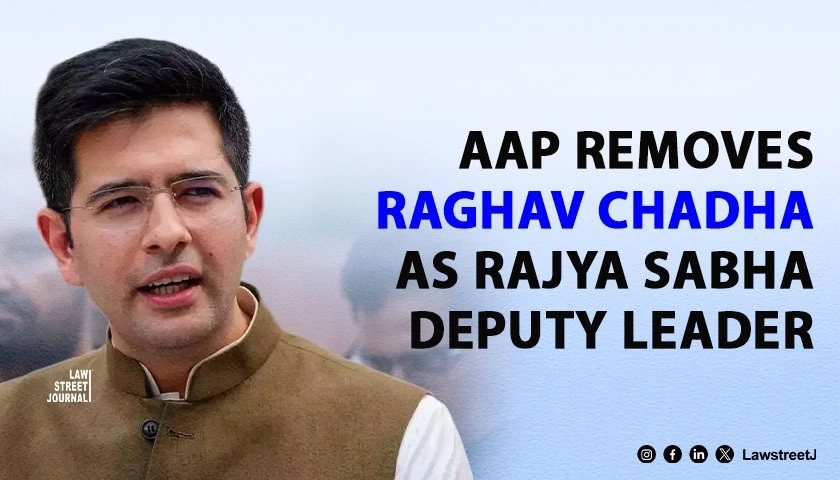
New Delhi: On April 2, 2026, the Aam Aadmi Party (AAP) formally notified the Rajya Sabha Secretariat that Raghav Chadha, Member of Parliament representing Punjab, has been removed as the party’s Deputy Leader in the Rajya Sabha. The communication also requested that Chadha not be allotted speaking time from AAP’s quota in the Upper House.
This decision is significant because the Deputy Leader plays a central role in coordinating parliamentary interventions, managing speaking slots, and representing the party’s stance during debates. By withdrawing Chadha’s speaking privileges, AAP has effectively curtailed his parliamentary role within the party framework while retaining his membership as a sitting MP.
The Rajya Sabha, India’s Upper House of Parliament, functions under the Rules of Procedure and Conduct of Business, which provide that parties are allotted speaking time proportionate to their strength. Distribution of this time among members is determined by the party leadership. AAP’s letter to the Secretariat is, therefore, a binding directive on how its allotted time should be managed.
Appointment of Ashok Mittal and Political Developments
Alongside Chadha’s removal, AAP announced the appointment of Ashok Mittal, Rajya Sabha MP from Punjab, as the new Deputy Leader. Mittal, who entered the Rajya Sabha in 2022, is expected to take over the responsibilities of parliamentary coordination and representation. His appointment reflects the party’s intent to restructure its leadership and ensure continuity in parliamentary representation.
The timing of this decision is notable. Just weeks earlier, Chadha was dropped from AAP’s list of star campaigners for upcoming Assembly elections. This sequence of events suggests a broader reorganization of responsibilities within the party, with implications for both electoral campaigning and parliamentary strategy.
Chadha, who has been a prominent face of AAP in national politics, was earlier known for his active participation in debates and interventions in the Rajya Sabha. His removal from the Deputy Leader role and restriction from speaking time indicate a deliberate recalibration by the party leadership.
Legal and Parliamentary Implications
The removal of a Deputy Leader in the Rajya Sabha is a procedural matter governed by internal party decisions. The Rajya Sabha Secretariat acts upon such communications by updating official records and ensuring that speaking time allocations reflect the revised leadership structure.
From a legal standpoint, Chadha’s removal does not affect his membership in the Rajya Sabha, nor does it alter his constitutional rights as an elected representative. He continues to hold his seat as a Member of Parliament. However, the restriction on speaking time significantly reduces his influence in shaping AAP’s parliamentary discourse.
The Rules of Procedure recognize the authority of political parties to determine how their allotted speaking time is distributed. By formally requesting that Chadha not be allotted time, AAP has exercised its prerogative to control internal allocation. This underscores the importance of party discipline in parliamentary functioning.
While individual MPs retain their constitutional rights, their ability to represent party positions in debates is subject to internal decisions. Chadha’s curtailed role highlights the balance between individual representation and collective party strategy in the functioning of the Rajya Sabha.
Key Issues Raised by Raghav Chadha in Parliament
1. Economic and Financial Concerns
- Stock Market Erosion: Chadha flagged the erosion of nearly ₹48 lakh crore in investor wealth in the Indian stock market following the escalation of conflict in West Asia. He urged the government to address investor concerns and provide clarity on measures to stabilize markets.
- Fiscal Accountability: He has consistently questioned the government on fiscal transparency, particularly regarding central schemes and budget allocations, emphasizing accountability in public spending.
2. Telecom and Consumer Protection
- Prepaid Mobile Recharge Irregularities: Chadha raised concerns about alleged irregularities in prepaid mobile recharges, describing it as a “scam” affecting consumers. He highlighted that subscribers were being forced into multiple recharges within short periods and called for regulatory intervention.
- Digital Services Oversight: He has also advocated for stronger consumer protection in digital services, emphasizing fair practices in telecom and internet-based platforms.
3. Governance and Legislative Oversight
- Delhi Services Bill: Chadha was among the most vocal critics of the Delhi Services Bill, arguing that it undermined the elected government of Delhi by transferring control of administrative services to the Centre.
- Committee Representation Dispute (2023): Chadha faced suspension from the Rajya Sabha after allegations that he added names of MPs to a motion without consent. Although the suspension was later revoked, the incident highlighted his assertive approach in parliamentary procedures.
4. Broader Policy Interventions
- Transparency in Governance: Chadha frequently pressed for greater transparency in government decision-making, particularly in matters of finance and administration.
- Public Accountability: He raised questions on issues ranging from healthcare funding to infrastructure projects, positioning himself as a watchdog on governance.
Chadha’s interventions made him one of AAP’s most visible MPs in the Rajya Sabha. His focus on economic stability, consumer rights, and governance transparency aligned with the party’s broader political messaging. However, his removal from the Deputy Leader role and restriction from speaking time now limit his ability to represent these issues in Parliament.
Broader Political Significance
This development comes at a time when AAP is preparing for crucial Assembly elections in multiple states. The removal of Chadha from both the star campaigner list and the Deputy Leader role suggests a shift in the party’s internal dynamics.
Chadha has been one of the youngest and most visible leaders of AAP, often representing the party in national debates and media interactions. His exclusion from key roles may indicate a strategic decision by the leadership to reassign responsibilities and recalibrate its public messaging.
Ashok Mittal’s appointment as Deputy Leader also reflects the party’s emphasis on continuity and stability. His background as an educationist and his relatively low-profile political career may align with AAP’s current parliamentary priorities.
This development represents a significant internal shift within AAP’s parliamentary leadership, with potential implications for its strategy in the Upper House and its broader political positioning.


![Kejriwal Govt's temporary appointments costing Rs. 30 cr per year axed by LG, decision upheld by Delhi High Court [Read Judgment]](/secure/uploads/2023/10/lj_3847_8da2bc6e-2fb2-4852-ad79-35f98380b3bf.jpg)