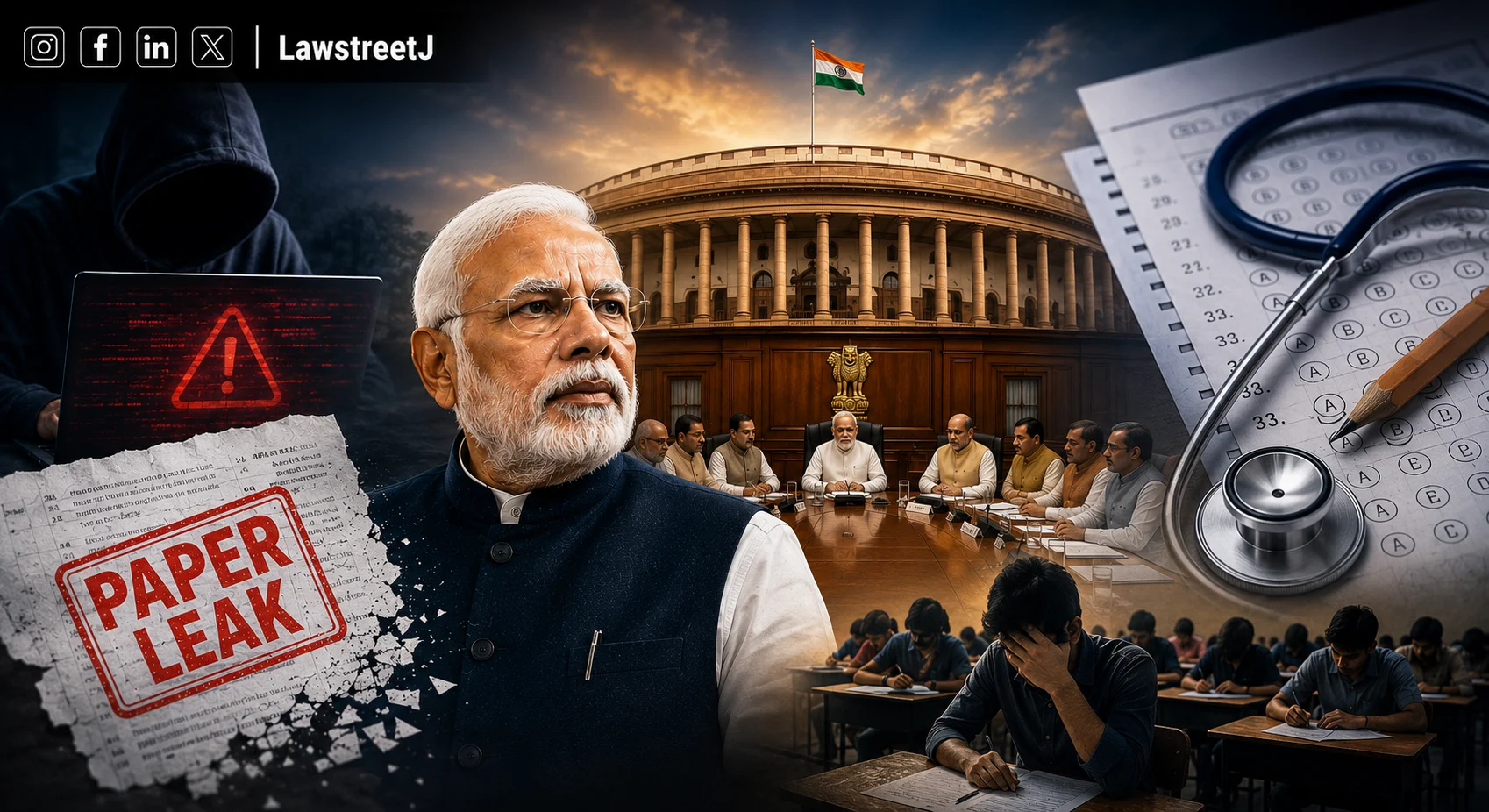
New Delhi: The Union Cabinet, chaired by Prime Minister Narendra Modi, officially approved a draft bill on Friday, July 24, 2026, to significantly strengthen the penalties under the existing anti-paper leak legislation. This legislative action seeks to amend the Public Examinations (Prevention of Unfair Means) Act, 2024, in response to mounting public pressure and widespread student protests following irregularities in major competitive examinations like NEET-UG and UGC-NET.
The move follows a late-night video message from the Prime Minister, wherein he assured the nation that the government would introduce tougher provisions to protect the integrity of the educational system.
The proposed amendments introduce an escalation in financial and custodial penalties for those involved in organized examination fraud. Under the new provisions, the maximum fine for organized paper leaks is set to rise from the current ₹1 crore to a staggering ₹10 crore. Furthermore, the maximum prison sentence for such offences will be maintained at 10 years, but the minimum punishment for individuals involved in paper leaks is proposed to increase from three years to five years of imprisonment. These stricter measures are intended to serve as a powerful deterrent against organized syndicates and institutions that exploit examination processes for monetary gain.
A central feature of the new draft bill is the mandatory establishment of fast-track courts to ensure the swift adjudication of cases related to paper leaks. The government has already designated a special fast-track court at Delhi’s Rouse Avenue Court to expedite trials under the 2024 Act. This procedural shift aims to restore public confidence by ensuring that perpetrators do not benefit from prolonged litigation cycles. Officials indicated that the Prime Minister’s Office has been in close coordination with the Ministry of Education to refine these reforms following several months of investigation into recent examination failures.
The scope of the anti-paper leak law is also slated for significant expansion to cover a broader range of examinations. While the original 2024 Act applied to central agencies such as the Union Public Service Commission (UPSC), Staff Selection Commission (SSC), Railway Recruitment Boards, and the National Testing Agency (NTA), the proposed amendments seek to bring state-level public examinations within the ambit of the central law. This change addresses a critical gap, as recent investigations revealed that paper leaks are often part of inter-state criminal enterprises.
Also Read- New Anti-Cheating Law enacted: Analysis
Legally, all offences under the amended Act will remain cognizable, non-bailable, and non-compoundable. This means that law enforcement authorities can make arrests without a warrant, bail remains at the sole discretion of the court, and cases cannot be settled through out-of-court compromises. The law continues to define a broad spectrum of illegal acts, including the unauthorized access to question papers, tampering with OMR sheets, creating fake examination websites, and hacking into computer systems used for testing. Notably, the legislation continues to protect individual candidates from its penal provisions, leaving them subject to the administrative rules of the respective examining authorities.
The political backdrop of these reforms is marked by intense agitation from student groups, most notably the Cockroach Janta Party (CJP), which has led nationwide demonstrations. The protesters have demanded the resignation of Union Education Minister Dharmendra Pradhan and sought compensation for the families of students who were adversely affected by the NEET-UG controversy. While the government has stood behind the Minister, it has engaged in high-level talks with protest representatives to discuss their demands for systemic reforms. These discussions have included suggestions for improving the National Testing Agency’s (NTA) operational standards and infrastructure.


![Supreme Court Upholds Relief to Telecom Companies on AGR Amidst Covid-19 [Read Order]](/secure/uploads/2023/09/lj_5865_Telecom_companies_Adjusted_Gross_Revenue.jpg)