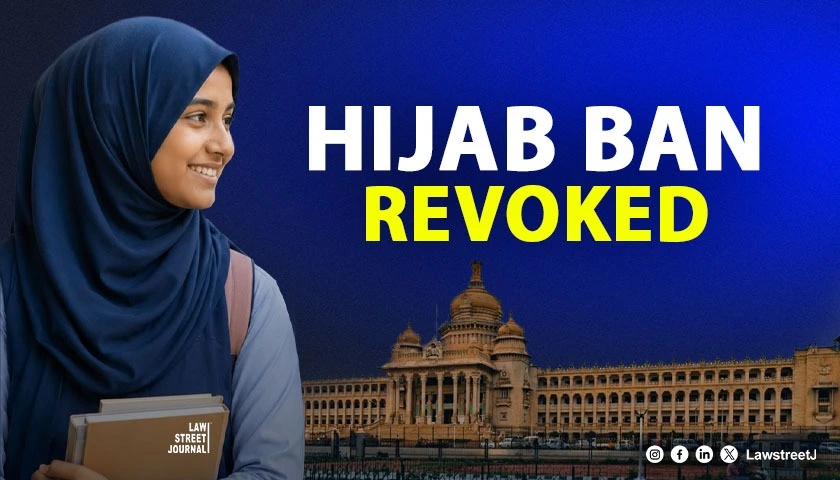
Karnataka: The Government of Karnataka has withdrawn its earlier Government Order No. ED 14 SHH 2022 dated 05.02.2022, which had led to widespread controversy across the State over the wearing of religious symbols and attire in educational institutions, and has issued fresh directions in its place vide Government Order No. ED 14 SHH 2022 dated 13.05.2026, Bengaluru, thereby superseding the earlier order with immediate effect.
The fresh order has been issued by the Under Secretary to the Government (Primary and Secondary Education Department) in exercise of the powers conferred under Section 7 and Section 133(2) of the Karnataka Education Act, 1983 read with Rule 11 of the Karnataka Education Institutions (Classification, Regulation and Prescription of Curricula etc.) Rules, 1995. The order is also informed by a review of the dress code framework applicable to Central Government schools run under the Kendriya Vidyalaya Sangathan and the service rules applicable to residential schools maintained by the Central Government.
The background to the fresh order lies in the difficulties that had arisen during the implementation of the earlier order. While the Government’s earlier order of 05.02.2022 had directed all educational institutions, aided institutions, private institutions and pre-university colleges to strictly enforce the prescribed uniform, difficulties arose particularly in respect of certain limited symbols worn by students belonging to various religious communities and faith traditions. The Government reconsidered the matter and took the view that students should be allowed to wear certain limited symbols rooted in religious or traditional practice alongside the institutional uniform, provided that such symbols do not threaten or compromise institutional discipline, public order, safety, the learning environment, or the secular character of the institution.
Accordingly, the new order makes clear that while permitting such limited symbols, they shall not function as supplementary or alternate uniforms, shall not replace the prescribed uniform itself, and shall not be used to undermine or defeat the purpose of the uniform system. No student shall be denied recognition, admission, or access to examinations, competitions, or academic activities solely on account of wearing such permitted symbols. The institution’s responsibility to maintain discipline and uniformity, protect student safety, and create a conducive academic environment is equally preserved.
The Government has clarified that the implementation of the order must be uniform across the institution and free from religious or caste discrimination. It has further clarified that secularism in the constitutional sense does not mean opposition to personal faith, but rather equal respect for all, social harmony, freedom from caste stigma, and non-discriminatory conduct. The Government is committed to maintaining a neutral and equal stance toward all religions and communities in accordance with constitutional principles.
The order sets out the following specific directions applicable to all Government schools, aided educational institutions, private educational institutions, and pre-university colleges in the State, as well as all related authorities:
First, the earlier Government Order No. ED 14 SHH 2022 dated 05.02.2022 is withdrawn and shall cease to be operative with immediate effect.
Second, all Government schools, aided educational institutions, private educational institutions, and pre-university colleges in the State are directed to enforce the prescribed uniform in accordance with the Government’s directions and the relevant regulations. Such institutions are prohibited from compelling students to wear attire that goes beyond the prescribed uniform. The prescribed uniform must be strictly adhered to, and institutions where a uniform is mandated must ensure that it is worn in a manner that upholds discipline, uniformity, and public order.
Third, students from communities whose prescribed uniform conflicts with certain limited traditional or faith-based symbols are permitted to wear such limited symbols alongside the uniform. However, such traditional or faith-based symbols must be complementary to the uniform and must not serve to replace the existing uniform, modify it, alter its character, or defeat its underlying purpose.
Fourth, the limited traditional or faith-based symbols that students are ordinarily permitted to wear alongside the prescribed uniform include the Peti or Turban, Janivara or Pavitra Dara, Shivadara, Rudraksha, Talevastre or Headscarf, or any other similar symbols that are of an equivalent nature rooted in religious or traditional practice. However, such symbols shall not interfere with institutional requirements relating to discipline, safety, or student identification.
Fifth, no student wearing such permitted limited traditional or faith-based symbols shall be denied admission, access to examinations or competitions, or participation in academic activities by any educational institution on that ground alone.
Sixth, no student shall be compelled or coerced into wearing such traditional or faith-based symbols. Similarly, the Government shall not compel the forcible removal of the limited traditional or faith-based symbols that it has permitted. However, in examination-related contexts, the State, national, and residential uniform regulations prescribed by the relevant competent authorities shall apply as contextually appropriate.
Seventh, the implementation of this order must be uniform, free from religious and communal discrimination, and non-discriminatory in character. It must be aligned with and conducive to the constitutional values of equality, dignity, fraternity, communal harmony, scientific temper, and rationality, as well as the constitutional right to education.
Eighth, the School Development and Monitoring Committees, College Development Committees, governing bodies, heads of institutions, and all concerned authorities and staff members are prohibited from targeting any student through discriminatory conduct, humiliation, or abusive behaviour on account of caste, religion, or community. All such institutions are directed to adopt an inclusive and liberal approach toward all students. Institutions must not penalise any student’s education through arbitrary and improper exclusion in order to maintain discipline.
Ninth, any circular, decision, instruction, or institutional directive inconsistent with this order shall be deemed unauthorised.
Tenth, the Commissioners of School Education and Literacy, the Directors of Pre-University Education, and all District Education Officers are directed to issue necessary instructions to all educational institutions in the State for the implementation of this order.
The order has been issued by the Government of Karnataka under the authority of the Governor and in the name of the Governor, and has been authenticated by the Under Secretary to the Government of Karnataka (Primary and Secondary Education Department) on 13.05.2026.
Reference: Government Order No. ED 14 SHH 2022, Government of Karnataka (Primary and Secondary Education Department), dated 13.05.2026, Bengaluru



![[Belagavi stripping incident] Karnataka HC slams state govt, says "Modern world is of Dusshasana"](/secure/uploads/2023/12/lj_9786_ae69bb19-5c7f-4bb3-ae97-101f5f8c127f.jpg)
![SC halts Karnataka’s half-yearly board exams for classes 8,9,10; Criticises Govt for harassing students [Read Order]](/secure/uploads/2024/10/lj_6656_WhatsApp_Image_2024-10-23_at_1.33.55_PM.webp)