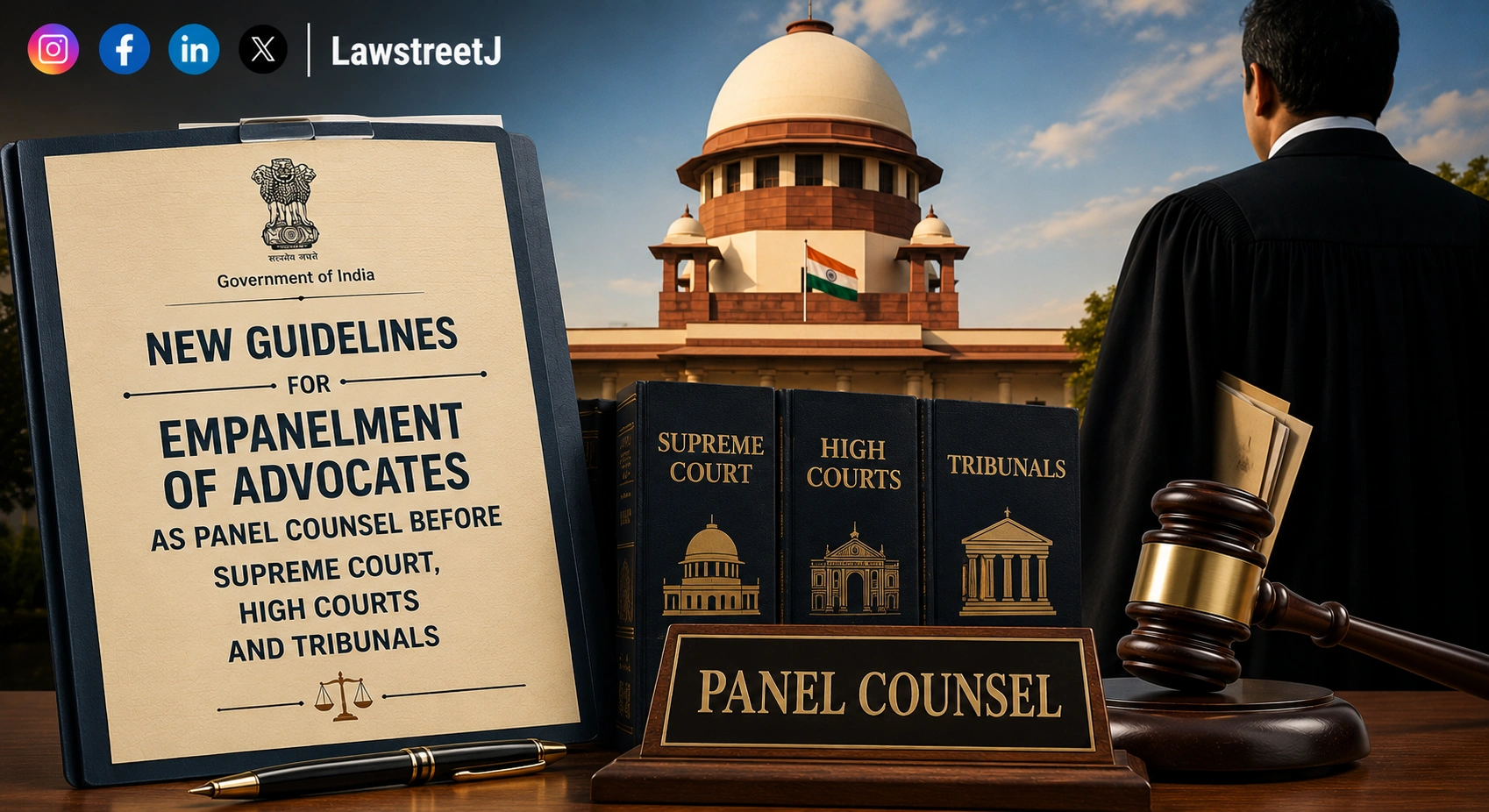
New Delhi: The Department of Legal Affairs has issued fresh guidelines governing the empanelment of Panel Counsel across the Supreme Court, all High Courts, tribunals and subordinate courts, setting out uniform eligibility, tenure, fee and conduct norms for advocates engaged to represent the Union of India.
Background
The Ministry of Law and Justice's Department of Legal Affairs, which holds the mandate for conducting litigation on behalf of the Union of India before various Courts, Tribunals and Forums, has issued an Office Memorandum dated 20th August, 2026 laying down comprehensive guidelines for the empanelment of Advocates as Panel Counsel. Panel Counsel are typically empanelled for a period of three years, and the fresh guidelines consolidate the qualifications, process and conduct requirements applicable across the Supreme Court, all High Courts, District and Subordinate Courts, and various Tribunals.
Eligibility and Qualifications
Under the guidelines, an applicant must hold a Bachelor's degree in law from a university or college recognised by the Bar Council of India, be enrolled with the respective State Bar Council under the Advocates Act, 1961, and must have qualified the All-India Bar Examination and obtained a Certificate of Practice. Advocates will be considered for empanelment based on their years of legal practice as prescribed under Annexure-I to the guidelines, with the Department also weighing the nature, complexity and category of cases handled, the level of responsibility shouldered, and an advocate's ability to conduct high-stakes matters.
The guidelines further provide that advocates with experience in Special Laws such as Income Tax, Customs, GST and PMLA may be considered for specialised panels, while those with at least ten years of legal work experience gained during Government service may also be considered for empanelment based on their area of expertise. The overall performance track record, conduct and integrity of an advocate during the empanelment process will additionally be taken into account.
Application Process
Applications for empanelment are to be submitted in the prescribed format under Annexure-II, addressed to the Deputy Secretary, Department of Legal Affairs, and may be sent by email to panelcounsel-dla@gov.in. Applications will be scrutinised by departmental officers for compliance with eligibility criteria, completeness, and authenticity of documents submitted, and any application found incomplete, illegible, or not in the prescribed format will be summarily rejected.
Applicants are required to submit a signed application along with bio-data containing contact details, educational qualifications, professional experience and Bar Council enrolment number, self-attested copies of certificates and testimonials, details of any prior empanelment with other Government bodies, a signed undertaking to abide by the terms and conditions including the fee structure, and a declaration that they have not been convicted of any criminal offence and are not disqualified or debarred from practice.
Tenure, Fees and Disqualification
The tenure of empanelment will run for three years or until further orders, whichever is earlier, with the performance of empanelled advocates reviewed annually. Professional fees will be admissible for litigation assigned to Panel Counsel, governed by the fee schedule approved by the Department as revised from time to time. An advocate will be disqualified for empanelment if they suffer from any disqualification under Section 24A of the Advocates Act, 1961, have faced professional disqualification by a Bar Council, or have previously abused their position as an advocate in a manner detrimental to the interests of the Union of India.
De-empanelment and Conduct Obligations
The Central Government may de-empanel a Panel Counsel at any time for acting against instructions, failing to return briefs, misappropriation of money, contempt of court, professional misconduct, or conviction by a court of law. An empanelled advocate may resign by giving at least one month's prior notice, during which all original case files, records and documents must be handed over and pending matters transitioned within fifteen days, though the notice period may be relaxed with the approval of the competent authority.
The guidelines also bar empanelled advocates from assigning or delegating any brief to another advocate without prior written approval, require strict confidentiality regarding all departmental information and documents, and clarify that the allocation of cases remains entirely at the discretion of the Department of Legal Affairs, with empanelment conferring no right or guarantee to a minimum number of assignments.
Scope Across Courts and Tribunals
Annexure-I to the guidelines sets out court-wise empanelment categories and the corresponding minimum experience required, ranging from Junior Counsel and Central Government Counsel positions requiring two to four years of practice, to Deputy Solicitor General posts at various High Courts requiring ten years. The framework covers the Supreme Court, all High Courts and their benches, the Central Administrative Tribunal, the Armed Forces Tribunal, District and Subordinate Courts across the country, arbitration matters in Delhi and the NCR, and specialised roles such as Standing Counsel before the National Green Tribunal and the Telecom Regulatory Authority of India, both of which require fifteen years of practice.
Implementation
The guidelines are effective from the date of issuance, and all prior empanelments of Advocates as Panel Counsel notified by the Department of Legal Affairs will continue to remain valid and operative until completion of their respective tenure.
Reference: OM No. J-11022/2/2015-Judicial/E.130475, Department of Legal Affairs, Ministry of Law and Justice, dated 20th August, 2026.