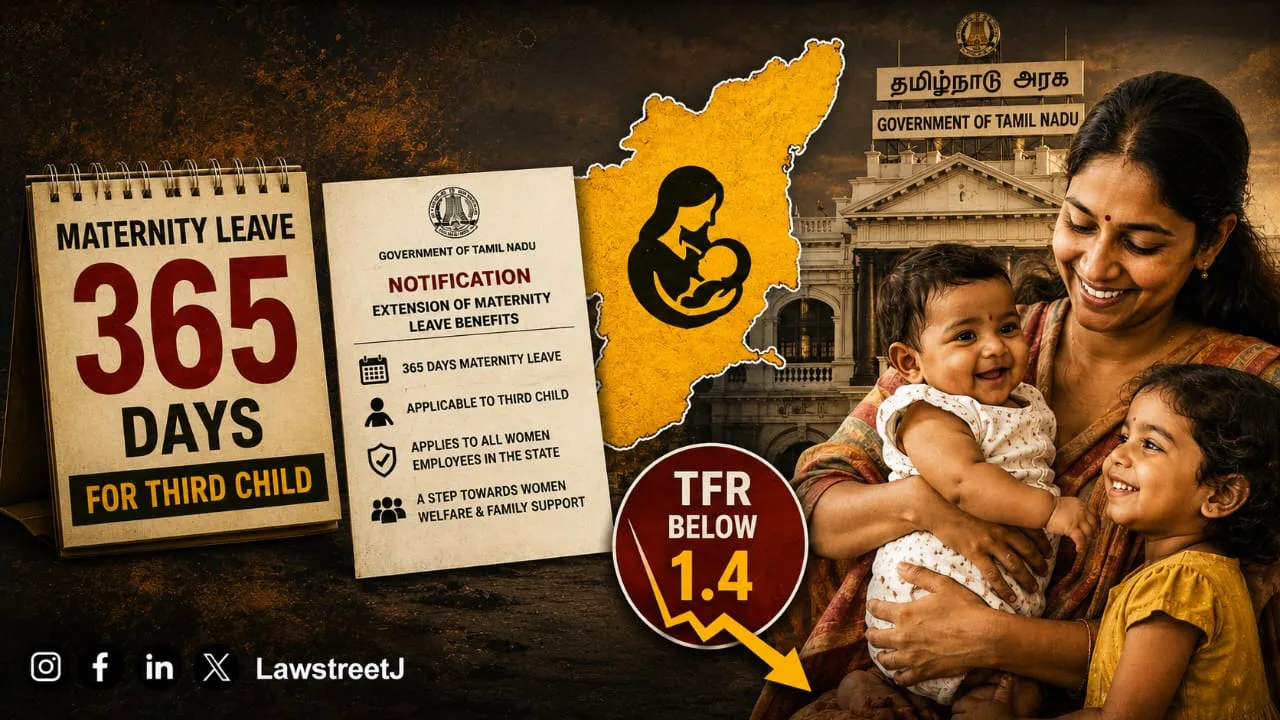

CHENNAI - The Tamil Nadu government on Tuesday announced one of the most significant expansions to its maternity leave framework in five years, extending the full 365-day leave entitlement to women government employees for the birth of their third child, a benefit that was previously available only for the first two children. The announcement, made by Human Resources Management Minister D Sarathkumar in the state Legislative Assembly during the demand for grants for his department, removes a long-standing disparity that had left women having a third child with only 12 weeks of paid leave, compared to a full year available to those having their first or second.
Tamil Nadu Human Resources Management Minister D. Sarathkumar said in the Assembly: "Under these circumstances, as the Tamil Nadu government is a welfare-oriented administration prioritising social welfare and women's empowerment, the maternity leave currently provided for the third child of female government employees will be enhanced from 12 weeks to 365 days."
At present, married women government employees with fewer than two surviving children are granted 365 days of maternity leave, while those with two or more surviving children receive up to 12 weeks of maternity leave. The new announcement changes the position for employees having their third child, their maternity leave will be increased from 12 weeks to 365 days.
A detailed government order is expected to be issued soon to formally implement the announcement.
The Disparity That Existed and Why It Was There
For women government employees in Tamil Nadu, the maternity leave framework has long contained an anomaly that the state has now moved to correct. The shorter 12-week provision for women with two or more children had been brought in following Supreme Court directives and subsequent amendments by the state government.
The Supreme Court's intervention that established the 12-week provision for third-child births was rooted in India's family planning framework, the broader policy environment, which for decades discouraged families from having more than two children through a combination of incentives and limitations on government benefits. The 12-week limit for a third child was one expression of that framework within Tamil Nadu's service rules.
Employees had been demanding a change in the rule, pointing out that three months was inadequate for recovering from childbirth and caring for a newborn. The decision was taken in view of court observations and guidelines, as well as the welfare of women government employees, Sarathkumar said in the Assembly.
A Policy That Has Been Expanding for 15 Years
The announcement is the latest step in a progressive expansion of maternity benefits for Tamil Nadu's government workforce that stretches back over a decade and a half.
Tamil Nadu originally offered 90 days of maternity leave to women in government jobs, which was later raised to 6 months in 2011 and to 9 months in 2016 by the then AIADMK government under Chief Minister J Jayalalithaa. In July 2021, the DMK government extended the entitlement to one full year, or 365 days, for eligible employees, but only for the first two children.
Each expansion in maternity leave has been the product of a combination of legislative activism, judicial direction, and shifting social and demographic context. The reform marks a major shift in Tamil Nadu's employee welfare framework and could become an important reference point in discussions around maternity benefits and women-friendly workplace policies across India.
The announcement comes at a moment when Tamil Nadu and several other southern Indian states, are confronting a demographic reality that makes the question of whether women feel supported in having children more urgent than it has been in decades.
The Demographic Crisis Behind the Decision
The maternity leave expansion does not exist in isolation. It was announced one day after a significant policy shift and against the backdrop of a demographic concern that Tamil Nadu's own health minister has described in unusually frank terms.
The extension of maternity leave comes amid growing concern over Tamil Nadu's demographic transition. Health Minister KG Arunraj said on Sunday that the state's Total Fertility Rate had fallen below 1.4, considerably lower than the replacement level of 2.1.
A day before the announcement, Tamil Nadu government had announced a shift in family planning strategy from population control to family well-being. That shift from a decades-long framework of discouraging large families to one of actively supporting women who choose to have children, is the policy context within which Tuesday's maternity leave expansion should be read.
A Total Fertility Rate of 1.4 is well below the replacement level of 2.1 children per woman required for a population to maintain its size over generations. Tamil Nadu's TFR has been declining steadily, placing the state in the same demographic bracket as South Korea, Japan, and parts of southern and eastern Europe countries that have struggled to reverse fertility decline through policy interventions. The maternity leave extension, alongside the broader shift in family planning framing, is part of Tamil Nadu's attempt to create a policy environment more conducive to the choice of having children.
The MLA Who Brought Her Baby to the Assembly
The policy announcement also arrived in the context of a personal story that had already placed the challenges of working motherhood before the Tamil Nadu Assembly.
The development comes after a row over first-time TVK MLA R Pallavi bringing her newborn to the Tamil Nadu Assembly during the ongoing session. Pallavi was elected from the Thiru-Vi-Ka Nagar segment in Chennai in the 2026 assembly elections. She brings her baby to the Assembly premises and leaves the newborn with a caregiver when she enters the main hall for proceedings. She faced criticism for carrying her child everywhere, to which she responded by saying that the accusation was unfair.
The debate around MLA Pallavi's decision to bring her infant to the Assembly, the criticism she received and her response to it, became a visible public conversation about what institutional support working mothers in public life actually receive. The maternity leave expansion, announced days into that controversy, addresses the structural dimension of the same question: whether the state's own rules for its employees reflect a genuine commitment to supporting women who choose motherhood alongside professional life.
Where India's Maternity Policy Stands
India's central maternity leave law, the Maternity Benefit Act, 1961, as amended in 2017, provides 26 weeks of maternity leave for formal sector employees with fewer than two surviving children, and 12 weeks for those with two or more. Tamil Nadu's 365-day provision for government employees, now extended to the third child, places the state dramatically ahead of the central law's requirements.
Andhra Pradesh has also recently removed restrictions on maternity leave entirely under Chief Minister Chandrababu Naidu, who declared that women employees would receive maternity leave for all child deliveries regardless of the number of children they have. The southern states appear to be leading a quiet but significant evolution in how India's state governments are approaching the intersection of women's workforce participation, demographic concerns, and maternity support.
Tamil Nadu's announcement brings the state's government sector workforce one step closer to a framework in which the number of children a woman has does not determine the quality of support she receives from her employer when she chooses to have another.


![Anti Corruption sleuths acted like "puppets in The Muppet Show", HC notice to ex TN CM in disproportionate assets case [Read Order]](/secure/uploads/2023/09/lj_8675_7b37fc02-1b2d-4f4a-9816-3df20545b37e.jpg)
![Supreme Court upholds Tamil Nadu's ban on reinforced paper cups [Read Judgment]](/secure/uploads/2023/10/lj_5974_Ban_on_use_of_reinforced_paper_cups.jpg)