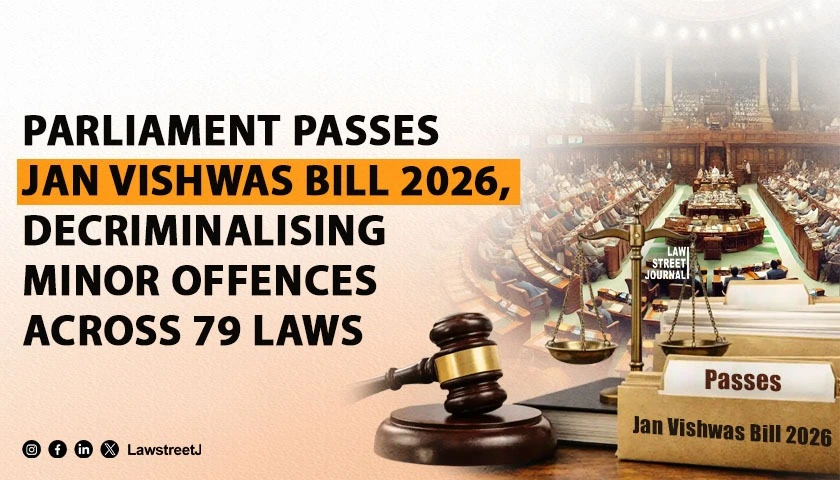
New Delhi: The Parliament of India has passed the Jan Vishwas (Amendment of Provisions) Bill, 2026, marking a significant structural shift in the country’s regulatory and legal framework. The legislation was approved by the Rajya Sabha through a voice vote on April 2, 2026, following its earlier passage in the Lok Sabha. The Bill represents one of the most expansive efforts to decriminalise minor, technical, and procedural defaults across central laws.
Building upon the Jan Vishwas Act of 2023, which decriminalised 183 provisions across 42 Acts, the 2026 amendment dramatically expands the scope of reform. It amends 784 provisions across 79 different Acts administered by 23 ministries, spanning sectors such as health, finance, agriculture, and the environment.
At its core, the legislation aims to eliminate criminal penalties, including imprisonment, for technical lapses that lack fraudulent intent. Of the 784 provisions amended, 717 have been converted into civil or administrative penalties. Imprisonment has been removed from 57 provisions, while fines have been eliminated from 158 others.
Prime Minister Narendra Modi described the reform as a move toward a “trust-based framework,” aimed at improving both the ease of doing business and the ease of living. By removing the fear of criminal prosecution for minor compliance errors, the legislation seeks to enable individuals and businesses, especially entrepreneurs, to focus on productivity and innovation rather than legal risks.
A key feature of the reform is the shift from judicial enforcement to administrative adjudication. The Bill empowers the government to appoint Adjudicating Officers and establish Appellate Authorities to handle such matters. These officers, typically at the rank of Assistant Commissioner or District Magistrate, are authorised to conduct inquiries and impose monetary penalties, thereby reducing reliance on the criminal justice system for non-serious violations.
This transition is expected to significantly reduce the litigation burden on courts, which currently face a backlog exceeding 50 million cases. The framework also introduces a strict 60-day timeline for appeals against decisions of Adjudicating Officers, ensuring faster resolution and preventing prolonged legal uncertainty.
The Bill introduces targeted reforms across several major legislations. Under the Motor Vehicles Act, 1988, a 30-day grace period has been introduced for expired driving licences, ensuring that individuals are not immediately treated as offenders. Additionally, vehicle registration has been made valid across an entire State or Union Territory, eliminating the need for re-registration when moving between districts.
In the pharmaceutical sector, amendments to the Drugs and Cosmetics Act, 1940, distinguish between serious violations and procedural lapses. Minor issues, particularly in the AYUSH segment, such as labelling or licensing errors, will now attract administrative penalties instead of imprisonment. However, stringent criminal provisions continue to apply to serious offences, including the manufacture of spurious drugs.
Environmental laws have also been rationalised. Under the Environment Protection Act, 1986, documentation-related defaults are now subject to monetary penalties, while violations causing actual environmental harm continue to attract criminal liability. This ensures that penalties are proportionate to the nature and impact of the offence.
A notable innovation in the Bill is the introduction of a “Correction First” approach for 76 offences across 10 Acts. Under this mechanism, Adjudicating Officers will issue an Improvement Notice, allowing entities a defined period to rectify non-compliance. Penalties will be imposed only in cases of failure to comply or repeated violations.
To maintain the effectiveness of penalties over time, the Bill incorporates an automatic inflation-indexing mechanism. Monetary penalties under the amended laws will increase by 10 percent every three years, ensuring that fines remain deterrent without requiring frequent legislative revisions.
The legislation follows extensive deliberations by a Select Committee chaired by Tejasvi Surya, which held 49 sittings and significantly expanded the scope of the Bill from its original draft covering 16 Acts to the final 79. This reflects a broader policy push aligned with the government’s principle of “Minimum Government, Maximum Governance.”
The Bill also removes or rationalises several archaic provisions rooted in colonial-era laws. These include changes to the Cattle-trespass Act, 1871, and the removal of criminal liability for minor acts such as false fire alarms under the Delhi Police Act and failure to report births and deaths under municipal laws.
For India’s 63 million MSMEs, the reform is expected to substantially ease compliance burdens. Small businesses, which often lack dedicated legal resources, are particularly vulnerable to inadvertent violations. The new framework allows them to correct errors through administrative channels instead of facing prolonged criminal proceedings.
Additional amendments, including those to the New Delhi Municipal Council Act, aim to simplify everyday regulatory processes, such as restructuring property tax into separate components for buildings and vacant land, thereby improving ease of living.
In sum, the Jan Vishwas Bill, 2026, signals a paradigm shift from a punitive, fear-driven regulatory approach to a compliance-based, trust-oriented system. While criminal law remains intact for serious offences affecting public safety, the creation of an administrative pathway for minor defaults is expected to enhance legal efficiency, reduce judicial burden, and foster a more business-friendly environment.


![Delhi Court Grants Permission to Evict AAP MP Raghav Chadha from Type 7 Government Bungalow [Read Order]](/secure/uploads/2023/10/lj_2396_AAP_MP_Raghav_Chadha_to_lose_govt_bungalow.jpg)