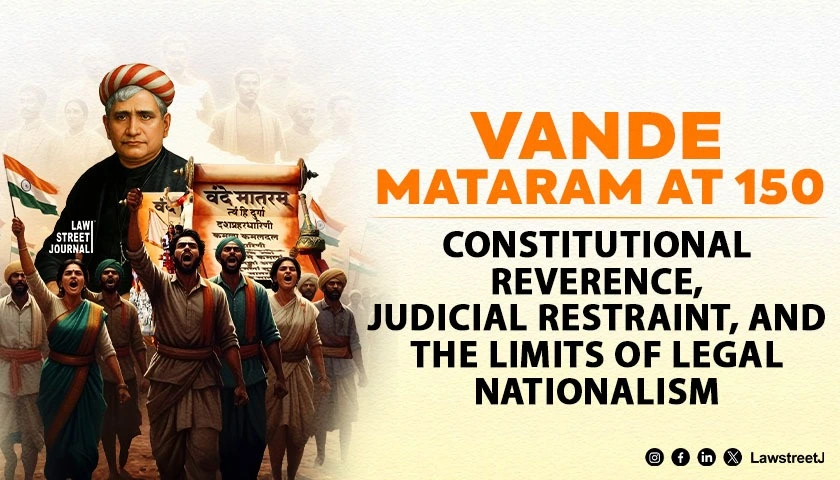
NEW DELHI: Seventy-six years after Dr Rajendra Prasad stood before the Constituent Assembly and declared that Vande Mataram shall be honoured equally with the national anthem, the promise made in that chamber on January 24, 1950, has finally been given the force of criminal law. President Droupadi Murmu on Tuesday gave her assent to the Prevention of Insults to National Honour (Amendment) Act, 2026, making it a punishable offence to intentionally disrupt or prevent the singing of India's national song, and extending to Vande Mataram the same statutory protection that Jana Gana Mana has held since 1971.
With the President's assent, the Prevention of Insults to National Honour (Amendment) Bill, 2026, has become a law. The Lok Sabha had passed the Bill on July 30, while the Rajya Sabha had cleared it a day earlier. The legislation grants Vande Mataram the same status as the national anthem, Jana Gana Mana.
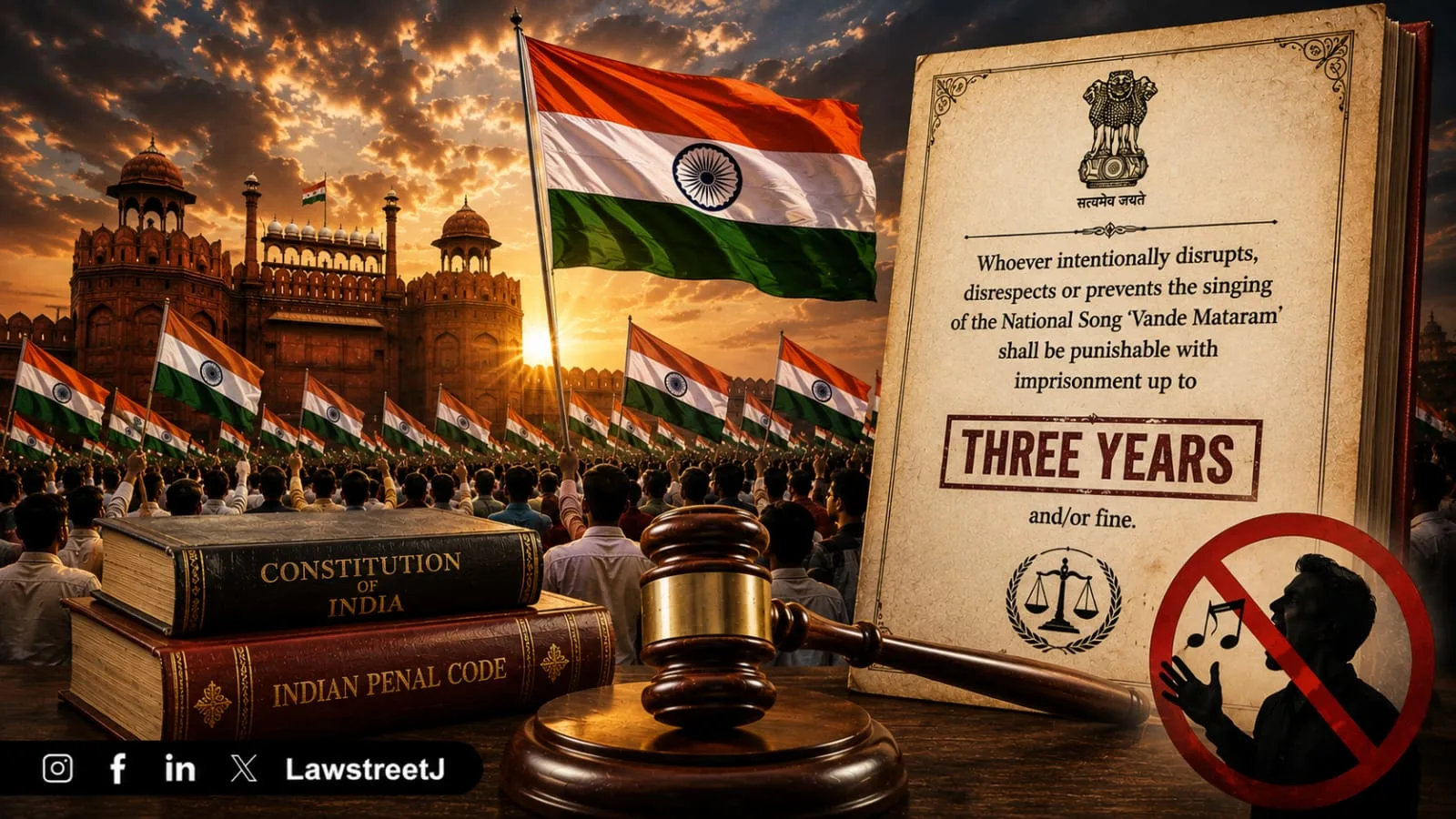
The amendment expands the Prevention of Insults to National Honour Act, 1971, which already penalises certain acts of disrespect towards the National Flag, the Constitution and the National Anthem. Under the amended provisions, the existing punishment framework will also apply to intentional obstruction or disturbance during the singing of Vande Mataram. Offences can attract imprisonment of up to three years, a fine, or both, with enhanced provisions applying in cases of repeat conviction.
The timing of the assent, four days before India's 80th Independence Day is not incidental. On August 15, Vande Mataram will be sung from the ramparts of the Red Fort for the first time in the country's post-independence history. The law and the ceremony together represent the most significant elevation of Vande Mataram's formal standing in Indian public and legal life since independence.
The Legal Gap That Existed for 76 Years
To understand what changed on August 11, it is necessary to understand what the law looked like before Tuesday. The Prevention of Insults to National Honour Act was enacted in 1971. Its Section 3 made it a punishable offence to intentionally prevent the singing of Jana Gana Mana, or to cause disturbance to any assembly engaged in singing the national anthem. The punishment was imprisonment of up to three years, a fine, or both.
Vande Mataram was not in that provision. It was not in any provision.
The Bill said: "Presently, there is no specific legal provision to prevent insults to the singing of Vande Mataram, which is honoured as the national song. Therefore, in order to prohibit any person from intentionally preventing the singing of the national song or causing disturbance to any assembly engaged in such singing, it is proposed to amend Section 3 of the said Act to include the national song also within its ambit, so as to make such acts punishable."
That gap existed despite the explicit declaration made by Dr Rajendra Prasad on January 24, 1950. The President of the Constituent Assembly stated that the song Vande Mataram composed by Bankim Chandra Chatterjee, which played a historic role in the Indian freedom struggle, shall be honoured equally with the national anthem Jana Gana Mana and shall have equal status.
The declaration established parity in honour. But parity in honour without parity in legal protection meant that disrupting the singing of Vande Mataram carried no criminal consequence under the law, even as disrupting Jana Gana Mana did. The 2026 amendment closes that 76-year gap.
The Bill's Parliamentary Journey
In May 2026, the Cabinet headed by PM Narendra Modi approved a proposal to grant Vande Mataram legal protection under the Prevention of Insults to National Honour Act on a par with the national anthem of India.
Introduced in the Rajya Sabha on July 24, 2026, by the Ministry of Home Affairs, the Bill was passed by both Houses shortly afterwards, on July 29 and July 30.
Union Minister of State for Home Affairs Nityanand Rai, who introduced the legislation in the Rajya Sabha on behalf of Home Minister Amit Shah, defended the move as more than a procedural amendment. During the parliamentary debate, Rai said it reflected India's commitment to its "national consciousness, cultural heritage."
The government described the move as an effort to uphold the national song's dignity and its role in India's freedom struggle, while Opposition parties raised concerns over religious implications of the law.
The Opposition's concerns during the debate centred on how the law would be applied in practice, whether the criminal provision could be invoked in ways that affected communities or individuals who, for historical or religious reasons, have had a complex relationship with Vande Mataram. Those concerns were registered in the parliamentary record. The Bill passed in both Houses regardless.
About Vande Mataram: The Song That Became a Movement
Vande Mataram was written in Sanskritised Bengali by Bankim Chandra Chatterjee in the 1870s and was first published in 1882 as part of Chatterjee's Bengali novel Anandamath.
The novel depicted a fictional uprising of Hindu monks against British colonial and preceding Muslim Nawabi rule, and the song within it was a hymn to the motherland. When it was first sung in a political context at the 1896 session of the Indian National Congress, it was sung by Rabindranath Tagore. From that moment, it became inseparable from the freedom movement.
The song was adopted as a battle cry during the Partition of Bengal in 1905, when it became the rallying anthem of the Swadeshi movement. It was sung in the streets, in prisons, and on the scaffold. The colonial administration, aware of its mobilising power, banned its singing in certain contexts. The irony is complete: a song that was banned by the British for being too politically powerful now has criminal law protecting it from disruption.
India is observing 150 years of Vande Mataram in 2026. The government has been marking the milestone throughout the year, the theme of the Republic Day parade in January was centred on Vande Mataram, with tableaux, military band performances, and a commemorative banner on Kartavya Path. Akashvani began broadcasting the full six-stanza version every morning from March 26, in a recording by classical vocalist Pandit Chandrashekhar Vaze in Raag Des. The 2026 amendment is the legal culmination of that year-long national commemoration.
Independence Day: The Ceremony That Completes the Picture
The Presidential assent arrived four days before a ceremony that will give the law its most visible public expression.
Vande Mataram will echo at the Red Fort ramparts for the first time on the 80th Independence Day, and all six stanzas of the national song will be played before the National Anthem at the conclusion of Prime Minister Narendra Modi's address.
For the first time in the country's post-independence history, the national song Vande Mataram will be sung from the ramparts immediately following the Prime Minister's arrival, establishing a brand-new ceremonial order for the August 15 celebrations.
Around 2,500 NCC cadets and My Bharat volunteers will form the words "Vande Mataram" on Gyanpath, opposite the Red Fort ramparts.
The Independence Day celebrations will include around 5,000 special guests, selected from different fields and recognised for their achievements.
The Centre had already made the singing of all six stanzas mandatory, instead of only the first two stanzas that were usually sung for many years.
Official invitation cards dispatched by the Defence Ministry feature all six stanzas of the national song, enabling guests to follow along. The cards also incorporate imagery of the newly-constructed Seva Teerth, which houses the Prime Minister's Office, alongside an outline of fundamental duties. One official explained the practical reasoning behind including the full lyrics: "People know the national anthem by heart, but few can sing the national song. The lyrics have been provided so that people can sing along."
The 80th Independence Day celebrations will centre on the theme "Yuva Shakti, Leading the Journey to Viksit Bharat." The Ministry of Defence has carved out special segments to showcase young Indian engineers and entrepreneurs, particularly those pioneering advancements in critical domains.
What the Law Now Covers
The Prevention of Insults to National Honour Act, as amended by the 2026 legislation, now covers four categories of national symbols: the National Flag, the Constitution, the National Anthem, and the National Song. Each carries criminal consequences for acts of deliberate disrespect or intentional disruption.
For Vande Mataram specifically, the offence is constituted by intentionally preventing the singing of the national song, or intentionally causing disturbance to any assembly engaged in its singing. The key word in both formulations is "intentionally", an element that requires the prosecution to establish that the act was deliberate rather than inadvertent.
Punishment is imprisonment for a term extending up to three years, a fine, or both. Enhanced provisions apply in the case of a repeat conviction, the law treats a second offence as a more serious matter than a first.
The law does not define what constitutes an "insult" to Vande Mataram beyond the two specific prohibited acts, prevention and disturbance. The broader question of what other forms of disrespect to the national song might be covered, if any, is not addressed in the text of the amendment and may be developed through judicial interpretation over time.