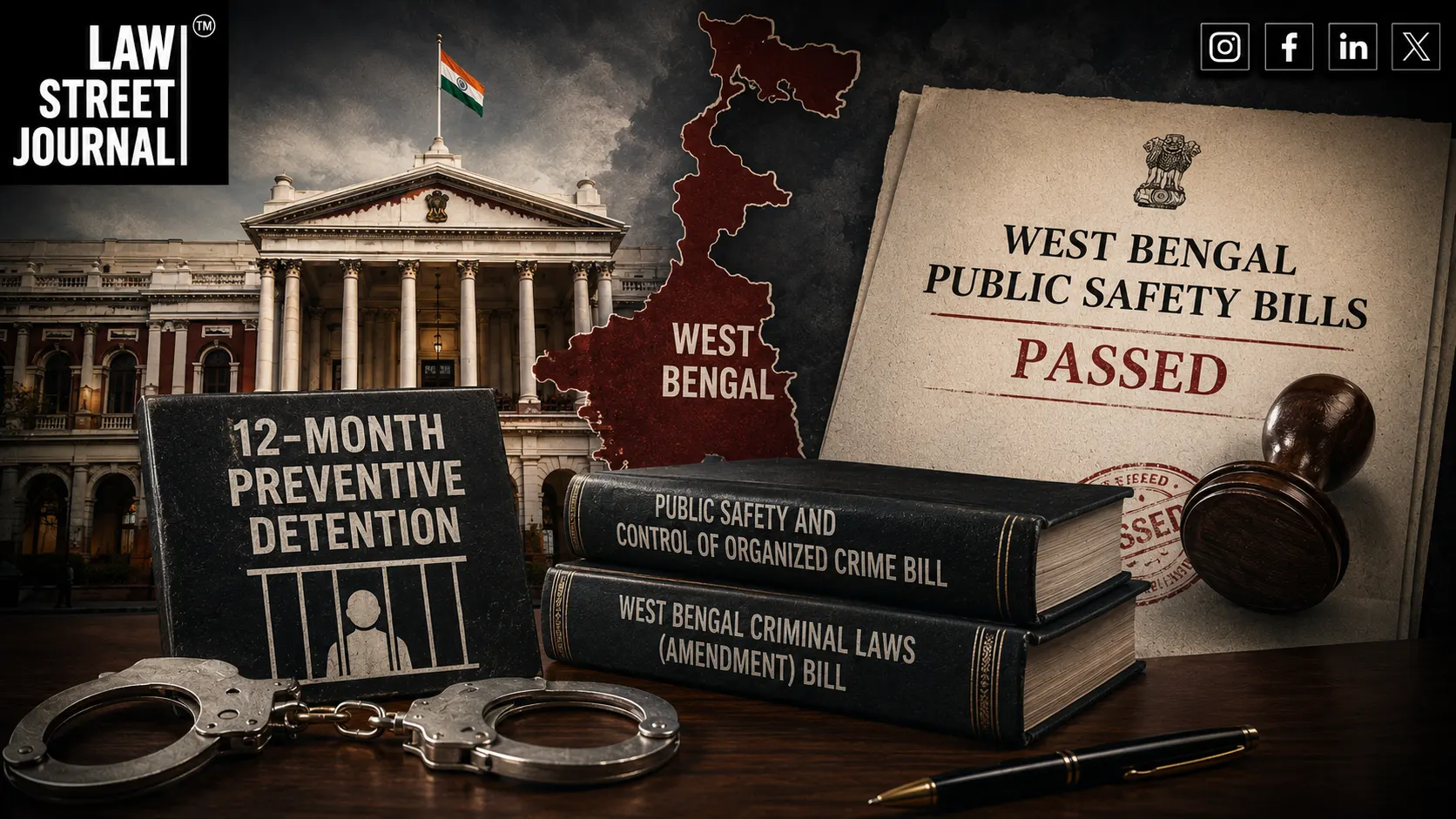
The West Bengal Legislative Assembly on Monday, June 29, 2026, passed two significant pieces of legislation aimed at overhauling the state's approach to maintaining law and order. The West Bengal Public Safety and Control of Anti-Social Activities Bill, 2026, and the West Bengal Maintenance of Public Order (Amendment) Bill, 2026, were approved following a heated debate in the Assembly. Introduced by the Bharatiya Janata Party (BJP) government led by Chief Minister Suvendu Adhikari, the laws substantially expand the state's powers to prevent crime and recover compensation for damage caused during riots and violent protests.
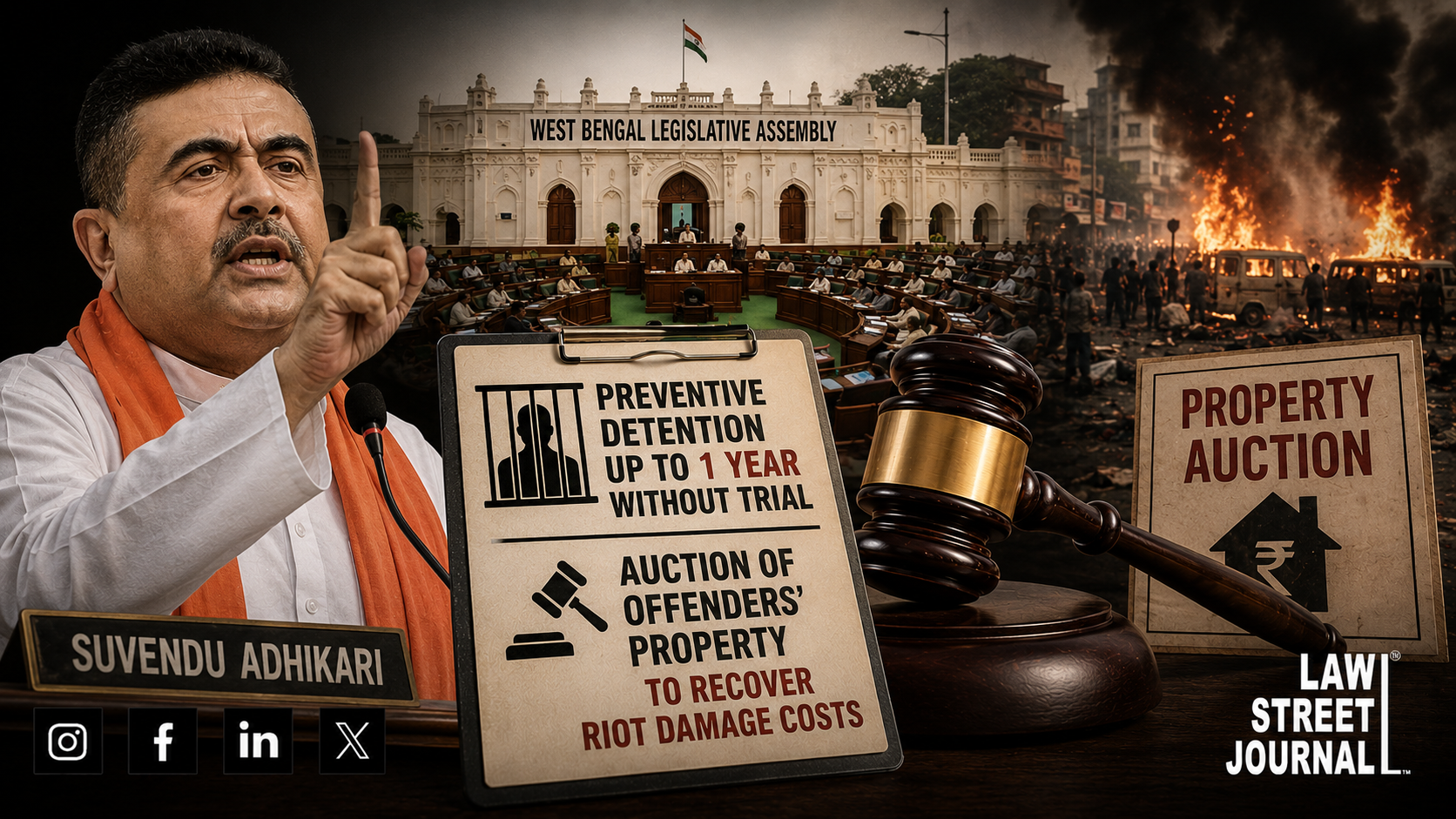
The West Bengal Public Safety and Control of Anti-Social Activities Bill, 2026 was passed by a voice vote. Its most debated provision authorizes preventive detention of individuals for up to 12 months without a formal trial. Under the legislation, the state government or authorized senior officials including district magistrates, commissioners of police, and officers not below the rank of Deputy Inspector General of Police may issue detention orders if they believe such detention is necessary to prevent activities prejudicial to public order.
The Bill adopts a broad definition of "anti-social activity." It includes acts that cause or are likely to cause alarm, fear, danger, or insecurity among the public, threaten life or property, or disturb public order. It also covers activities that obstruct lawful business or trade, involve unlawful dispossession of property, or result in significant damage to public or private assets. Environmental and resource-related offences such as illegal mining, illegal sand extraction, and theft of forest produce or wildlife causing substantial loss to the public exchequer are also included within its scope.
The legislation also introduces an expansive definition of the term "goonda." It includes habitual offenders, members or leaders of criminal syndicates, and individuals previously chargesheeted for organized or petty organized crime under the Bharatiya Nyaya Sanhita (BNS). It further extends to persons who are "generally reputed to be desperate and dangerous to the community," making reputation a relevant factor in determining whether preventive detention may be invoked.
To review detention orders, the Bill provides for the establishment of three-member Advisory Boards headed by a serving or retired High Court judge, along with two members qualified to be appointed as High Court judges. Every detention order must be placed before the Board within three weeks.
A notable feature of the legislation is the restriction on legal representation. Detainees are not ordinarily entitled to be represented by a legal practitioner before the Advisory Board. However, the Board may permit legal representation in appropriate cases after recording reasons in writing. The proceedings of the Advisory Board will remain confidential, with only its final opinion being made public.
The West Bengal Maintenance of Public Order (Amendment) Bill, 2026 was passed with 176 MLAs voting in favour, 42 opposing it, and 20 abstaining. The legislation seeks to establish a mechanism for recovering compensation for damage caused to public and private property during riots, violent protests, or unlawful assemblies.
The Bill provides for the creation of Claims Commissions vested with powers equivalent to those of civil courts to assess damages and determine liability. The awards passed by these Commissions will be final and cannot be challenged through an appeal before any court.
Importantly, liability for compensation is not limited to those directly responsible for acts of violence. Organizers, financiers, instigators, and persons providing logistical support for riots or unlawful assemblies may also be held liable. Where compensation remains unpaid, authorities will be empowered to attach and auction the offender's property to recover the assessed amount.
Defending the legislation, Chief Minister Suvendu Adhikari said the new laws were necessary to address a growing culture of lawlessness and political violence. He argued that existing criminal laws had failed to deter organized criminal networks and individuals responsible for large-scale destruction of property during riots. Referring to previous incidents of communal violence and attacks on police personnel, he maintained that stronger preventive measures were required. He also assured the Assembly that the laws were intended to target habitual offenders and criminal elements, and would not be misused against innocent citizens or for political vendetta.
Opposition parties, particularly the Trinamool Congress (TMC), strongly opposed the legislation, describing it as "draconian." Critics compared the measures to the Emergency-era Maintenance of Internal Security Act (MISA) and the colonial-era Rowlatt Act. They argued that the broad and subjective definitions of "anti-social activity" and "goonda" grant excessive discretionary powers to the executive, raising concerns that the laws could be used to suppress political dissent, student movements, and civil society activism.
However concerns have been raised regarding the constitutional validity of several provisions, particularly those permitting preventive detention without trial and restricting legal representation before the Advisory Board.
With the BJP enjoying a majority in the Assembly, the passage of these Bills marks a significant shift in West Bengal's legal framework governing public order and preventive detention. The legislation will now be sent to Governor R.N. Ravi for assent before coming into force. Constitutional challenges to several of its provisions are expected once the laws receive gubernatorial approval.


![Calcutta HC Stays State Notifications on OBC Classifications and Reservations [Read Order]](/secure/uploads/2025/06/lj_7327_Calcutta_HC_Stays.webp)
![Calcutta HC: Accused Are Entitled to Dignity, Directs DGP to Curb Egg Attacks and Mob Violence [Read Order]](/secure/uploads/2026/07/lj_8813_Calcutta_HC_Accused_Are_Entitled.webp)