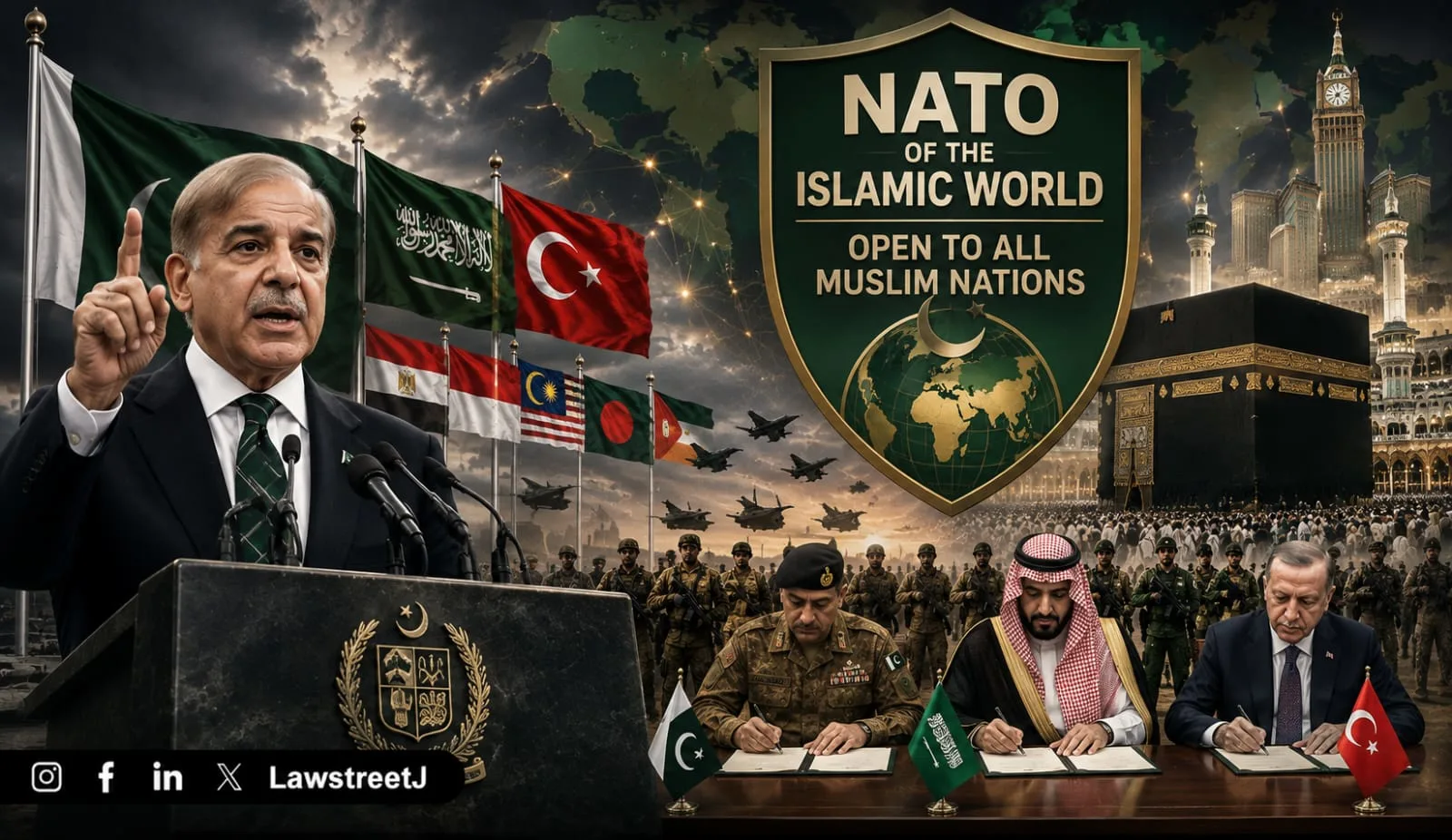
ISLAMABAD — The ink on the Mecca Joint Defence Agreement was barely dry when Pakistan's Defence Minister Khawaja Asif stepped forward with a proposal that goes significantly further than the trilateral pact just signed in Mecca. Speaking publicly after Saudi Arabia, Turkiye and Pakistan formalised their collective defence arrangement on August 7, Asif called for the three-nation agreement to become the foundation of a far broader Muslim military alliance, one he explicitly described as the "NATO of the Islamic world."
Pakistani Defense Minister Khawaja Asif suggested the Turkiye-Saudi-Pakistan defense agreement should expand to become the NATO of the Islamic world. Calling the potential alliance a possible "NATO of the Islamic world," Asif said its doors should remain open to other Muslim countries and stressed that the initiative must not become an exclusive club. He said Muslim nations should put their differences aside and unite on a common security platform, signalling Islamabad's ambition to turn the three-way defence arrangement into a wider strategic partnership.
He said: "The doors really cannot be closed to other countries. This should not be an exclusive club."
The Pakistani Defence Minister had also emphasised that the proposed arrangement is not directed against any country but is aimed at enhancing regional stability and reducing external dependence. "Dependence will remain in the world; there is a community, an international community in which all countries are linked economically and otherwise, but for peace in one's own region, I think this pact is not against anyone, but it is very important to protect peace within our region," he added.
This is not the first time Asif has articulated an expansionary vision for Muslim defence cooperation. During an interview with Pakistani media outlet Hum News in May, Asif had said discussions on the arrangement were at various stages of completion and could include countries such as Qatar and Turkiye in the future, potentially creating a broader regional security arrangement. The Mecca signing has now given that vision its first formal institutional base.
What the Mecca Pact Actually Created and What Asif Wants It to Become
To understand the scale of Asif's ambition, it helps to first understand what the Mecca Joint Defence Agreement itself established and what it did not.
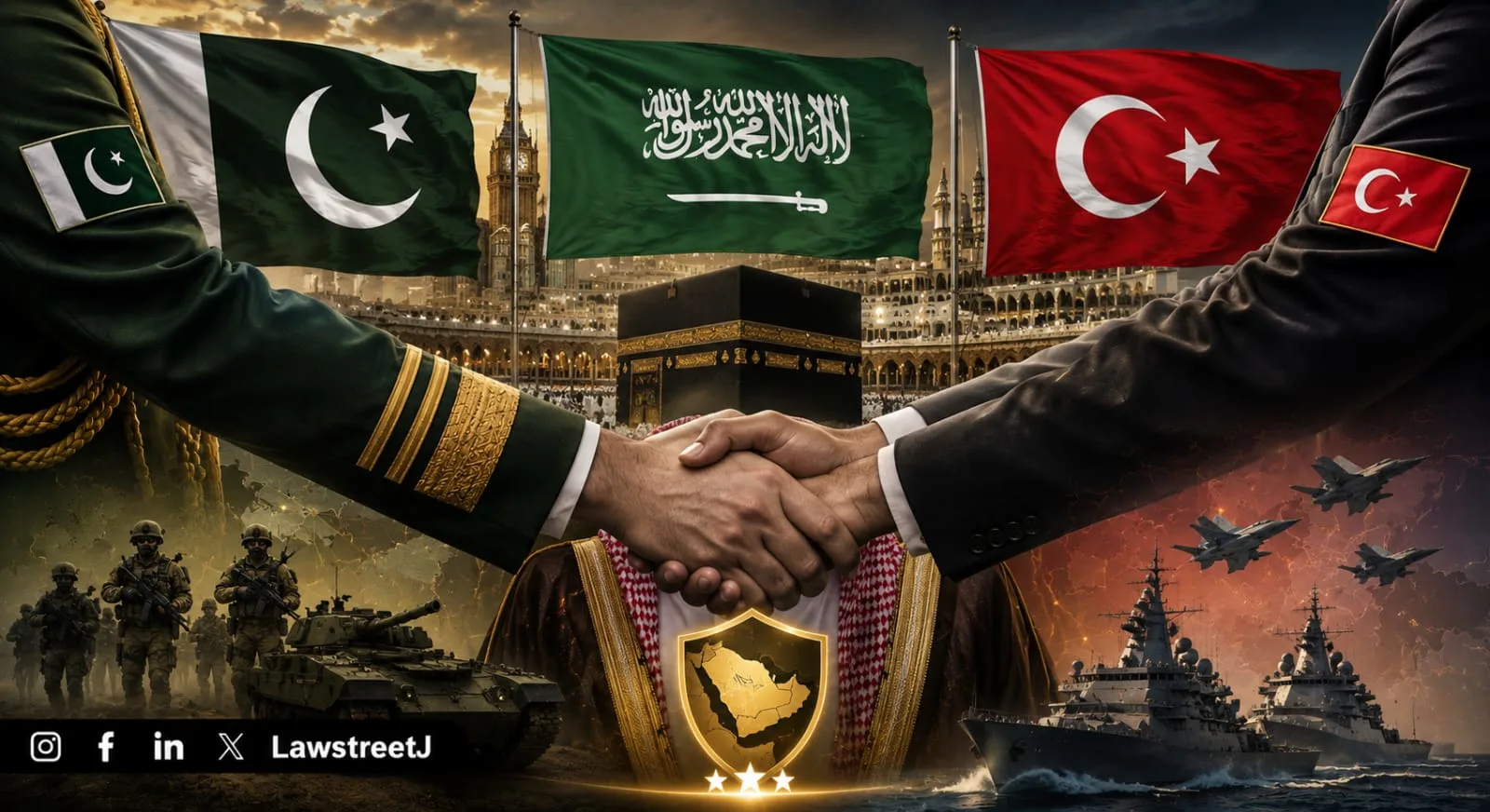
The Mecca Joint Defence Agreement is a trilateral collective-defence pact signed in Mecca, Saudi Arabia, by Saudi Arabia, Pakistan and Turkey. Under the pact, an armed attack against any one of the three states is to be treated as an attack against all three.
The alliance united the military and financial giant of the Middle East in Saudi Arabia, the second most powerful NATO army in Turkey, and the only nuclear-armed Muslim power in Pakistan.
The pact's collective defence clause mirrors NATO's Article 5, the provision under which an attack on any alliance member obligates all others to respond. It is this structural similarity that has made the term "Islamic NATO" both compelling as a descriptor and politically contentious as a label, with the signatories themselves explicitly rejecting a sectarian framing even as the concept gained wide currency in international commentary.
Saudi Deputy Minister for Public Diplomacy Rayed Krimly stated after the signing that the agreement is not intended to establish a military alliance or sectarian bloc, and is not linked to any nuclear ambitions or regional arms race. That disclaimer was carefully constructed, an acknowledgement that the three signatories understood exactly how the pact would be read internationally.
What Asif is now proposing is to take this framework and expand it. Under his vision, the Mecca Joint Defence Agreement's collective defence clause would not be limited to three countries, it would become an open architecture to which any Muslim-majority nation could accede. The practical implication is a mutual defence framework spanning populations, territories, military assets and, critically, Pakistan's nuclear deterrent, across a significant portion of the Islamic world.
A Concept With History and One Critical Difference
The idea of a Muslim military alliance is not new. It has circulated in strategic thinking across the Islamic world for decades, and it has had one significant institutional precedent.
In 2015, Saudi Arabia announced the formation of the Islamic Military Alliance to Fight Terrorism, a 39-nation coalition with a command centre in Riyadh that was specifically chartered to counter terrorism. In 2017, former Pakistan Army Chief General Raheel Sharif became the alliance's first commander, a move that itself generated significant domestic debate within Pakistan about the country's involvement in a Saudi-led military structure. The IMAFT, however, was explicitly limited to counter-terrorism operations and did not include a mutual defence clause of the Article 5 type.
The Mecca Joint Defence Agreement, and Asif's proposed expansion of it, represents a qualitatively different proposition. A mutual defence clause, the commitment that an attack on one is an attack on all, is the foundational element of a genuine military alliance. It is what distinguishes NATO from a loose security dialogue or a counter-terrorism coalition. It is also what makes the proposal genuinely consequential in global strategic terms, because it would draw Pakistan's nuclear arsenal under a collective defence umbrella that could theoretically extend to dozens of nations.
The emerging alliance has already triggered reaction from Tehran. Iranian lawmaker Ebrahim Rezaei dismissed the agreement's potential to guarantee Saudi security, arguing that closer cooperation between Riyadh, Ankara and Islamabad would not necessarily provide the kingdom with protection.
Tehran's dismissal reflects a straightforward strategic calculation. All three signatories of the Mecca agreement and all of the additional countries that Asif envisions eventually joining are Sunni-majority states. Iran, the primary adversary in the current US-Iran conflict and the regional power whose proxy network has been attacking Saudi infrastructure, is a Shia-majority state. The collective defence architecture being proposed has an implicit directional logic, even as its architects insist it is not directed against any specific country.
Why India and Israel Are Watching Closely
The international reaction to Asif's "NATO of the Islamic world" proposal has extended well beyond the immediate Gulf region and Iran. India and Israel have both taken careful note.
Recent high-level statements from Islamabad have reignited intense geopolitical debates across South Asia and the Middle East. The phrase "Islamic NATO" has been circulating in Indian defence and strategic commentary with particular intensity since Asif's remarks became public, in part because Pakistan is one of the three founding members of the pact, and in part because Asif's stated vision of an open-membership framework raises the question of which countries might eventually join.
For India, the formation of a nuclear-armed trilateral defence alliance involving Pakistan, already India's most consequential security concern and potentially expanding to include other Muslim-majority nations across South Asia and the Gulf, is a development with direct strategic implications. India maintains significant diplomatic and economic relationships with each of the three signatories, but the military dimension of the Mecca framework sits outside those relationships.
For Islamabad, the agreement could significantly strengthen its strategic position in the wider Muslim world. Pakistan could gain greater diplomatic standing and security partnerships across the region.
For Israel, the alignment of the Mecca pact's three signatories, none of whom have normalised relations with Israel under the current political climate, and all of whom have been critical of Israel's military operations, creates an additional dimension of strategic concern. Saudi Arabia had been the subject of ongoing normalisation discussions with Israel before the current regional war, and the Mecca agreement's signing in Islam's holiest city carries implicit commentary on where Riyadh's immediate strategic priorities lie.
The Sectarian Question and the Internal Tensions
The Mecca agreement and Asif's expansionary proposal both carry a sectarian undertow that none of the parties have fully addressed publicly, even as they have explicitly disclaimed it.
Saudi Arabia, Turkiye, and Pakistan are all Sunni-majority states. The agreement was signed in Mecca. The countries that Asif specifically cited as potential future members, Qatar and others in the Gulf are also Sunni-majority. Iran, which is Shia-majority and whose proxy network has been the primary source of security threats to Saudi Arabia during the current conflict, is the most prominent Islamic nation not implicitly included in this architecture.
Within Pakistan itself, the proposal has not been without domestic friction. In Pakistan, leaders of the minority Shia community and political parties have previously raised concern about the country's involvement in Saudi-led military structures, fearing it would fuel domestic sectarian rivalries. Those concerns are likely to resurface in the context of Asif's "Islamic NATO" pitch.
The Saudi qualifier that the Mecca agreement is not a "sectarian bloc" is a political necessity, not a political reality. Any Muslim military alliance that includes Saudi Arabia, Turkiye, Pakistan and their Gulf neighbours, and excludes Iran, will be read, regionally and globally, as having a Sunni-Shia dimension, regardless of what its founding documents say.
Asif's call for Muslim nations to "put their differences aside" and unite is, implicitly, an invitation to Iran as well. Whether Tehran reads it that way, given the current state of the US-Iran war and Saudi Arabia's position in that conflict, is an entirely different question.
What Comes Next
Asif's proposal is a political statement, not a diplomatic initiative with a timeline or a formal process behind it. The Mecca Joint Defence Agreement is three days old. It has no secretariat, no established command structure, and no precedent as a functioning alliance.
For the proposal to move from rhetoric to reality, several things would need to happen that have not yet begun. Member states would need to agree to expand the framework. New accession protocols would need to be designed. The existing trilateral agreement would need to be tested in practice before any additional members could meaningfully commit to its obligations.
What Asif's statement has done, regardless of whether the "NATO of the Islamic world" ever takes institutional form is signal Pakistan's ambition clearly. Islamabad sees the Mecca agreement as the beginning of something larger, not as the end of a diplomatic process. Whether the other two founding members share that ambition, and whether the wider Muslim world is ready to act on it, will determine whether this remains a proposal or becomes a reality.