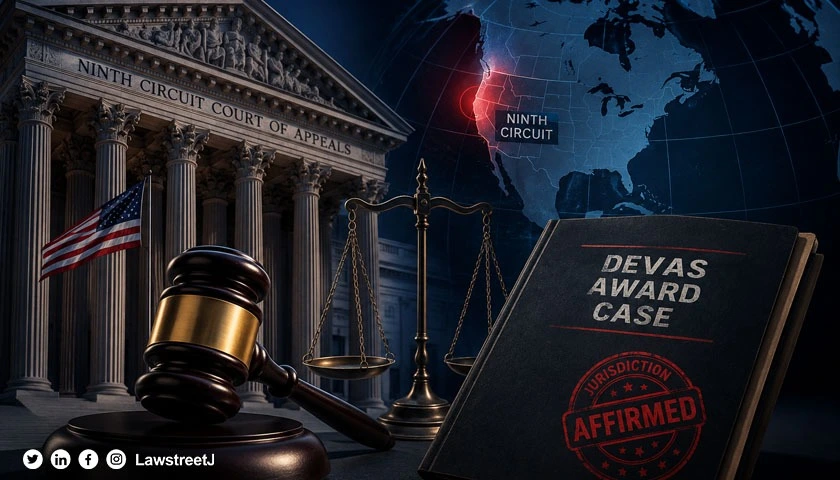
San Francisco: The United States Court of Appeals for the Ninth Circuit has affirmed that United States courts have both subject matter and personal jurisdiction to confirm a $562.5 million international arbitral award held by Devas Multimedia Private Limited against Antrix Corp. Ltd., a corporation wholly owned by India, and has further held that the doctrine of forum non conveniens has no application to an action to confirm a foreign arbitral award under the New York Convention.
The opinion, authored by Circuit Judge Lucy H. Koh for a panel comprising Circuit Judge Eric D. Miller and District Judge Donald W. Molloy (sitting by designation), was delivered on remand from the Supreme Court of the United States.
Devas and four intervenors, including three of its Mauritian shareholders and Devas Multimedia America, Inc., had sought to enforce the Award against Antrix under the Convention on the Recognition and Enforcement of Foreign Arbitral Awards, commonly known as the New York Convention, after an International Chamber of Commerce tribunal held in 2015 that Antrix had wrongfully repudiated a 2005 agreement to lease S-band spectrum capacity to Devas.
The panel had earlier reversed the district court's exercise of personal jurisdiction over Antrix, applying then-controlling Ninth Circuit precedent that required a traditional minimum contacts analysis under the Foreign Sovereign Immunities Act. The Supreme Court reversed that decision, holding that the FSIA does not require a plaintiff to establish “‘minimum contacts’ over and above the contacts already required by the [FSIA]’s enumerated exceptions to foreign sovereign immunity” before a federal court may exercise personal jurisdiction over a foreign state, and remanded for the panel to address Antrix's remaining arguments consistent with principles of forfeiture and waiver.
On remand, the panel first held that the FSIA's arbitration exception to foreign sovereign immunity supplied the district court with subject matter jurisdiction, since the exception requires only that the arbitration agreement concern a subject matter capable of settlement by arbitration under United States law, without any additional requirement that the underlying commerce bear a nexus to the United States. The court rejected Antrix's argument that disputes involving purely foreign commerce fall outside the exception, holding that Congress had not imported such a limitation into the arbitration exception even though it had done so expressly elsewhere in the FSIA.
On the question of personal jurisdiction, the panel assumed without deciding that Antrix was a “person” entitled to Fifth Amendment due process protections, and applying the reasonableness framework recently articulated by the Supreme Court in Fuld v. Palestine Liberation Organization, held that the exercise of jurisdiction was reasonable. The court weighed the United States' interest as the forum state in enforcing its treaty obligations under the New York Convention, the manageable burden on Antrix as a sophisticated, government-backed entity, and Devas's substantial interest in obtaining relief given that only a United States court could attach Antrix's commercial assets located within the country.
Rejecting Antrix's forum non conveniens argument, the panel held that the doctrine is incompatible with the Convention's mandatory scheme of recognition and enforcement, under which a signatory state may refuse enforcement only on the limited grounds enumerated in Article V. The court reasoned that
a foreign court cannot attach assets located in the United States and therefore cannot serve as an adequate alternative forum to U.S. courts.
The panel further noted that even if the doctrine did apply, the district court had not abused its discretion in declining to dismiss the petition, since India could not be treated as an adequate alternative forum. The decision aligns the Ninth Circuit with the D.C. Circuit's position that forum non conveniens is unavailable in proceedings to confirm foreign arbitral awards.
The court accordingly affirmed the district court's judgment as to subject matter jurisdiction, personal jurisdiction, and forum non conveniens. In a memorandum disposition filed concurrently with the opinion, the panel affirmed the district court's confirmation of the Award and its registration of the judgment as against intervenor Devas Multimedia America, Inc., but reversed and vacated the shareholder intervenors' standing to register the judgment, remanding for the district court to consider in the first instance the effect of the subsequent set-aside of the Award by Indian courts.
Appearances:
For Petitioner-Appellee (Devas Multimedia Private Limited): Christopher E. Tutunjian and Aaron M. Streett, Baker Botts LLP, Houston, Texas.
For Appellees-Intervenors: Matthew D. McGill, Amy R. Upshaw, Nicholas A. Mecsas-Faxon, and Arka Gupta, King & Spalding LLP, Washington, D.C.; Kevin D. Mohr, King & Spalding LLP, Houston, Texas; Lee R. Crain and Anne M. Champion, Gibson Dunn & Crutcher LLP, New York; David W. Casazza and Jacob T. Spencer, Gibson Dunn & Crutcher LLP, Washington, D.C.; Malaika Eaton, McNaul Ebel Nawrot & Helgren PLLC, Seattle.
For Respondent-Appellant (Antrix Corp. Ltd.): Amanda S. Berman, Nicholas Roberti, Neil Nandi, and T. Michael Guiffre, Crowell & Moring LLP, Washington, D.C.; Jennifer S. Romano, Crowell & Moring LLP, Los Angeles; Brian C. Free and Louis D. Peterson, Hillis Clark Martin & Peterson PS, Seattle; Kevin A. Meehan, Marwa Farag, Joseph D. Pizzurro, and Juan O. Perla, Curtis Mallet-Prevost Colt & Mosle LLP, New York; Kwaku A. Akowuah, Gregory M. Williams, Madeleine Joseph, and Carter G. Phillips, Sidley Austin LLP, Washington, D.C.
Case Title: Devas Multimedia Private Limited v. Antrix Corp. Ltd., Nos. 20-36024, 22-35085, 22-35103, United States Court of Appeals for the Ninth Circuit



.jpeg)