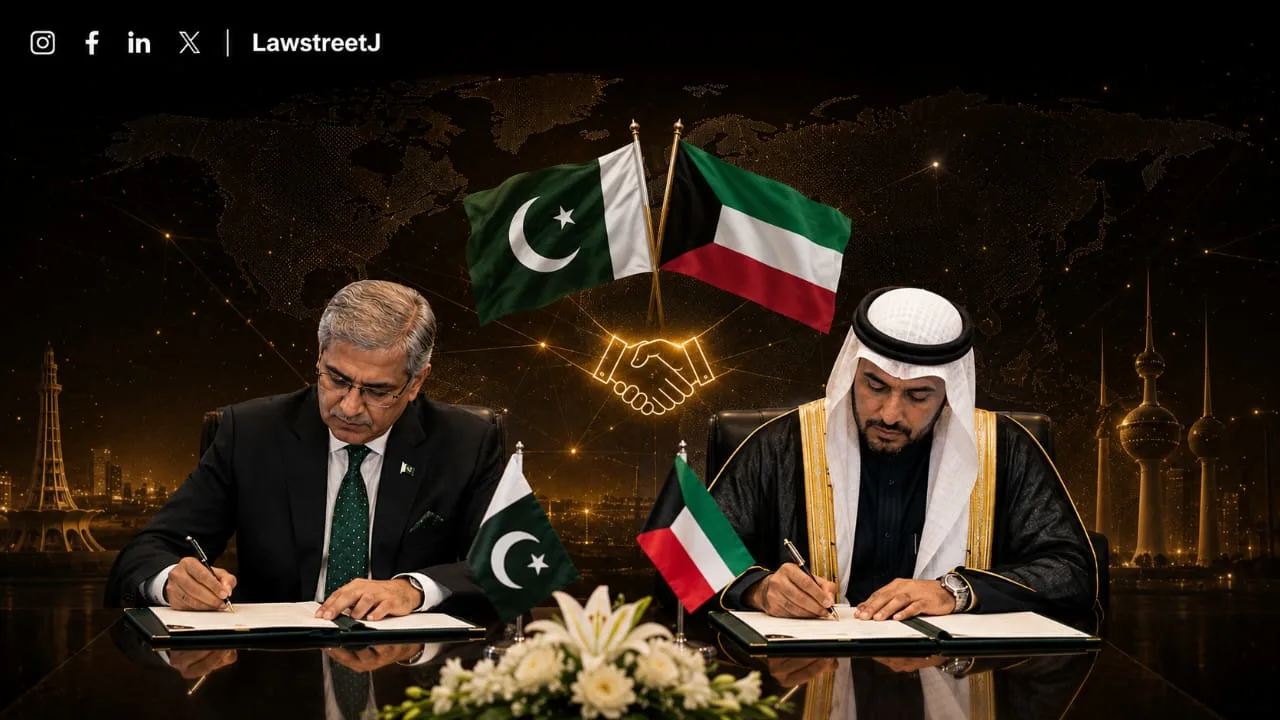
RAWALPINDI - Pakistan and Kuwait formalised an expanded military cooperation framework on Thursday, signing the Protocol Agreement-2026 in Rawalpindi, a development that further cements Islamabad's position as the Gulf's most relied-upon military partner and adds Kuwait to a growing list of Gulf states that have concluded defence agreements with Pakistan in the span of just three weeks.
The Protocol Agreement-2026 was signed during a meeting between Pakistan's Defence Minister Khawaja Muhammad Asif and a high-level Kuwaiti delegation led by Kuwaiti Defence Minister Sheikh Abdullah Ali Abdullah Al-Saleem Al-Sabah at the Ministry of Defence in Rawalpindi. The Kuwaiti delegation also included Chief of General Staff of the Armed Forces Lieutenant General Khalid Darj Saad Al-Shriaan.
Under the new agreement, the Armed Forces of Pakistan will extend assistance to the Armed Forces of Kuwait in diverse fields, including training, capacity building, border management and other mutually agreed areas of defence collaboration. The agreement significantly enhances the existing military cooperation framework established under the Defence Cooperation Agreement-2023, which was signed in June 2023 but formally ratified by Kuwait only last month.
The agreement reflects the deep trust, mutual respect and shared strategic interests underpinning the longstanding defence relationship between the two countries. Both sides reaffirmed their resolve to further strengthen this partnership in support of mutual security and regional peace and stability.
Kuwaiti Delegation Meets Field Marshal Asim Munir at GHQ
Separately from the formal signing ceremony, the Kuwaiti delegation, led by Defence Minister Sheikh Abdullah Ali Al-Sabah and accompanied by Lieutenant General Khalid Al-Shriaan, called on Field Marshal Syed Asim Munir, Chief of Army Staff and Chief of Defence Forces, at the General Headquarters in Rawalpindi.
The ISPR said the meeting focused on matters of mutual interest, regional security, and bilateral defence cooperation. Both sides reaffirmed their commitment to enhancing institutional ties and expanding mutually beneficial defence collaboration between the armed forces of the two countries. The Kuwaiti delegation appreciated the professionalism and operational excellence of the Pakistan Armed Forces and their contributions towards regional peace and stability.
The meeting between the Kuwaiti defence minister and Field Marshal Munir, who now holds dual authority as both COAS and CDF under Pakistan's new Defence Forces Act, gives the Kuwait engagement a weight that goes beyond a standard bilateral defence discussion, placing it within the broader command framework that Munir now anchors across all three of Pakistan's military services.
A Pattern That Has Been Building for Weeks
The Kuwait agreement is not an isolated development. It is the latest addition to a run of Gulf defence agreements that Pakistan has concluded in rapid succession over the past several months.
In recent years, Pakistan has signed a mutual defence pact with Saudi Arabia, joined a trilateral collective-security agreement with Saudi Arabia and Turkiye called the Mecca Pact, signed on August 7 in Mecca, deployed thousands of troops and a fighter squadron to Saudi Arabia, and deepened training arrangements with Qatar. Pakistan has offered training and manpower to Gulf militaries for decades.
The question raised by this run of agreements is less about any one pact than the pattern itself: Why do Gulf states keep turning to Pakistan, and what does Pakistan gain by saying yes?
Pakistan's answer is demographic and institutional. With one of the world's largest standing armies, decades of experience deploying soldiers abroad for training and advisory roles, and a military that has been tested in counterinsurgency, border security, and conventional warfare, Islamabad offers something that Gulf states with smaller military establishments cannot easily build domestically, experienced personnel, battle-tested doctrine, and institutional depth.
For the Gulf states, Pakistan represents an Islamic-world military partner without the geopolitical complications that come with Western security relationships. Pakistan's soldiers are available in numbers, affordable by Gulf standards, and politically straightforward to deploy.
For Pakistan, the Gulf relationships bring financial flows from the Pakistani diaspora, bilateral investment commitments, and an expanding network of formal defence agreements that place Islamabad at the centre of Gulf security architecture, a position that Defence Minister Khawaja Asif has publicly positioned as the foundation for his proposed "NATO of the Islamic world."
Pakistan-Kuwait Defence History
Defence cooperation between Pakistan and Kuwait dates to the late 1960s, a relationship built initially on military training assistance and subsequently deepened through personnel deployments, joint exercises, and institutional exchanges.
Thursday's Protocol Agreement-2026 is the most formal expression of that relationship since the Defence Cooperation Agreement-2023, which provided the underlying framework that the new protocol significantly expands. The addition of border management to the scope of Pakistani assistance to Kuwait is a notable new element, reflecting Kuwait's specific security concerns about its land borders in the context of the broader regional instability created by the ongoing US-Iran conflict.
Kuwait, which has come under indirect pressure from Iranian-backed Houthi attacks and the broader disruption of Gulf security produced by the war that began in February 2026, has a direct security rationale for formalising its military cooperation with one of the Muslim world's most capable military establishments.