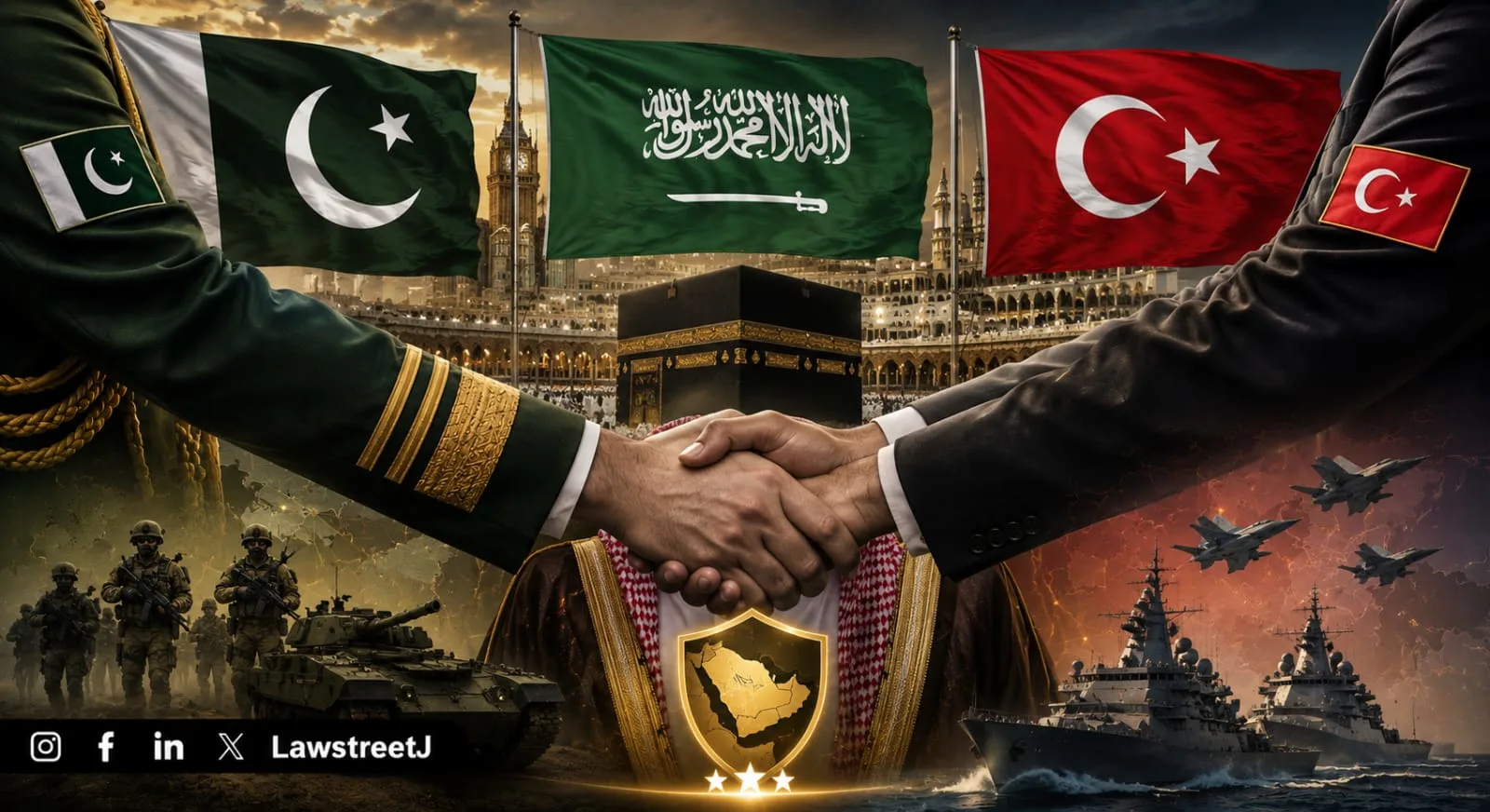

MAKKAH AL-MUKARRAMAH — In one of the most consequential geopolitical developments of 2026, three of the world's most militarily significant Muslim-majority nations formalised a collective defence pact on Friday in the holiest city in Islam. Saudi Crown Prince Mohammed bin Salman, Turkish President Recep Tayyip Erdogan, and Pakistani Prime Minister Shehbaz Sharif signed the Mecca Joint Defence Agreement in Mecca, Saudi Arabia, deepening security cooperation amid heightened military tensions and conflicts in the Middle East.
The Mecca Joint Defence Agreement is a trilateral collective-defence pact signed on August 7, 2026 in Mecca, Saudi Arabia, by Saudi Arabia, Pakistan and Turkey. Under the pact, an armed attack against any one of the three states is to be treated as an attack against all three.
The deal brings together oil-rich Saudi Arabia, nuclear-armed Pakistan, and Turkey, which has NATO's second-largest army and a rapidly growing defence industry. The three leaders also performed Friday prayers together at the Grand Mosque in Mecca before the signing, an act of deliberate symbolism in the world's most sacred Islamic site, reinforcing the agreement's framing as rooted in shared Islamic identity and mutual obligation.
In a joint statement published by the official Saudi press agency and Pakistan's Ministry of Foreign Affairs, the three countries announced the signing of the Mecca Joint Defence Agreement. Pakistan's Prime Minister Sharif called the joint pact a "historic endeavour" which serves "the interests of our homelands and enhances the security and stability of our region."
What the Agreement Contains

The formal text and official statements released after the signing make the scope and limits of the agreement clear on several key points.
Pakistan's Foreign Ministry said in a statement: "The Agreement is intended to strengthen collective deterrence against any act of aggression, and stipulates that any armed attack against any one of the three States shall be regarded as an attack against them all. It further provides for the enhancement of all aspects of defence cooperation among the three States."
This collective defence clause is modelled on the mutual defence principle most associated with NATO's Article 5, the provision that has governed the North Atlantic alliance's core commitment since 1949. Under it, an attack on Poland, for example, is treated as an attack on all 32 NATO members. The Mecca Joint Defence Agreement extends the same legal and political principle to a trilateral grouping of nations that are geographically and strategically distinct from the Western alliance but face a convergent set of regional threats, most immediately from Iran.
The agreement also contains specific language that the signatories have used to define what the pact is not. Saudi Deputy Minister for Public Diplomacy Rayed Krimly said: "The agreement is not intended to establish a military alliance or sectarian bloc, and is not linked to any nuclear ambitions or regional arms race." He added it is "not linked to nuclear ambitions or an arms race, but rather to building sustainable, self-reliant capabilities."
Turkiye's Erdogan said on X that the deal was signed "based on collective deterrence" and that Ankara would continue "its principled stance toward resolving conflicts and crises through dialogue and diplomacy on the basis of respect for international law."
The explicit disavowal of a sectarian or religious bloc is a careful piece of diplomatic framing, acknowledging that a pact signed by three Muslim-majority states in Mecca could easily be read as the formation of an Islamic military alliance, a reading all three governments are clearly intent on pre-empting.
The Road to Mecca: A Year of Bilateral Groundwork

The Mecca Joint Defence Agreement did not materialise out of nothing on August 7. It is the product of nearly a year of bilateral defence relationships between the three countries, each of which has deepened considerably since 2023.
The agreement builds on the bilateral Strategic Mutual Defence Agreement concluded between Saudi Arabia and Pakistan in September 2025, extending a comparable mutual-defence commitment to include Turkey.
The Strategic Mutual Defence Agreement was signed on September 17, 2025, at Al-Yamamah Palace, Riyadh, by Crown Prince Mohammed bin Salman and Prime Minister Shehbaz Sharif. That agreement formalised decades of military cooperation between the two countries, during which Pakistan had long provided training and technical assistance to Saudi forces.
Turkey and Pakistan had separately deepened their own defence ties, exchanging warships and training aircraft. In 2023, Saudi Arabia agreed to purchase Turkish-made drones in what Ankara described as its largest defence export contract at the time.
By the time negotiations for the trilateral agreement began in earnest, roughly a year before the August 7 signing, the bilateral architecture was already in place. The deal follows nearly a year of negotiations. Sealing the agreement in Mecca, home to Islam's holiest site, adds symbolic heft to a pact that builds on longstanding bilateral military ties.
Why Now: The Iran War and the Regional Security Context
The timing of the Mecca Joint Defence Agreement is inseparable from the regional war that has reshaped the Middle East since February 2026.
The agreement was signed against the backdrop of a wider regional war involving Iran that began in February 2026, during which Saudi Arabia and other Gulf states came under repeated missile and drone attack. Saudi Arabia, which has been directly targeted by Iranian strikes during this period, has an immediate and concrete security rationale for formalising a collective defence commitment with two of the most militarily capable nations in the Muslim world.
For Pakistan, the agreement deepens its longstanding strategic relationship with Riyadh, a relationship built over decades of military cooperation, economic dependency through remittances from the Pakistani diaspora in the Gulf, and shared concerns about Iranian influence. Pakistan hosts a large Shia Muslim minority, and its military establishment has historically been cautious about being seen as aligned exclusively against Iran. The explicit disavowal of a sectarian character in the agreement's official language reflects that domestic political sensitivity.
For Turkiye, the agreement extends President Erdogan's sustained effort to position Ankara as an indispensable regional power, one capable of operating independently of NATO on some questions while remaining within the alliance on others. Turkiye's defence industry, centred on the Bayraktar drone programme developed by Baykar Defence, has become a major factor in regional military equations, and the trilateral pact creates a framework within which Ankara can deepen those commercial and strategic relationships with both Riyadh and Islamabad.
What each nation brings to the pact is distinct. Saudi Arabia contributes the world's most significant hydrocarbon wealth and a geographic position at the heart of the Gulf. Pakistan contributes a nuclear arsenal, one of the largest standing armies in the world by personnel, and decades of documented military expertise in training and advising Saudi forces. Turkiye contributes NATO's second-largest military, a domestically produced drone force that has changed the character of warfare in multiple theatres, and a diplomatic reach that spans Europe, the Middle East, and Central Asia.
Iran's Reaction and the Regional Implications
The immediate regional reaction to the agreement was predictable, and it came from the country whose behaviour most directly motivated the pact.
Iranian lawmaker Ebrahim Rezaei warned Riyadh that it would take more than the pact to achieve regional security. The statement, while not constituting an official government position, signals how Tehran is reading the agreement, as a security architecture being constructed in direct response to Iran's military conduct since February 2026.
The Mecca Joint Defence Agreement does not name Iran as the threat it is designed to address. The language of the agreement speaks of "any act of aggression" and "external armed attack" without specifying a source. But the regional context, repeated Iranian missile and drone strikes on Gulf states during the US-Iran war that began in February, and Saudi Arabia's position at the centre of that threat environment, makes the implicit target of the collective defence clause legible to anyone following the conflict.
For India, which maintains significant strategic relationships with all three signatories as well as with Iran and the United States, the Mecca Joint Defence Agreement represents a new variable in an already complex regional equation. The pact sits at the intersection of the Iran-US conflict, Pakistan's nuclear status, Turkiye's NATO membership, and Saudi Arabia's position as the world's most important swing oil producer, a combination of factors with implications well beyond the immediate neighbourhood of the three signing states.
Whether the agreement will be tested and in what circumstances remains to be seen. What is certain is that, as of August 7, 2026, three nations representing a combined population of over 330 million people, a nuclear arsenal, NATO's second-largest military, and the world's largest proven oil reserves, have formally committed that an attack on any one of them will be treated as an attack on all three.