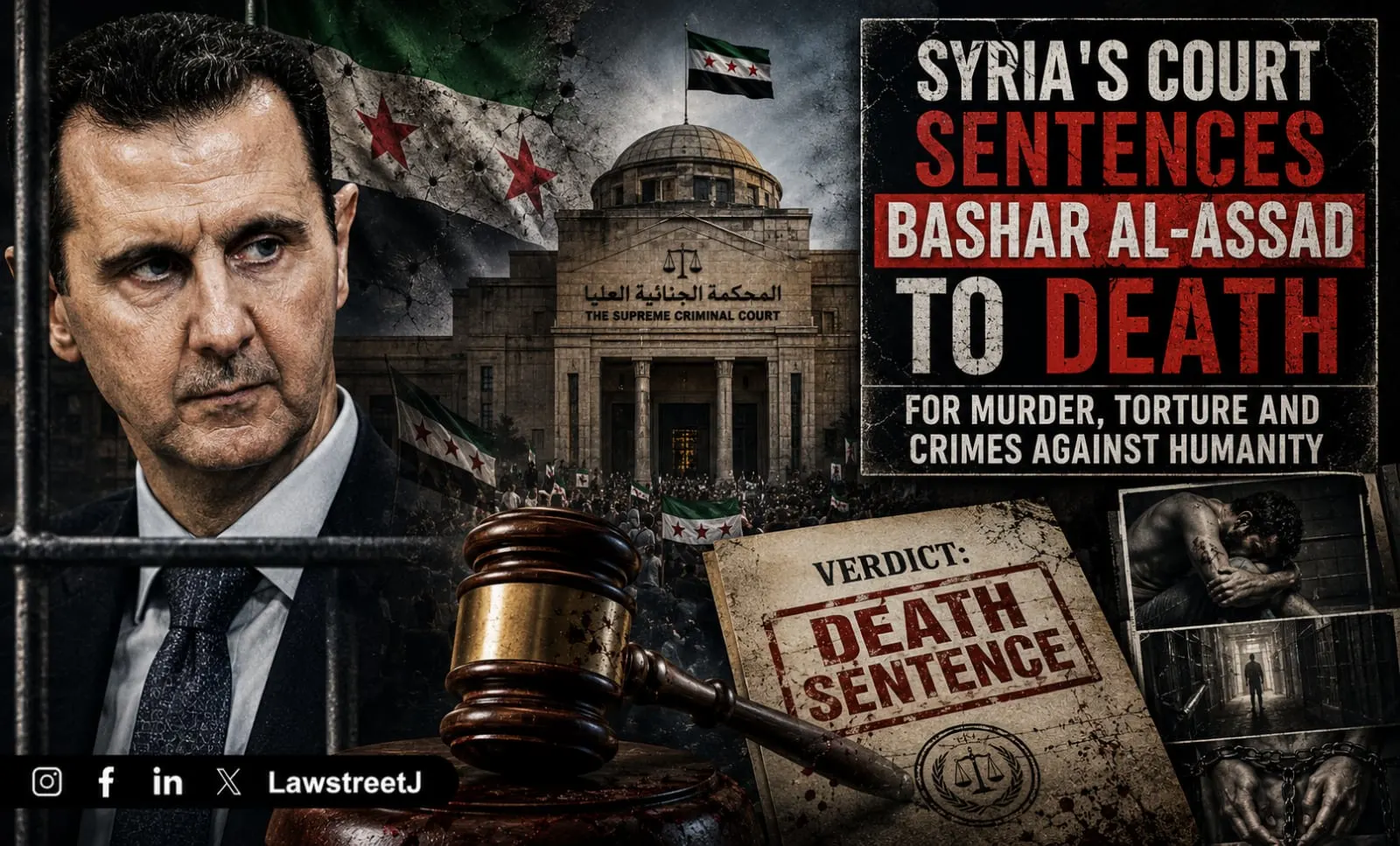
DAMASCUS : In a courtroom in Damascus on Tuesday, a judge read a sentence that would have been unimaginable just two years ago. Bashar al-Assad, who ruled Syria with a combination of state terror and familial dynasty for nearly a quarter of a century, was sentenced to death by the Fourth Criminal Court in the capital he once controlled absolutely. His younger brother Maher al-Assad received the same sentence. Their cousin Atef Najib, who was present in the courtroom standing inside a cage in a prisoner's uniform, was also sentenced to death.
The verdict, announced by Judge Fakhareddine al-Aryan during a session aired live on Syrian state television, is the first conviction against Assad or members of his inner circle since the Assad family's five decades in power came to an end 20 months ago. A Syrian court sentenced ousted leader Bashar al-Assad to death on Tuesday after a trial in absentia, convicting him of crimes including killings, torture, and arbitrary arrest during the country's nearly 14-year war.
Syrians gathered around the court in Damascus, chanting, clapping and waving the Syrian flag as news of the sentences spread. Outside the courtroom, people held up photographs, photographs of people who had been tortured to death in Assad's prisons, people who had disappeared into the detention system and never came out, people whose fate was confirmed only years later through documents smuggled out of the country at enormous personal risk.
Three Defendants, Three Death Sentences
The Fourth Criminal Court in Damascus on Tuesday found Bashar al-Assad, who was toppled in December 2024 and now lives in exile in Russia, guilty of premeditated murder, torture and crimes against humanity, and sentenced him to death in absentia. The court also sentenced his younger brother Maher al-Assad, also now living in Russia, to death in absentia for premeditated murder and torture.
Judge Fakhareddine al-Aryan stated during the proceedings: "Bashar Assad used state agencies to commit war crimes and crimes against humanity."
For Atef Najib, the sentencing was not in absentia. Najib, the former head of political security in southern Syria's Deraa province, who was arrested in January last year, was sentenced to death for "crimes against humanity." Najib, who launched a deadly crackdown on protesters in Deraa in 2011, which led to the uprising and later civil war, stood inside a cage wearing a prisoner's uniform as the judge read the sentence. His crimes include murder, "the intentional killing of children under 15" and "torture leading to death," according to the court.
Maher al-Assad was the former commander of the Syrian military's 4th Armored Division, which Syrian opposition activists had for years accused of killings, torture, extortion, drug trafficking, and running its own private detention centres beyond the formal prison system. His sentencing alongside his brother places the structure of command responsibility on record in a Syrian court for the first time.
What Triggered a 14-Year War: The Daraa Crackdown
The name Atef Najib carries specific weight in Syrian history that extends far beyond his individual crimes. He is, in a direct and documented sense, the man whose actions in Daraa in 2011 lit the match that became a civil war.
In March 2011, teenagers in the southern Syrian city of Daraa spray-painted anti-government graffiti on the walls of their school inspired, as many across the Arab world were at that moment, by the Arab Spring uprisings that had already toppled governments in Tunisia and Egypt. Najib's political security apparatus arrested them. What followed was documented torture of children.
When parents and community members came to demand the children's release, Najib's forces opened fire on the gathering crowd. The killings produced protests. The protests produced a crackdown. The crackdown produced an uprising. And the uprising, as the Assad government chose military suppression over political accommodation at every turn over the following months, became a civil war that lasted nearly 14 years, killed approximately half a million people, displaced more than half of Syria's pre-war population of 21 million, and reduced the country's cities, hospitals, schools, and infrastructure to rubble.
The death sentence handed to Atef Najib on Tuesday is therefore not simply the sentencing of a security official. It is the legal closing of the circle that Daraa opened in 2011.
The Scale of What Happened: A Documented Record of Atrocity
The charges against the three defendants are drawn from a 14-year record of documented atrocity that is, by any measure, among the most extensively evidenced cases of state violence against a civilian population in the 21st century.
The al-Assad regime's documented atrocities over 14 years include the use of chemical weapons, most notably a sarin attack on the Ghouta suburb of Damascus in August 2013 that killed an estimated 1,400 people, according to US intelligence reports. The use of sarin was confirmed by the Organisation for the Prohibition of Chemical Weapons. The regime also dropped more than 80,000 barrel bombs on civilian areas, according to the Syrian Network for Human Rights.
The most extensive documentation of regime crimes came from the so-called "Caesar photographs." The evidence consists of 55,000 images of some 11,000 detainees who died from torture, starvation or execution in Syrian government facilities, smuggled out by a military police photographer known by the codename Caesar.
The Caesar photographs, taken by a man who risked his life to document what was happening inside Syria's detention system, became the single most important evidentiary trove of the Assad regime's crimes. The man known as Caesar eventually defected and brought the photographs out of Syria in 2013. He testified before the United States Congress and the European Parliament. His images showed malnourished, brutalised bodies systematically documented by a system that treated death as an administrative fact to be recorded. The Syrian Network for Human Rights has documented over 14,000 civilians tortured to death in regime detention facilities.
Amnesty International documented systematic mass hangings at Saydnaya military prison, which it described as a "human slaughterhouse." Thousands of Syrians were executed there in procedures so regularised that they were described by survivors as bureaucratic in character.
The Practical Question: Where Assad Is and What Happens Next
The death sentence handed down in Damascus on Tuesday is legally significant and symbolically enormous. It is also, in its practical dimension, limited by a fact that has not changed since Assad fled Syria in December 2024.
Syria has repeatedly demanded that Russia extradite al-Assad, a longtime ally of Moscow who reportedly now lives a life of luxury in the Russian capital.
Russia has not agreed to extradite him. There is no indication that it intends to. Assad's presence in Moscow is a function of the decades-long Russian-Syrian strategic relationship that saw Russia intervene militarily in the Syrian civil war from 2015 onwards to prevent the collapse of the Assad government. That relationship did not end when Assad's government did.
Caroline Rose, Senior Director at The Soufan Center, said: "The ruling we saw today on the al-Assad brothers and their cousin, Atef Najib, marks a new chapter in Syria's post-regime accountability landscape. Realistically, the sentencing will only apply to Najib, who is in Syrian custody, while Bashar and Maher remain in Russia and likely will not be handed over by Moscow."
She added: "It is a decision that seeks to satisfy millions of Syrians who seek accountability and justice after war crimes committed by the regime, seeking closure."
Assad also faces an arrest warrant in France over the bombing of a press centre in Homs in 2012, one of numerous international legal actions that have been initiated against the former president and members of his government in European courts, none of which have resulted in his arrest given his location in Russia.
The only defendant present in court on Tuesday was Atef Najib. His death sentence is the only one of the three that can be carried out by the Syrian state as currently constituted. The sentences for Bashar and Maher al-Assad are on the record. Whether they are ever executed depends on whether Russia's position on extradition changes, a prospect that no current political analysis supports.
What the Verdict Means for Syria's Transition
The significance of Tuesday's verdict extends beyond the three individuals sentenced. It establishes something that Syria has never had before, a domestic legal record, produced by a Syrian court, documenting the crimes of the Assad regime against the Syrian people.
Hitto said the verdict would also set a strong legal precedent for others accused of crimes under al-Assad's rule. "People across Syrian towns are looking for justice, not just for al-Assad, but for the executioners," said Al Jazeera's Osama bin Javaid.
"This is something they've waited for a long time. They want to see these people that tortured their children, displaced them from their homes and destroyed their communities be held to account for these crimes," Hitto said.
The phrase "not just for al-Assad, but for the executioners" captures a reality about transitional justice that Syria's new government will need to navigate carefully. The individuals who carried out the torture, ran the prisons, dropped the barrel bombs, and operated the gas chambers were not all named in Tuesday's verdict. Many of them remain in Syria. Some may have quietly integrated into the new security structures. The verdict against Assad establishes the legal principle of accountability, the application of that principle to the tens of thousands of individuals who implemented the regime's violence is the harder, longer, and more politically treacherous work that follows.