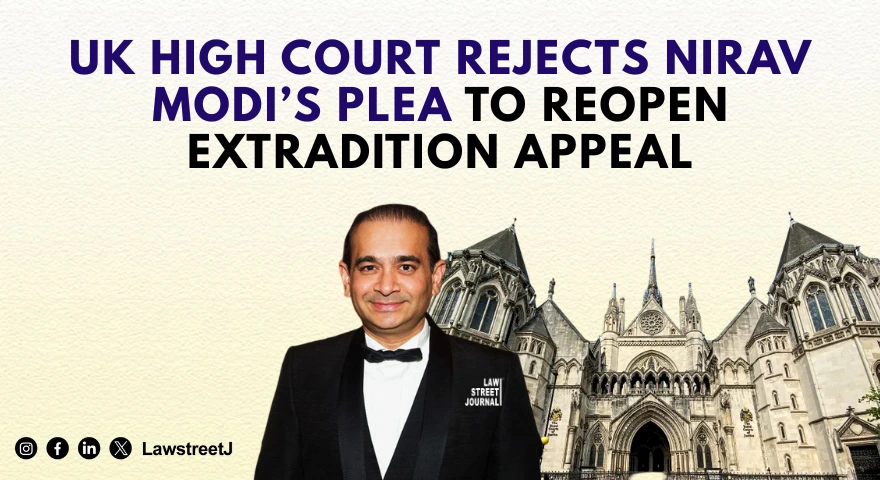
United Kingdom: The Divisional Court of the King’s Bench Division of the High Court of Justice in England has refused fugitive diamond merchant Nirav Modi’s application to reopen his extradition appeal. The Court held that the assurances furnished by the Government of India—that he would not be interrogated by any of the five investigating agencies after extradition—are comprehensive, detailed, and reliable. It further held that the case does not meet the twin thresholds of “exceptional circumstances” and “real injustice” required to reopen a concluded extradition appeal.
The judgment was delivered on 25 March 2026 by a bench comprising Lord Justice Stuart-Smith and Mr Justice Jay, dismissing Modi’s application filed under CrimPR Part 50.27 seeking permission to reopen his extradition appeal.
The extradition of Modi is sought by the Government of India pursuant to two requests dated 27 July 2018 and 11 February 2020. The first request relates to proceedings initiated by the Central Bureau of Investigation (CBI) and the Enforcement Directorate (ED) concerning an alleged fraud on Punjab National Bank involving losses exceeding £700 million, along with allegations of laundering the proceeds of that fraud. The second request pertains to a third set of proceedings involving alleged interference with evidence and witnesses in the CBI case. Modi was arrested in the United Kingdom on 19 March 2019 and has since remained in custody at HMP Wandsworth.
The extradition hearing before District Judge Goozee at Westminster Magistrates’ Court concluded in January 2021, with the Court finding no legal bars to extradition. The Secretary of State ordered extradition on 15 April 2021. Modi’s subsequent appeal before the Divisional Court—on grounds including compatibility with Article 3 of the European Convention on Human Rights (risk of torture or inhuman treatment) and oppression due to his physical or mental condition under Section 91 of the Extradition Act 2003—was dismissed by the same bench on 9 November 2022. Permission to appeal to the Supreme Court was later refused.
Following a legal bar that prevented his extradition until 13 August 2025, Modi filed the present application on 18 August 2025 seeking to reopen his appeal. The application was based on the Divisional Court’s earlier ruling in Bhandari v Government of India [2025] EWHC 449 (Admin), delivered on 28 February 2025. In that case, the Court had examined whether Jatin Bhandari faced a real risk of torture or inhuman treatment if extradited to India. It concluded that the use of proscribed treatment, including torture to obtain confessions, was “commonplace and endemic” within certain investigative contexts, and that the assurances provided by the Government of India in that case were insufficient.
Relying on these findings, Modi argued that he faced a similar risk if extradited and interrogated by multiple agencies in India.
As a preliminary issue, the Court considered whether the application had been made “as soon as practicable” under CrimPR Part 50.27(2)(a). Although noting a delay between the Bhandari judgment (February 2025) and the filing of the present application (August 2025), the Court accepted Modi’s explanation regarding practical constraints, including the time required to gather evidence, and held that the requirement was satisfied.
Between September 2025 and February 2026, the Government of India submitted a series of assurances and affidavits. On 2 December 2025, Mr Rakesh Pandey, Joint Secretary in the Ministry of Home Affairs, formally undertook to His Majesty’s Government that Modi would not be interrogated by the CBI, ED, or any other investigating agency—including the Serious Fraud Investigation Office (SFIO), the Directorate of Revenue Intelligence (DRI), and the Central Board of Direct Taxes (CBDT)—in connection with any ongoing matter. Any future interrogation, it was stated, would require prior consent of UK authorities. It was also assured that Modi would not be transferred from Arthur Road Prison, Mumbai, even if consent were granted for trial in additional cases.
Supporting affidavits were filed by senior officials of the CBI and ED confirming that investigations in their respective matters had concluded and that trial courts were already seized of the proceedings. On 12 February 2026, a note verbale issued by the Indian High Commission reaffirmed that these assurances are binding, derive authority from India’s constitutional and statutory framework, and would be strictly adhered to by all relevant agencies.
Appearing for Modi, Edward Fitzgerald KC advanced several arguments, including that the systemic issues identified in Bhandari remained unresolved, that the assurances originated from agencies implicated in such conduct, and that enforcement across multiple authorities over time would be impractical. He also challenged the validity of the “carve-out” permitting future interrogation with UK consent, arguing that UK authorities lack the legal power under Section 129 of the Extradition Act 2003 to grant such consent. Additionally, he relied on a production warrant issued by a court in Surat, Gujarat, which would require Modi’s transfer and potentially expose him to risk.
For the Government of India, Helen Malcolm KC argued that the assurances were comprehensive, made in good faith, and binding on all relevant authorities. She further contended that the carve-out was effectively redundant, as the condition precedent—UK consent—could never legally be fulfilled, thereby rendering interrogation permanently impermissible.
The Court applied the eleven-factor test laid down by the European Court of Human Rights in Othman v United Kingdom (2012) and reaffirmed the principle that courts may ordinarily presume good faith on the part of a friendly foreign state governed by the rule of law.
It found that the assurances were specific, fully disclosed, and provided by a competent authority capable of binding all relevant agencies. The Court also noted that torture is prohibited under Indian law and acknowledged the longstanding diplomatic relationship between the UK and India.
While recognising concerns raised regarding prior conduct of certain officials, the Court held that these did not outweigh the binding nature and good faith of the assurances.
On enforceability, the Court clarified that formal enforceability under domestic law was not decisive; diplomatic accountability and the reputational consequences of breach were sufficient safeguards.
Addressing the carve-out issue, the Court held that since UK authorities cannot legally consent to interrogation, the condition precedent could never be satisfied, effectively making any interrogation impermissible. It also rejected concerns arising from the Surat production warrant, holding that all agencies, including the DRI, are bound by the assurances.
Ultimately, the Court concluded that the Government of India had provided a comprehensive and reliable set of assurances that fully addressed the risks raised. It held that the circumstances were neither exceptional nor indicative of real injustice, and therefore refused the application.
Appearance:
For the Applicant: Edward Fitzgerald KC and Graeme L. Hall (instructed by Boutique Law LLP)
For the Respondent: Helen Malcolm KC and Nicholas Hearn (instructed by the Crown Prosecution Service)
Case Title: Nirav Deepak Modi v Government of India
Citation: [2026] EWHC 716 (Admin)


.webp)