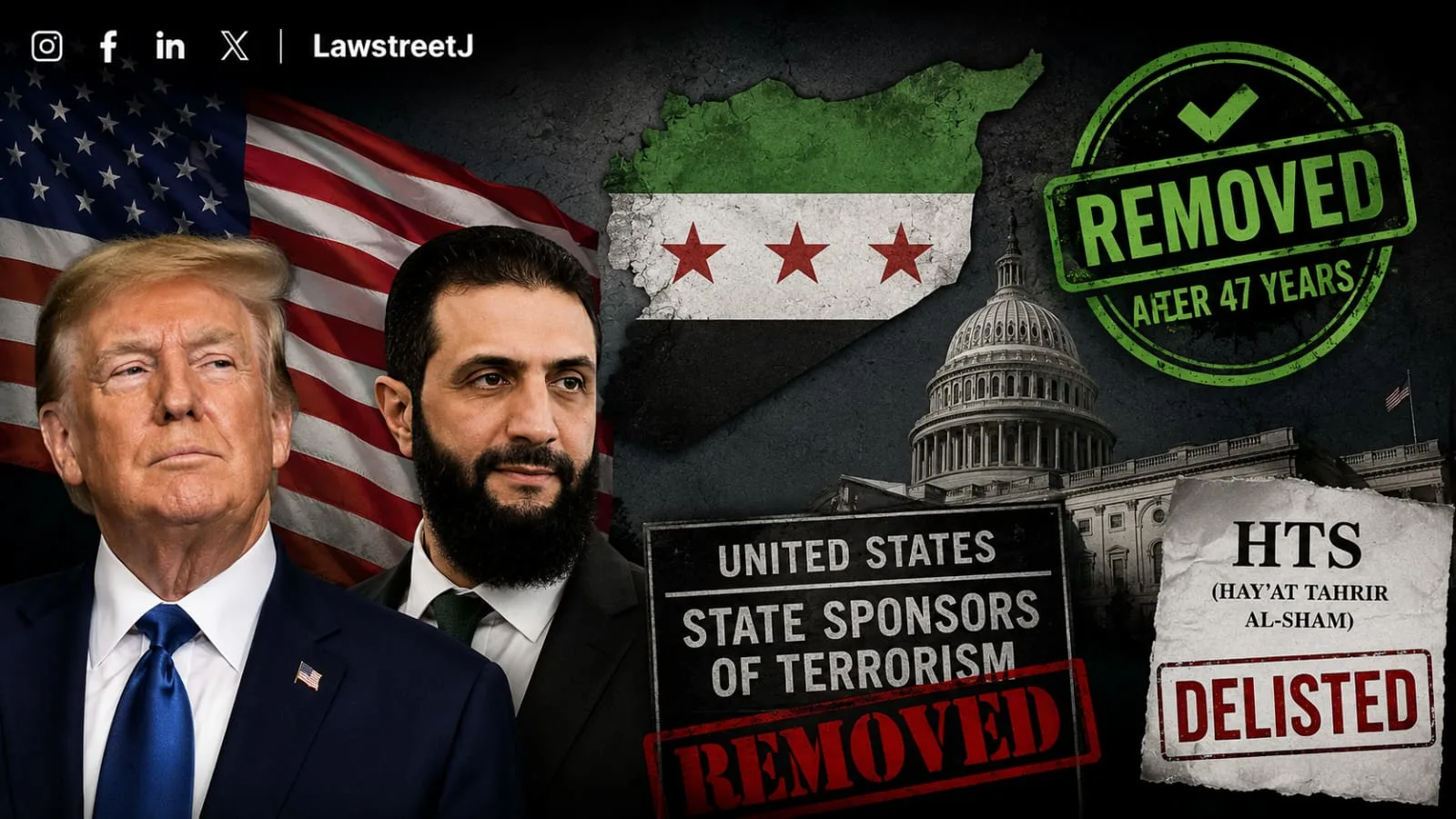

WASHINGTON D.C. - The United States formally removed Syria from its list of State Sponsors of Terrorism on Monday, ending a designation that had been in place for 47 years and simultaneously delisting the armed group Hayat Tahrir al-Sham from the Specially Designated Global Terrorist list marking the most consequential act of American sanctions relief for Syria since the fall of Bashar al-Assad's government in December 2024.
The United States removed Syria from its list of state sponsors of terrorism on Monday, lifting what Damascus says was the last major impediment to investing in the country as Washington deepens ties to the new Syrian government.
The removal of the SST designation provides enormous sanctions relief for Syria and the ability for Damascus to fully rejoin the international financial system. The country faces huge challenges in reconstruction following more than a decade of civil war.
The US State Department also revoked its designation of al-Nusrah Front, also known as Hayat Tahrir al-Sham, as a global terrorist organisation, leaving Cuba, Iran and North Korea as the three countries designated by Washington as state sponsors of terrorism.
The decision was announced simultaneously by the State Department under Secretary Marco Rubio and the Treasury Department under Secretary Scott Bessent.
Secretary of State Marco Rubio said the removal of the SST label recognised "positive actions and further commitments" by the Syrian government under al-Sharaa to fully distance the country from acts of international terrorism. "Rescinding Syria's designation as an SST and HTS' designation as an SDGT eliminates the final major barriers for private sector investment in Syria and promotes Syria's economic recovery and reintegration into the global economy," Rubio said in a statement.
Treasury Secretary Scott Bessent said: "Today's action will help foster additional investment in Syria to promote political and economic stability." Treasury said the moves were "in line with President Trump's promise to deliver sanctions relief to Syria." But the agency stressed that its removal of restrictions on Syria "does not change Treasury's posture with regards to countering global terrorism and our commitment to hold bad actors in Syria accountable."
47 Years: How Syria Came to Be on the List and Why It Is Being Removed
Syria has carried the label for some 46 to 47 years, having been placed on the State Sponsors of Terrorism list in 1979 during the era of the Assad family.
The designation placed on Syria by the United States in 1979, during the presidency of Hafez al-Assad, father of the ruler who was toppled last year, carried a specific set of legal consequences: restrictions on US foreign assistance to Syria, prohibitions on defence exports, and limitations on financial transactions that effectively placed Syria outside the international banking system. For the more than four decades that followed, successive US administrations maintained the designation regardless of the diplomatic state of the relationship.
The announcement was made formal on Monday, 45 days after notifying Congress of the intention to rescind the designation for Syria. Trump formally notified Congress on July 8 of his intention to rescind the designation. The move had strong bipartisan support in Congress, with Senator Jeanne Shaheen, Senator Elizabeth Warren and Representative Joe Wilson urging Rubio to delist Syria in a July letter.
The lawmakers wrote: "Syria's SST designation represents the most significant remaining legal impediment to Syria's reconstruction. Its removal could create new opportunity for foreign investment, economic development and capacity building to ensure the Syrians can remain capable and willing partners to the United States."
Ahmed al-Sharaa: From al-Qaeda Affiliate to American Partner
The individual at the centre of the US-Syria rapprochement is Ahmed al-Sharaa, a figure whose political and personal biography captures the full complexity of Syria's transformation.
Al-Sharaa led Hayat Tahrir al-Sham, which helped topple al-Assad's dictatorship in December 2024. HTS was once al-Qaeda's official branch in Syria and was led by al-Sharaa. Under his leadership, the group removed former President Bashar al-Assad in December 2024 following a lightning offensive.
HTS was earlier known as Al-Nusra Front and was formerly the branch of Al-Qaeda in Syria. It broke ties with the jihadist group in 2016.
Trump has increasingly treated Sharaa's government as a potential partner in efforts to stabilise Syria. Trump met al-Sharaa on the sidelines of the NATO summit in Ankara, Turkey, in July 2026 and pledged to begin dismantling the broad network of US sanctions accumulated during Assad's rule.
The designation of HTS as a terrorist organisation had continued to complicate US-Syria normalisation even as broader sanctions on the country were being relaxed. By simultaneously delisting HTS as an organisation, the Trump administration has removed a legal obstacle that would have complicated any American company or government agency from dealing with al-Sharaa's government given that HTS remains the dominant political-military force in post-Assad Syria.
In the past year, the government of Syria has taken significant steps to counter terrorism, including formally joining the Global Coalition to Defeat ISIS in November and conducting operations to disrupt the terror networks of ISIS, al-Qa'ida, Hizballah, and Iran-aligned groups.
Reuters reported this month that Damascus agreed to drastically reduce imports of Russian oil during discussions with Washington over lifting the terrorism designation, according to three sources familiar with the talks. The reduction of Russian oil imports is a signal of Syria's willingness to distance itself from Moscow, a strategic shift that aligns with US interests in the region and adds a geopolitical dimension to what is formally presented as a counter-terrorism assessment.
The Broader Sanctions Relief Trajectory
Monday's formal SST removal is the latest step in a year-long process of US sanctions dismantlement for Syria that began shortly after Assad's fall.
The historic June 2025 Executive Order "Providing for the Revocation of Syria Sanctions" accelerated the process of sanctions relief for Syria, including by terminating the Syria Sanctions Program and the national emergency with respect to Syria, and directing reviews on various Syria-related sanctions and terrorist designations.
The US lifted broader sanctions on Syria in June 2025, alongside the European Union. Over the following year, the administration moved steadily in the direction of full normalisation. Washington eased some export restrictions, worked with Congress to eliminate sanctions imposed under the Caesar Syria Civilian Protection Act, and revoked the terrorist designation applied to Sharaa's former militant organisation. The SST removal on August 24 completes that trajectory, removing what the State Department itself described as the final major barriers to private sector investment in Syria.
As stated by Secretary Rubio: "Rescinding Syria's designation as an SST and HTS' designation as an SDGT eliminates the final major barriers for private sector investment in Syria and promotes Syria's economic recovery and reintegration into the global economy."
The caveat embedded in Treasury's announcement is noteworthy. The US government made explicit that removing Syria from the SST list does not constitute a blanket clearance for all actors and activities within Syria. Targeted sanctions on specific individuals involved in terrorism, human rights abuses, or other designated activities remain in place. The SST removal is a macro-level shift in Syria's status, not a declaration that all of Syria's challenges with terrorism, governance, and accountability have been resolved.
Syria's new government has acknowledged that the country's path to reconstruction is long and requires broad international engagement. The formal removal from the State Sponsors of Terrorism list, a designation that has been in place longer than many Syrian citizens have been alive removes the most significant formal barrier to that engagement and signals that Washington has decided to treat Ahmed al-Sharaa's Syria as a partner rather than an adversary.

.jpeg)