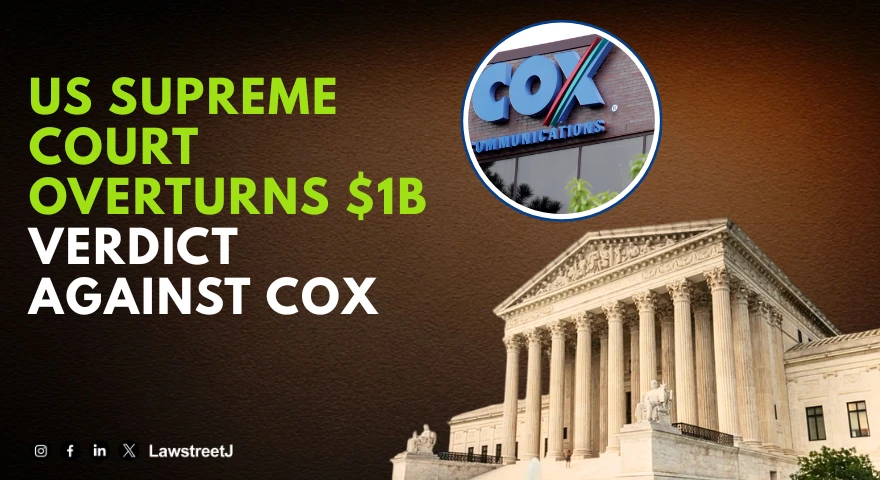
Washington: The United States Supreme Court has reversed a $1 billion copyright infringement verdict against Cox Communications, ruling that an internet service provider cannot be held contributorily liable for the copyright infringement of its subscribers merely on the ground that it knew about the infringing activity and continued providing internet access. The 7–2 decision, authored by Justice Clarence Thomas, was delivered on March 25, 2026.
Sony Music Entertainment and other major music copyright owners had sued Cox after their tracking service, MarkMonitor, sent Cox over 163,000 notices over a two-year period identifying IP addresses of Cox subscribers associated with copyright infringement. Rather than suing the individual infringers, Sony proceeded against Cox itself on two theories of secondary liability, i.e., contributory liability and vicarious liability. A jury in the Eastern District of Virginia found in Sony’s favour on both counts, returned a finding of willful infringement, and awarded statutory damages of one billion dollars. The Fourth Circuit Court of Appeals upheld the finding of contributory liability while reversing the finding of vicarious liability. The Supreme Court then granted Cox’s petition on the contributory liability question.
Cox, which serves approximately six million subscribers, had a graduated response system in place for copyright complaints. After the second notice concerning a subscriber’s IP address, Cox sent a warning. After further notices, Cox suspended internet access temporarily and later required the subscriber to call in before restoration. After thirteen notices, the subscriber was subject to full termination. Cox also contractually prohibited subscribers from using their connection to post, copy, transmit, or disseminate content that infringed copyrights. Cox contended that this system resolved identified infringement in 98 percent of cases. Sony pointed out, however, that Cox terminated only 32 subscribers for infringement during the relevant period while terminating hundreds of thousands for non-payment, and cited internal communications from Cox employees expressing reluctance to act on infringement notices.
Before the Supreme Court, the central question was what level of knowledge and conduct is required to hold a service provider contributorily liable for the copyright infringement of those who use its service. The Court traced the doctrine through its earlier decisions in Sony Corp. of America v. Universal City Studios (1984) and Metro-Goldwyn-Mayer Studios Inc. v. Grokster, Ltd. (2005), and held that contributory liability can be established only in two ways, i.e., either by showing that the provider actively induced infringement through specific promotional or marketing conduct, or by showing that the service provided was one not capable of substantial or commercially significant non-infringing uses.
Applying those tests, the Court held that Cox satisfied neither. Cox had not induced or encouraged its subscribers to infringe; on the contrary, it had warned them, suspended their access, and terminated accounts. And its service, broadband internet access, was plainly capable of vast lawful use and had not been designed or adapted to facilitate copyright infringement. The Fourth Circuit’s holding—that supplying a product with knowledge that the recipient will use it to infringe is sufficient for contributory liability—was rejected as going beyond any basis recognised by the Court’s precedent and as conflicting with the Court’s repeated position that knowledge alone cannot ground secondary copyright liability.
Sony had argued before the Court that the Digital Millennium Copyright Act’s (DMCA) safe harbour provisions, which protect ISPs from secondary liability if they implement a policy for the termination of repeat infringers, would be rendered meaningless if ISPs faced no liability for continuing to service known infringers. The Court rejected this argument, holding that the DMCA safe harbour creates a defence from liability and does not itself create the liability from which protection is sought. The DMCA expressly provides that failing to qualify for the safe harbour does not establish that the ISP’s conduct was infringing.
Justice Sonia Sotomayor, joined by Justice Ketanji Brown Jackson, concurred in the outcome but wrote separately to express disagreement with the majority’s reasoning. Justice Sotomayor took the position that the majority had unnecessarily foreclosed the possibility of secondary liability under common-law aiding and abetting principles, which the Court’s earlier decisions in Sony and Grokster had expressly left open. She argued that Grokster had specifically held that Sony did not displace other fault-based theories of secondary liability derived from the common law, and that the majority’s categorical limitation of secondary liability to the two recognised theories was inconsistent with that holding and with the principle of stare decisis.
Justice Sotomayor further argued that the majority’s rule had the practical effect of rendering the DMCA safe harbour provision obsolete. If ISPs face no realistic prospect of secondary liability regardless of what they know about infringement on their networks, they have no legal incentive to implement the anti-infringement policies the DMCA was designed to encourage. She noted that Cox’s own counsel had conceded at oral argument that, under the rule the majority was adopting, the safe harbour provision would do nothing going forward.
However, Justice Sotomayor concluded that even under a common-law aiding and abetting analysis, Sony’s case against Cox could not succeed on the present record. Aiding and abetting requires that the defendant have intended to assist the specific infringing conduct, and the facts here did not support that inference. When Cox received a copyright infringement notice, it knew only which IP address had been used, not which individual at that address had committed the infringement. A single IP address may serve an entire household, a university residence, a hospital, or a regional ISP with thousands of downstream users. Without knowing the identity of the actual infringer, Cox could not meaningfully be said to have intended to aid that person’s specific act of infringement. On that basis, Justice Sotomayor concurred in the reversal of the judgment.
The judgment of the Fourth Circuit was reversed, and the matter remanded for further proceedings consistent with the Supreme Court’s opinion.
Case Title: Cox Communications, Inc. et al. v. Sony Music Entertainment et al., No. 24-171 (Supreme Court of the United States, March 25, 2026)