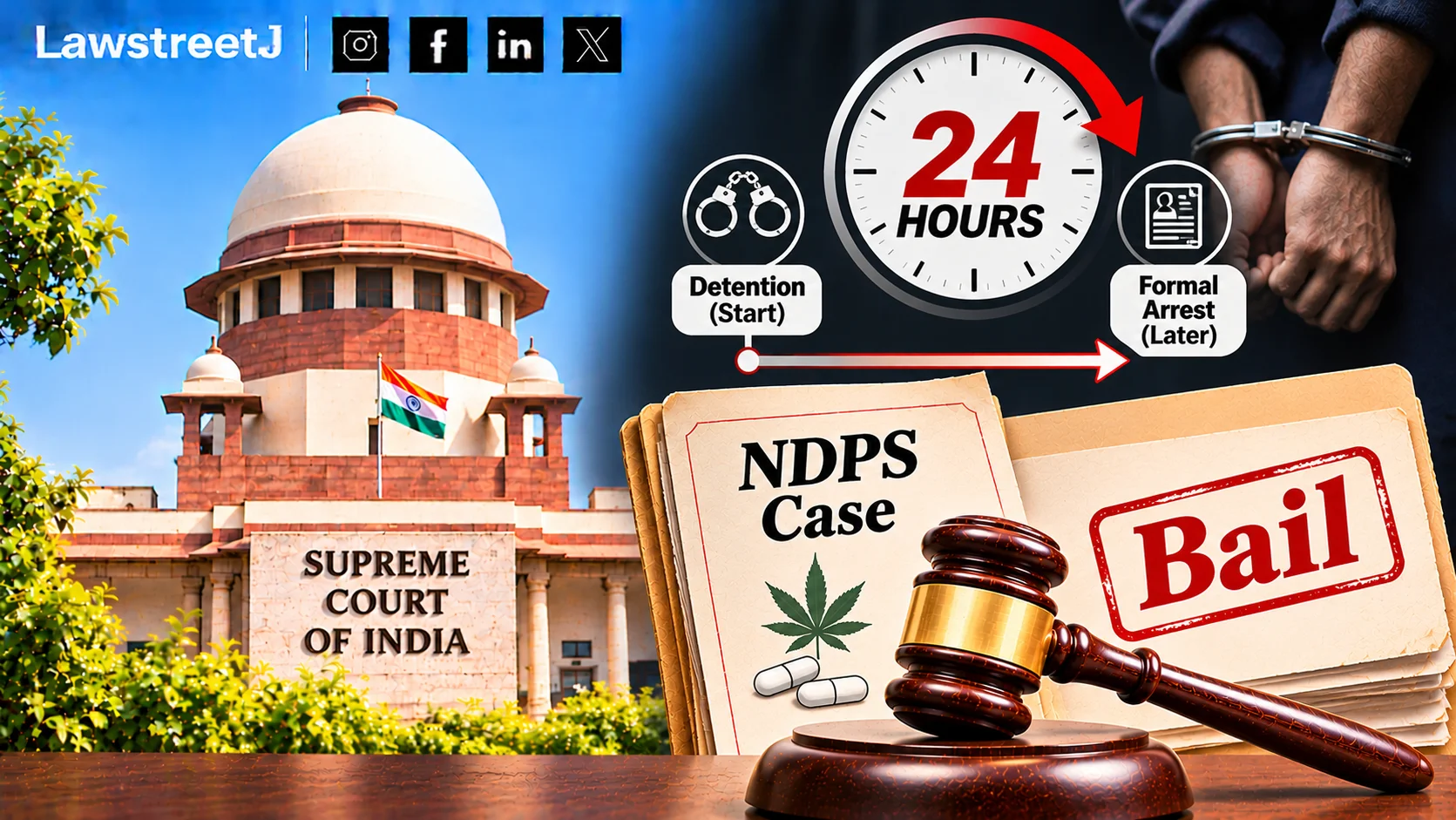
New Delhi: The Supreme Court has held that the 24-hour period under Article 22(2) of the Constitution runs from the time a person is detained and his liberty is curtailed, and not from the time of his formal arrest, and has directed the release on bail of three accused in an NDPS case involving 60.79 kg of methamphetamine (Yaba) tablets.
A Bench of Justice Ujjal Bhuyan and Justice Atul S. Chandurkar delivered the judgment on 5 November 2026 (2026 INSC 1195), and held that the Orissa, Madras and Kerala High Court decisions taking a contrary view do not lay down the correct law.
The appellants, Sujit Das, Suman Das and Rupak Sarkar, are accused in a case registered under Sections 21(C), 22(C), 23(C), 25, 25A, 28 and 29 of the NDPS Act. According to the prosecution, on 29.09.2025, on secret information, an inspector of the Divisional Preventive Force, Customs Division, Agartala, laid an ambush near Khowai. The truck carrying the accused was followed and, at about 1 pm, a sack was handed over to a person who arrived on a motorcycle at Shanitala Noabadi, after which 11.03 kg of Yaba tablets were recovered, and further bags found hidden under ginger sacks at the Customs office took the total to 60.79 kg.
The respondent’s own affidavit states that the accused were intercepted at 02:00 pm on 29.09.2025 and that the search and seizure procedure was completed at 05:00 pm the same day. They were shown as formally arrested at 11:00 am and 11:15 am on 30.09.2025, and were produced before the Judicial Magistrate at 04:45 pm on 30.09.2025. The Special Judge and the High Court had rejected their bail applications, the High Court relying on State of Punjab v. Sukhwinder Singh @ Gora on the rigour of Section 37 of the NDPS Act.
The issue arose during the hearing on 21.09.2026, when the appellants’ Senior Counsel, Mr. Rouf Rahim, pointed out the gap between the interception and the formal arrest. He argued that the distinction between detention and arrest is artificial, that the accused were under the control of the investigating team with their liberty curtailed from the time of interception, and that the formal arrest was shown late to circumvent the 24-hour mandate. The Additional Solicitor General argued that there was no breach after the formal arrest, and that the intervening hours were needed for the statutory formalities and interrogation.
The Court reiterated that the 24-hour period in Article 22(2) is a constitutional mandate which must be followed, and that its breach renders the arrest illegal and unconstitutional. Examining the meaning of “arrest” and “detention”, it held that the detention and arrest of a person cannot be treated as distinct for this purpose, and that the period commences from the time a person is intercepted and detained by the investigating agency and his liberty is curtailed.
The Court held that the Orissa High Court’s decision in Aryaman Pattnayak, the Madras High Court’s in Kannan and the Kerala High Court’s in Arun K. Thomas, which had taken the formal arrest as the starting point, do not lay down the correct law. Applying the principle, it held that the appellants’ arrest for the purpose of Article 22(2) must be taken to have happened at 02:00 pm on 29.09.2025, so that they had to be produced before the Magistrate before 02:00 pm on 30.09.2025, and their production at 04:45 pm was a clear breach of Article 22(2) that vitiates the arrest and makes their continued detention beyond that time illegal.
The Court also found a breach of Section 58 BNSS (Section 57 CrPC), which requires that detention within the 24 hours should not be longer than reasonable in the circumstances. There was an unexplained gap of 18 hours between the end of the search and seizure at 05:00 pm and the formal arrest. The Court said that “18 hours in custody without judicial oversight is a long period” with a clear possibility of misuse and abuse of authority.
On Section 37 of the NDPS Act, the Court expressed reservations about the observations in Sukhwinder Singh @ Gora, which had said that Article 21 rights must be exercised within the framework of Section 37. It said that numerous judgments, including K.A. Najeeb, Satender Kumar Antil and Vijay Singh, hold that when Article 21 is violated, the rigour of Section 37 must give way. It declined to comment further, as Sukhwinder Singh is by a coordinate Bench.
Summarising its conclusions, the Court laid down that the 24 hours begin from the time of detention and not formal arrest, that no time can be excluded except the time necessary for the journey to the magistrate, and that a person detained beyond 24 hours before production must be released forthwith. It added that the magistrate at the time of production must record the actual date and time of detention, examine whether the 24-hour deadline has been complied with, and may decline remand if the detention within 24 hours has been longer than reasonable.
The Court set aside the High Court’s judgment of 29.04.2026 and directed that the appellants be produced before the jurisdictional Special Court within seven days, after which they shall be released on bail on such terms as the court deems appropriate. It directed that a copy of the judgment be circulated to all Directors General of Police, the Registrars General of the High Courts and the Directors of State Judicial Academies.
Appearances: For the Appellants: Mr. Rouf Rahim, Senior Advocate. For the Respondent: Mr. Raghavendra P. Shankar, Additional Solicitor General.
Case Title: Sri Sujit Das and Others etc. v. Union of India, Criminal Appeals arising out of Special Leave Petition (Criminal) Nos. 12451-12453 of 2026