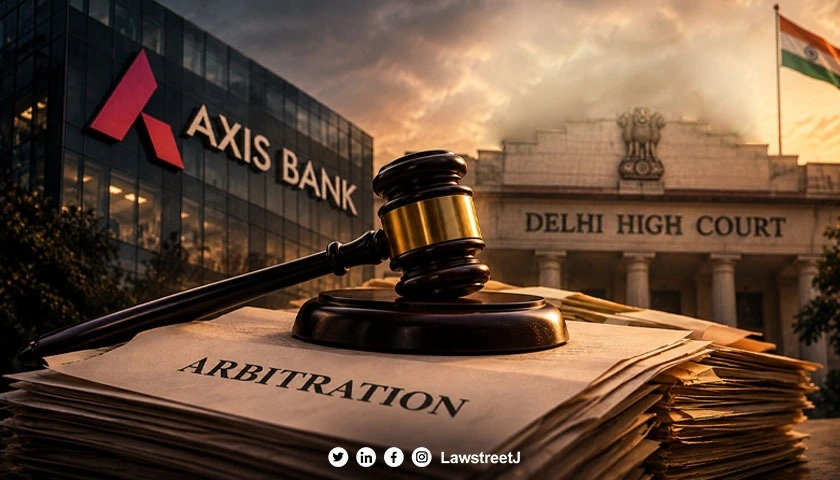
New Delhi: The Delhi High Court has declared an arbitral award passed in favour of Axis Bank unenforceable against a borrower, after the bank conceded that awards made by unilaterally appointed arbitrators are void ab initio. The court noted that the same sole arbitrator had handled 4,155 arbitrations for the bank in four to five years, and observed that this was "nothing but the tip of an iceberg."
A Division Bench of Justice Prathiba M. Singh and Justice Dinesh Bhatt was hearing an appeal against the order dated 30.01.2025 of the District Judge (Commercial Court)-05, Tis Hazari, which dismissed the borrower's petition under Section 34 of the Arbitration and Conciliation Act, 1996 as time barred. The issue before the court, it said, concerned enforcement of awards where the respondent had not been properly served, along with unilateral appointment of the same arbitrators by banks in thousands of disputes.
The bank had disbursed a loan of Rs. 16,66,795 in January 2019. After alleged default, it communicated the initiation of arbitration on 18.01.2023, and the sole arbitrator accepted the reference on 06.02.2023. The appellant disputed receiving either communication. The matter proceeded ex parte by order dated 16.05.2023 and the award was passed on 26.05.2023. The appellant said she learned of the proceedings only when she received a copy of the award on 02.06.2023. The appeal was entertained in April 2025, and mediation attempted in August 2025 did not succeed.
On 03.09.2026, the court asked the bank to file an affidavit on whether there was proof of service, whether the arbitrator was connected to the bank, how many arbitrations he handled for it, and whether he had made the declarations required under the Sixth and Seventh Schedules. The bank said the award itself recorded that notices were sent to the appellant's last known address, that this was the address she had herself disclosed, and that she had never complained of non-service in her later applications for the arbitral record. It also said the arbitrator had no relationship with it of the kind covered by the Seventh Schedule and had given the requisite declarations.
The court found that there was no proof of service except what the arbitrator recorded in the award. It also noted that, on being asked, the bank's official said the arbitrator had been paid his fees through the bank's lawyer. The Bench called the 4,155 cases the "most shocking aspect" of the affidavit, and held that this would clearly violate the provisions of the Act introduced by the 2015 amendment. It observed that the scale of conflict contemplated by the Fifth Schedule, which treats two or more appointments by one party in three years as giving rise to justifiable doubt, was far lower than what was unearthed here. The amendments came into effect on 23.10.2015, yet unilateral appointments by the bank continued until 2023.
Mr. Dayan Krishnan, Senior Counsel for the bank, conceded that awards made on unilateral appointments are void ab initio, relying on the Supreme Court's decisions in Perkins Eastman Architects DPC v. HSCC (India) Ltd., (2020) 20 SCC 760, and Central Organisation for Railway Electrification v. ECI SPIC SMO MCML (JV), (2025) 4 SCC 641. The court noted that it has itself set aside awards on this ground in Satyaprakash and Brothers (P) Ltd. v. Union of India [2025:DHC:6615-DB] and Sidharth Construction Co. v. Indian Tourism Development Corporation [2025:DHC:2313-DB], and that a Coordinate Bench held similarly in Ram Kumar v. Shriram Transport Finance Co. Ltd., 2022 SCC OnLine Del 4268.
The senior counsel further stated that, of the 4,155 cases, about 65 per cent (around 2,700 cases) had been settled, while in about 1,264 cases no execution petition or fresh appointment had been made. On instructions, he submitted that no unilateral appointment has been made since 2023, and that a total of 76,000 awards have been passed by such sole arbitrators across India concerning the bank.
Reacting to the figures, the Bench observed that arbitrators appointed in thousands of matters without proper declarations cannot be said to be independent and impartial. It held that even under the unamended Section 12(1), handling thousands of arbitrations for the very same arbitrator appointed by one party would raise justifiable doubts, and that repeated appointments go against the core of neutrality, which is at the soul of any arbitral process.
The court said the bank is answerable for how this situation was permitted and must take remedial measures. At the same time, it stressed that banks, being custodians of public money, cannot avail remedies contrary to law to recover loans, while defaulting borrowers cannot be allowed to go scot free. It described the position as a "double blow" for the bank, since such awards are void and unenforceable while the bank is also unable to enforce them or easily invoke fresh arbitration. A centralised, institutional solution was needed, failing which substantial public money would go unrecovered and a significant number of awards would be rendered void.
The Bench directed the bank to file a fresh affidavit giving the reasons why thousands of arbitrations were given to the same arbitrator, and setting out its future course of action on awards passed by unilaterally appointed arbitrators, including enforcement and steps for recovery. It also directed the Reserve Bank of India, as the sector regulator, to caution all banks so that other banks and financial institutions can look into remedial measures, and to file its affidavit by 16.11.2026.
On the merits, since the bank itself took the stand that the award was void ab initio, the court declared the award dated 26.05.2023 unenforceable against the appellant and held that the appeal succeeds. The bank is free to take steps afresh for recovery of the loan in accordance with law, if permissible. The matter was listed on 17.11.2026 and will be treated as part-heard.
Appearances:
For the Appellant: Mr. Vishal Gupta, Mr. Ratneswar Das, Ms. Barnali Deka Das and Ms. Swati Singh, Advocates.
For the Respondents: Mr. Dayan Krishnan, Senior Advocate, with Mr. Sanjay Kumar, Advocate; Mr. Ramesh Babu, Senior Advocate, along with Ms. Manisha Singh, Advocate, for the Reserve Bank of India.
Case Title: Shikha Ghosh vs. Axis Bank Ltd. & Anr., FAO (COMM) 91/2025 & CM APPL. 20542/2025 [2026:DHC:8705-DB]


![Delhi High Court Sets Aside Arbitral Tribunal's Award Against NHAI in Highway Project Delay Case [Read Judgment]](/secure/uploads/2023/07/lj_9605_23374c2e-392c-4491-a2fe-f2f12fc5272f.jpg)
![Delhi Court Rejects Stay Request in Defamation Case Against Rajasthan CM Ashok Gehlot [Read Order]](/secure/uploads/2023/08/lj_5208_80de1ddc-d76a-4f7f-b180-408e3ae14fb4.jpg)