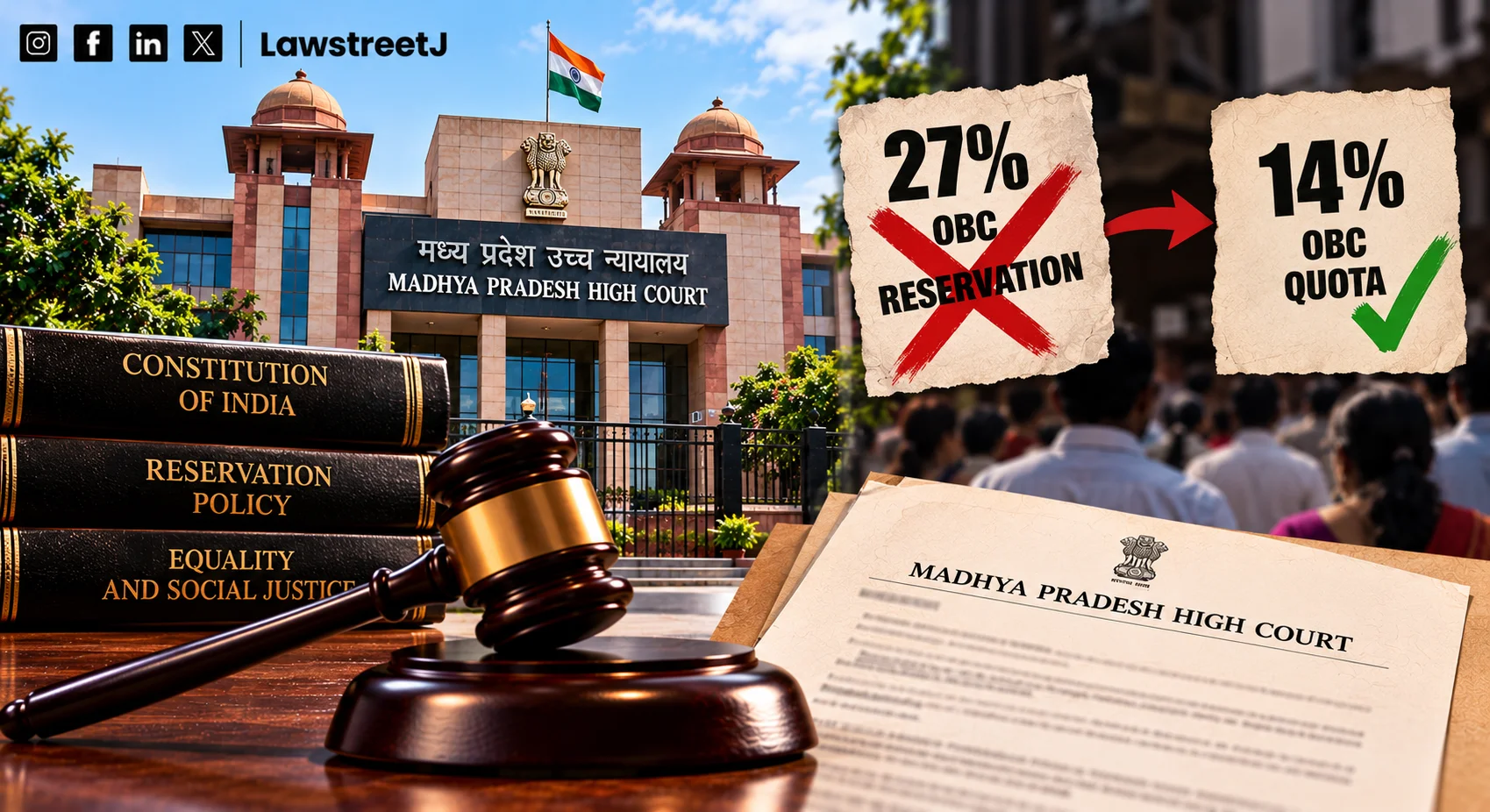
Jabalpur: The Madhya Pradesh High Court has struck down the Madhya Pradesh Lok Seva (Anusuchit Jatiyon, Anusuchit Jan Jatiyon aur Anya Pichhde Vargon Ke Liye Arakshan) Sanshodhan Adhiniyam, 2019, along with Ordinance No. 2 of 2019 dated 08.03.2019, which had increased reservation for Other Backward Classes (OBCs) from 14% to 27%, holding that the 50% ceiling laid down in Indra Sawhney v. Union of India, and reiterated in Jaishri Laxmanrao Patil v. Chief Minister, could not be breached as no extraordinary situation had been shown.
A Division Bench of Justice Anand Pathak and Justice Vinay Saraf delivered a common judgment on 09.10.2026, after reserving it on 05.08.2026, in Writ Petition No. 5901/2019 (Ashita Dubey and Others v. State of Madhya Pradesh and Others) along with a large batch of connected petitions challenging the 27% OBC reservation in public services and higher education, including admissions to medical courses. The petitions had been heard earlier by several benches, and the present bench, nominated by an administrative order dated 15.06.2026 after the then Chief Justice's elevation to the Supreme Court on 02.06.2026, heard the matter with the consent of all parties for 15 days, comprising about 30 hours. An application by an intervener for constitution of a special bench was rejected as having lost its meaning at that stage.
The court noted that the Madhya Pradesh Lok Seva (Reservation) Adhiniyam, 1994 had provided 16% for Scheduled Castes, 20% for Scheduled Tribes and 14% for OBCs, that a 2003 executive resolution raising the OBC quota to 27% was quashed in 2014, and that the 2019 Ordinance and Amendment Act again raised it to 27%. By an interim order of 19.03.2019, the High Court had restrained reservation above 14% for OBCs in admissions, and, following a General Administration Department letter of 29.09.2022, recruitment results were being declared with 87% of posts filled and the remaining 13% kept provisional between the OBC and unreserved categories.
The petitioners, represented by a battery of senior counsel, contended that the amendment took total reservation beyond the 50% ceiling, that the State had no quantifiable data showing inadequate representation or any extraordinary circumstance, that the 2023 report relied on by the State was a post facto exercise based on a small survey of only OBC respondents, and that the National Commission for Backward Classes had not been consulted. The State, through the Additional Solicitor General, and the respondents supporting the Act relied on the recommendations of the Mahajan Commission, the State Backward Classes Commission and a later welfare commission for 27% to 36% reservation, argued that the 50% ceiling is not watertight and that observations in paragraph 810 of Indra Sawhney were obiter, and urged that OBCs form around half of the State's population.
Rejecting these contentions, the court held that the observations in paragraph 810 of Indra Sawhney form part of the ratio, as they answered a specific question framed by the Constitution Bench, and that Jaishri Patil had maintained the ceiling and declined a reference to a larger bench. It observed that "ceiling can be broken, but under extraordinary situations", and held that no such exigency had been made out in Madhya Pradesh, adding that only adequate, and not proportionate, representation can be provided.
On the data, the court concluded that OBCs are adequately represented in higher education and public services. It noted, among other figures, that OBCs account for roughly 34% to 39% of enrolment in higher education and held about 28% of government positions according to secondary data in the 2023 study, against a 14% quota. It found the 2023 BRAUSS report vulnerable and incapable of supporting a breach of the ceiling, because it was prepared after the Act and surveyed only about 10,000 persons, all from the OBC category, in a population of about 7.26 crore. The court also held that the State had not consulted the National Commission for Backward Classes under Article 338B(9) on a major policy matter, observing that the Act reflected undue haste and ill-preparedness, with drafting errors in it, and that, cumulatively, a case for interference was made out.
Holding that the case concerned the extent and not the grant of reservation, the court declared that OBCs are entitled to 14% reservation in public services and higher education, and that the Amendment Act, 2019 and the Ordinance are ultra vires the Constitution and contrary to the 50% ceiling. Relying on the Constitution Bench decision in Chebrolu Leela Prasad Rao v. State of Andhra Pradesh, the court saved OBC appointments made in excess of 14% between March 2019 and 29.09.2022, directing that those posts be adjusted in the next three recruitment drives. Appointments after 29.09.2022 are to be limited to 87%, with the remaining 13% to be filled from the unreserved category list, and the recruiting agencies, including the M.P. Public Service Commission and the Employees' Selection Board, must do so within three months at the outer limit.
The connected petitions seeking additional reservation for OBCs along with EWS reservation, and those on horizontal reservation, were treated as decided and dismissed in view of the judgment, and all petitions were disposed of accordingly.
Appearances:
For the Petitioners: Mr. Aman Lekhi, Mr. Gopal Sankaranarayanan, Mr. Pradeep Sancheti, Mr. Ankur Chibbar, Ms. Aparajita Singh, Ms. Shobha Gupta and Mr. Aditya Sanghi, Senior Advocates, with Mr. Anshuman Singh and other advocates.
For the State: Mr. K.M. Nataraj, Senior Advocate/Additional Solicitor General, and Mr. Prashant Singh, Advocate General, with other counsel.
For other respondents supporting the 2019 Act: Mr. P. Wilson and Mr. Rameshwar Singh Thakur, Senior Advocates, Mr. Shashank Ratnoo and other advocates.
For the M.P. Public Service Commission: Mr. Siddharth Sharma and other advocates.
Case Title: Ashita Dubey and Others vs. The State of Madhya Pradesh and Others, Writ Petition No. 5901 of 2019, with connected matters (2026:MPHC-JBP:79348)